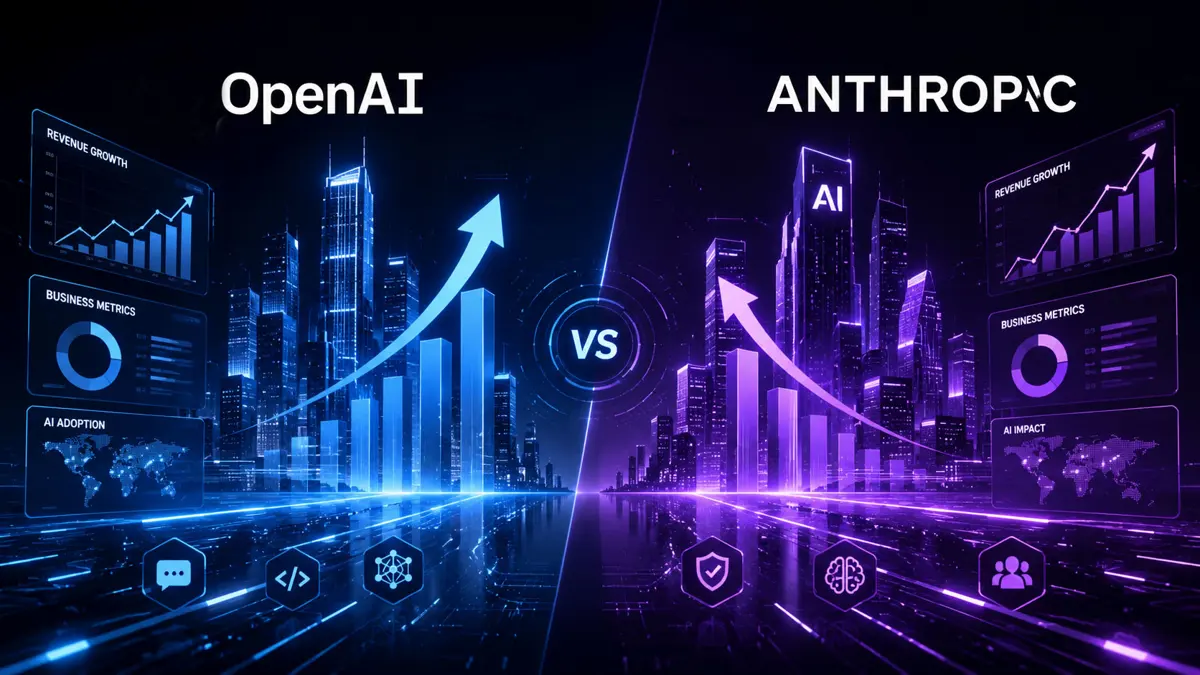
Anthropic Overtakes OpenAI in Revenue - Hitting $30 Billion Run Rate
Claude's maker passed ChatGPT's parent in annualized revenue - and the gap is widening fast

Anthropic overtakes OpenAI in revenue - and it happened faster than almost anyone predicted. By April 2026, Anthropic's annualized run rate crossed $30 billion, putting it ahead of OpenAI's roughly $24 billion for the first time. Fifteen months earlier, Anthropic was at $1 billion. That 30x climb is not a rounding error - it is a structural shift in who is winning the enterprise AI market.
Enterprise Customers Drove Every Dollar of That Growth
Anthropic's revenue comes almost entirely from businesses, not consumers. Over 1,000 companies now spend more than $1 million per year on Claude - a figure that doubled in under two months.
OpenAI has no comparable number to share. Its growth still leans on ChatGPT subscriptions from individual users - a very different revenue model.
| Metric | Anthropic | OpenAI |
| Revenue Run Rate (2026) | $30B+ | $24B |
| Who They Sell To | Businesses (B2B) | Everyone (B2C + B2B) |
| Million-Dollar Clients | 1,000+ paying $1M+/yr | Not disclosed |
| Where They Started 2025 | $9B ARR | $4B per quarter |
For developers, that distinction matters. Anthropic built its business on API access - meaning the money comes from teams integrating Claude into products, not from people paying $20 a month to chat. That revenue profile is stickier, harder to churn, and far more predictable than consumer subscriptions.
OpenAI Plans to Spend $125 Billion on Training by 2030 - Anthropic Plans $30 Billion
Revenue is only half the picture. OpenAI projects training costs of $125 billion per year by 2030. Anthropic's projection for the same period sits at around $30 billion. Same race, 4x difference in cost - and that gap is probably the most important number in this story.
OpenAI expects $14 billion in losses for 2026. Anthropic projects positive free cash flow by 2027. A company that out-earns its rival while spending a fraction of what that rival spends on training is not just ahead on revenue - it is building a structurally different kind of business.
Claude Code Hit Nearly $1 Billion in Revenue Since Launch
One product explains a large chunk of the recent acceleration. Claude Code, Anthropic's command-line coding tool, reached nearly $1 billion in annualized revenue shortly after launching. Developers adopted it fast - and enterprise teams followed. For any developer who has not tried it yet, that number suggests the adoption curve is already well past early majority.
Anthropic also signed a far-reaching infrastructure deal with Google and Broadcom, covering several gigawatts of next-generation computing capacity. Scaling compute is the one bottleneck that kills revenue growth in AI - locking in that capacity early removes a ceiling that OpenAI still faces.
What This Means if You Are Choosing Between Claude API and GPT-4o Today
Anthropic overtakes OpenAI in revenue for one reason: enterprise teams trust it more. The API is reliable, the pricing is competitive, and Claude's performance on coding and reasoning tasks has closed the gap with GPT-4o on most benchmarks. For a developer choosing an AI backend today, that is a more useful signal than any valuation number.
OpenAI still leads in consumer mindshare and raw user count, with around 900 million weekly active ChatGPT users. But mindshare does not pay enterprise invoices. The companies writing million-dollar checks to Anthropic are betting that reliability and enterprise focus matter more than brand recognition - and right now, the revenue data backs that bet.
Anthropic is reportedly evaluating a public offering as early as October 2026, with Goldman Sachs, JPMorgan, and Morgan Stanley in early talks. OpenAI has not commented publicly on Anthropic's revenue crossover.