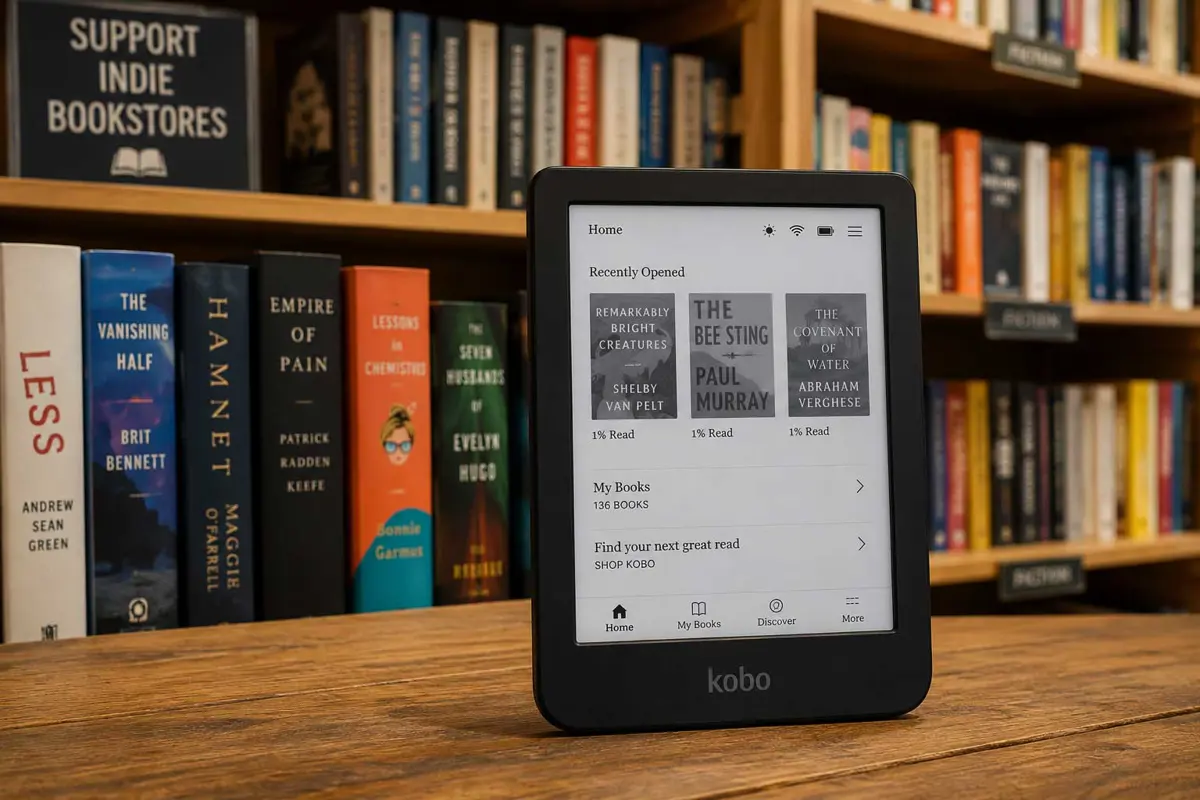
Bookshop.org announced a partnership with Kobo that will let readers buy ebooks through their indie bookstore of choice directly on Kobo e-readers and apps - no manual file transfer required. Buying a Bookshop.org ebook today means downloading a DRM-free EPUB from Glassboxx and sideloading it via USB cable - a process that works technically but that most readers will not bother with. Native Kobo integration changes that: ebook purchases land in the Kobo library the same way titles bought from Kobo's own store do. Kindle will never offer the same - Amazon has no financial reason to route ebook sales toward a competitor, and its proprietary KFX format with Amazon-controlled DRM closes the technical door too.
$70 Million in Revenue and a Record Year Made This Partnership Matter
Bookshop.org posted close to $70 million in revenue for 2025, a 55% jump from 2024. Ebooks drove a meaningful portion of that growth. The US ebook store launched in January 2025 with roughly 600,000 titles and cleared $1 million in early sales before the year was out.
Indie bookstore partners have now received more than $46 million from Bookshop.org since the platform launched in 2020. Last year was a record: $9.5 million distributed across 2,900 partner stores, covering about 90% of American Booksellers Association members. A February 2026 deal with Draft2Digital opened the catalog to hundreds of thousands of self-published titles, with more than one million expected as that partnership expands. Earlier this year, Spotify added a feature for US and UK audiobook buyers that routes purchases through Bookshop.org and credits a local store. Taken together, these moves suggest Bookshop.org is building a deliberate strategy around embedding itself into device and platform ecosystems rather than relying only on web traffic.
Kobo Is the Only Major E-Reader Platform That Can Say Yes to This
Kobo - owned by Rakuten since 2012 - holds about 23% of the global e-reader market to Kindle's roughly 67%. That gap matters less than the structural difference between the two platforms. Kobo runs on open ePub standards and already integrates with OverDrive and Libby for library lending, and with StoryGraph for reading tracking. Kobo has partnered with indie bookstores through the American Booksellers Association since 2012. Being a flexible device, not a closed storefront, is part of how Kobo competes.
Kindle's architecture runs in the opposite direction. Amazon's KFX format uses proprietary DRM, and every Kindle ebook purchase routes money directly to Amazon. Routing any of that revenue to Bookshop.org would mean competing against Amazon's own retail business on hardware Amazon sells. Kobo has no equivalent conflict: Rakuten earns from device sales and its own store, but it does not operate an Amazon-scale retail business that Bookshop.org purchases would cannibalize. For Kobo, carrying Bookshop.org ebooks makes its hardware more useful to a growing segment of readers who specifically want their purchases to benefit local bookstores.
Indie Bookstores Now Get a Cut Without Readers Needing to Sideload
Every Bookshop.org purchase routes a portion of revenue to an indie bookstore - either one the reader picks directly, or a pool split among partner stores. Print sales have always worked this way. Ebooks carried the same model from day one, but the sideloading requirement kept most of that revenue on the table. Readers who would support a local bookshop with one click will not support one if it requires a USB cable and a file manager.
Native Kobo integration means a Kobo Clara or Libra owner can now buy an ebook, have it arrive on their device, and route the sale to a bookshop near them - inside the same interface they already use. That friction removal is probably the most consequential part of this deal, more than any catalog expansion or revenue-share percentage change. Bookshop.org has also discussed plans for its own branded e-reader hardware. Whether that proceeds, the Kobo partnership gives the company something immediately useful: distribution on a device already in millions of readers' hands, owned by people who are more likely than average to care where their ebooks come from.