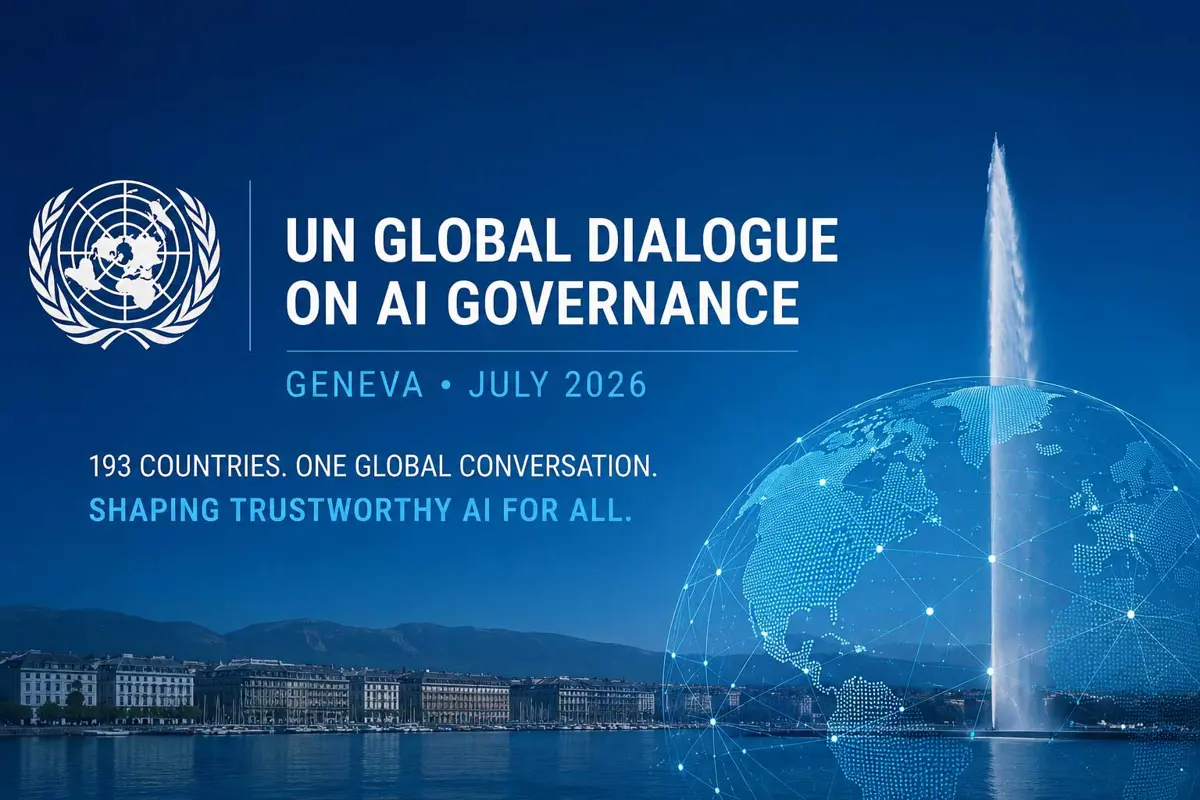
UN AI governance got its first dedicated global forum on Monday when 193 member states, 11,000 participants from 169 countries, and the CEOs of Nvidia, Amazon, and Microsoft gathered in Geneva for the inaugural Global Dialogue on AI Governance. Running July 6-7 at the Palexpo convention centre, the talks feed directly into the AI for Good Global Summit from July 7-10 and the first meeting of the UN's new AI for Good Global Commission on July 8. No binding rules will come out of this week. What will come out is the first UN-level consensus document on AI, shaped by every government on earth - and that carries policy weight even without enforcement teeth.
Big Tech CEOs Sit Alongside Heads of State on the Commission - With No Mandate to Regulate
Salesforce CEO Marc Benioff and Rwandan President Paul Kagame co-chair the AI for Good Global Commission, which holds its inaugural meeting July 8. Jensen Huang, Andy Jassy, Brad Smith, Anthropic co-founder Jack Clark, and Cohere co-founder Aidan Gomez sit as founding members alongside 35 heads of state, UN agency executives, and policymakers from Kazakhstan, Namibia, Nigeria, Saudi Arabia, and Singapore. Putting Huang and Jassy in the same governance body as a sitting African head of state is itself unusual. Neither Amazon nor Nvidia reports to the UN. Commission membership carries no regulatory mandate - its scope covers building shared understanding and recommending norms, not writing regulations that governments must adopt.
Getting tech CEOs to show up to UN governance processes without a binding obligation is part of the design. Ambassador Rein Tammsaar of Estonia, one of two Dialogue co-chairs, named the underlying tension: frontier AI development sits almost entirely in the United States and China. For the other 191 countries at the table, that concentration raises questions about access, dependency, and what happens when the two dominant AI powers disagree on safety standards or export controls. Putting their companies in the room does not resolve that asymmetry, but it at least surfaces it officially.
Yoshua Bengio: Science Cannot Guarantee AI Will Not Cause Catastrophic Harm
Yoshua Bengio, co-chair of the UN's Independent International Scientific Panel on AI and one of the researchers who established the foundations of modern deep learning, published the panel's first global assessment on July 1 - five days before the Geneva talks opened. His framing was unusually blunt for a scientific document: science currently cannot guarantee that AI will not cause catastrophic harm as capabilities keep growing, whether on its own or because malicious actors gain access to the systems. Bengio has advocated for this kind of governance forum for years. A 40-member scientific panel drawn from every world region agreeing on that language, then placing it in front of 193 governments in the same week, is a more coordinated warning than anything the AI safety community has previously managed.
Maria Ressa, Nobel Peace Prize laureate and the other Scientific Panel co-chair, focused on the information layer. Social media's first wave of AI - recommendation algorithms - accelerated the spread of misinformation by prioritising outrage. More capable AI compounds that dynamic. "If you can't tell fact from fiction, you cannot have a democracy," she told UN News ahead of the summit. Ressa called the current information environment an "information Armageddon" - a phrase that will likely travel further than any consensus text the Dialogue produces this week.
No Binding Rules - But Policy Convergence Has Its Own Mechanism
Developers expecting Geneva to produce a global AI compliance framework this week will leave disappointed. Governments cannot agree binding AI rules in two days, and the Dialogue is explicitly not a regulatory body. But "no binding rules" and "no impact" are not the same thing. Internet governance norms propagated from similar UN forums - not through mandates, but through governments using the resulting language in procurement requirements, funding conditions, and bilateral agreements until that language became a de facto standard. Agentic AI systems that cross borders already face fragmented national regulations on documentation, auditing, and deployment. UN-backed framing tends to reduce that fragmentation over time, whether or not any country formally adopts it.
Anthropic published its own safety framework earlier this month, including a structured severity scale for AI jailbreaks - the kind of voluntary self-governance document that becomes relevant when procurement checklists start referencing UN standards. That documentation is voluntary now. Whether it stays that way depends partly on what language the Geneva talks produce and which governments start citing it. Ambassador Egriselda López of El Salvador framed the access problem plainly: countries with strong research infrastructure and those without are not starting from the same position, and AI's development pace is outrunning the gap's ability to close. For developers shipping models internationally, that divide matters - it shapes which regulatory environments they will have to satisfy first.
A second session follows in New York in May 2027. Practitioners should watch which UN-backed standards references end up in government procurement language before that meeting - that signal will arrive well before any formal resolution does.