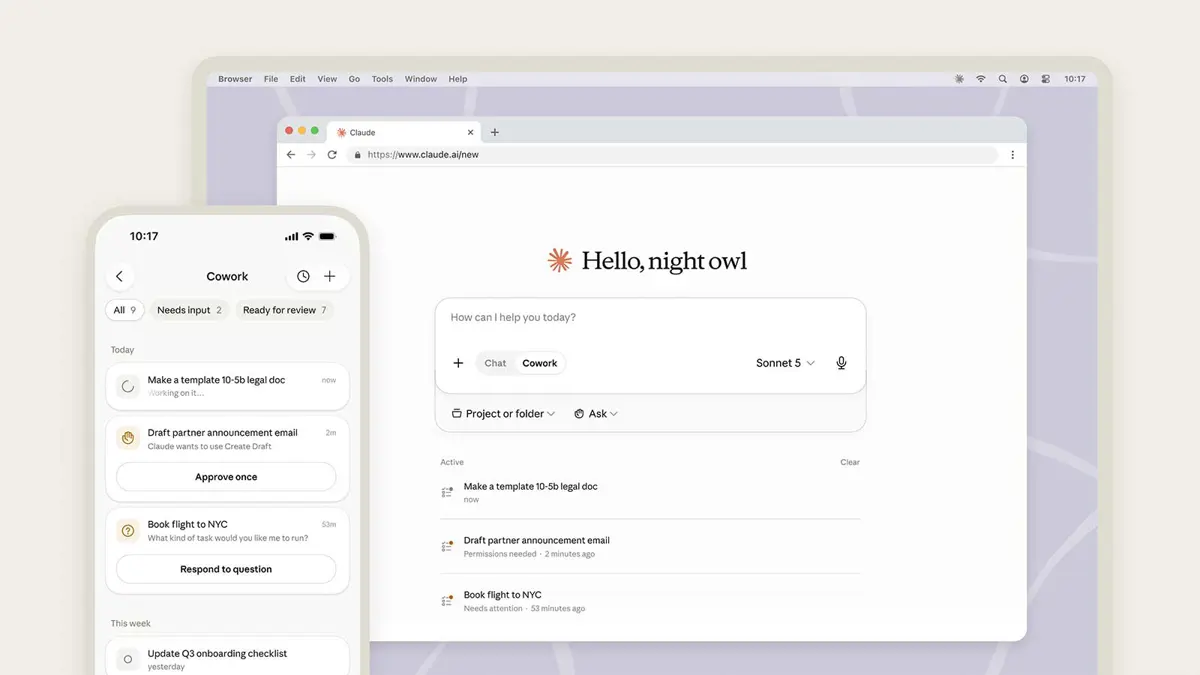
Anthropic opened Claude Cowork to web and mobile today. Max plan subscribers get access first, with additional plans following over the coming weeks. Cowork launched as a desktop-only app in January 2026; until now, running a task meant staying at a computer while Claude worked through it. Starting today, a user can hand Claude a task at their desk, close the laptop, and pick up the finished output on their phone - Claude keeps working regardless of device state.
33% of Sessions Are Business Operations - Software Development Placed Fifth
Alongside the launch, Anthropic published usage data. Data from 1.2 million anonymized Cowork sessions across more than 600,000 organizations - covering the last two weeks of May 2026 - shows business operations as the dominant use case by a wide margin. Business process and operations topped the category breakdown at 33.4%: tasks like pulling scattered project updates into a consolidated report, building onboarding checklists, and reconciling spreadsheets. Content creation and copywriting came second at 16.4%, covering client proposals, slide decks, social posts, and internal communications.
Software development placed fifth at 8.7% of all sessions. For a product built on the same engine as Claude Code, that number repositions Cowork entirely. Anthropic describes the dominant pattern as "the work around the work" - tasks that span finance, HR, marketing, and operations roles but land on someone's desk because no one else formally owns them. That category turns out to be far larger than engineering tasks on a platform that started in a developer terminal.
Desktop Keeps Deep Work, Mobile Handles the Handoff
Desktop remains the home for tasks requiring local file access and browser control. Mobile is not a full replacement. Anthropic designed the expansion as a handoff layer: start a task at the desk, receive a push notification when Claude hits a decision only the user can make, and collect the finished output from any device. Close the laptop and the task keeps running.
Scheduling works the same way. Anthropic's example: set a client briefing task for 6 AM Monday, and Claude reads through email threads, call transcripts, and recent coverage overnight, builds the document, and leaves the follow-up email drafted but not sent. Chat and Cowork now share a single interface on web and desktop - one sidebar, one search bar, and one location for projects and artifacts, rather than split views across two surfaces.
Anthropic Is Racing Cursor and OpenAI Into Non-Developer Work
Cowork going mobile is not an isolated move. Cursor launched its iOS app in public beta last month, letting developers run agents from a phone for the first time. Both companies are converging on the same product thesis: a background agent running continuously across devices wins more enterprise contracts than any single-surface tool. OpenAI runs a parallel play with Codex - built for software development, it now handles reports, research, and presentations for non-developer roles.
Anthropic has been building this out for months. Claude Tag launched in June as a persistent agent inside Slack, handling @-mentions, pulling company context from message history, and completing requests without requiring a context switch. Cowork on web and mobile means Claude now runs as a background agent in Slack, in the browser, on the phone, and at the desktop - without a separate product per surface. That kind of breadth is what enterprise procurement teams increasingly require before committing to a platform.
Max plan subscribers navigate two changes today. Fable 5 moves to usage credits on July 8 at $10/$50 per million tokens, which changes what sustained Max-tier usage actually costs. Cowork sessions drawing on Claude's full capabilities count against those credits, so any team planning long-running agentic tasks across mobile and desktop should verify credit settings and spending caps before the new rates start.
No timeline given. Additional plans beyond Max join the rollout over the coming weeks, Anthropic said, without specifying which plans follow or in what order.