What Is Quantum Computing and When Will It Actually Matter?
Google ran a benchmark in five minutes that would take classical hardware 10^25 years. IBM is targeting verified quantum advantage by December 2026. Here is what is actually happening.

Google's Willow chip completed a standard benchmark computation in under five minutes in December 2024 - a task that would take the fastest classical supercomputer an estimated 10^25 years to finish. For scale, 10^25 years is roughly a million billion times longer than the current age of the universe. Quantum computing is no longer a theoretical exercise. But for developers, engineers, and organizations making infrastructure decisions today, the question that matters more than any benchmark is a simpler one: when does quantum computing affect production systems, current encryption, and real business problems?
Classical Computers Process Bits - Quantum Computers Work With Probability
Classical computers store and process information as bits. Each bit is either 0 or 1. Quantum computers use qubits, which exist in a state called superposition - simultaneously representing 0, 1, and every weighted combination between them until measured. String enough qubits together and a quantum processor can evaluate a vast number of possible solutions in parallel, rather than checking each one sequentially. For certain classes of problems - prime factorization, optimization, molecular simulation - that parallelism produces an exponential speedup over classical approaches.
Entanglement is the second property that gives quantum computing its edge. Entangled qubits are correlated in a way classical systems cannot replicate: measuring one instantly determines the state of another, regardless of physical distance between them. That correlation lets quantum algorithms manipulate information in ways that binary logic structurally cannot. Neither superposition nor entanglement helps with every computation - quantum hardware runs slower than classical chips on most routine tasks - but on the specific problem classes where quantum algorithms apply, the advantage can be astronomical.
Stability has always been the central engineering obstacle. Qubits decohere - they lose their quantum state - from heat, vibration, and electromagnetic interference. Until late 2024, scaling up qubit counts made error rates worse, not better. Every added qubit brought more noise, and the computation collapsed before producing useful results. That constraint defined the field's progress for three decades.
Google Solved the Error Problem - Then Ran a Benchmark No Classical Machine Can Touch
Google's 105-qubit Willow chip, published in Nature in December 2024, demonstrated something researchers had been chasing since the field began: as Willow's qubit count scaled up, error rates dropped rather than increased. Adding more qubits made the processor more accurate. Willow achieved what the field calls the "below-threshold" regime - the point at which quantum error correction actually works, where larger systems become more reliable, not less.
Willow separately ran a quantum algorithm 13,000 times faster than the same algorithm on the fastest available classical supercomputer. Both results were verified independently. Neither benchmark represents a practically useful commercial computation yet - Random Circuit Sampling was designed to demonstrate quantum advantage, not to solve logistics or drug discovery problems. But the error correction result is structural. Processors that get more accurate as they scale can, in principle, grow toward the qubit counts needed for real-world problems without collapsing under their own noise.
IBM Targets Verified Advantage by December 2026 - Microsoft Bet on Different Physics Entirely
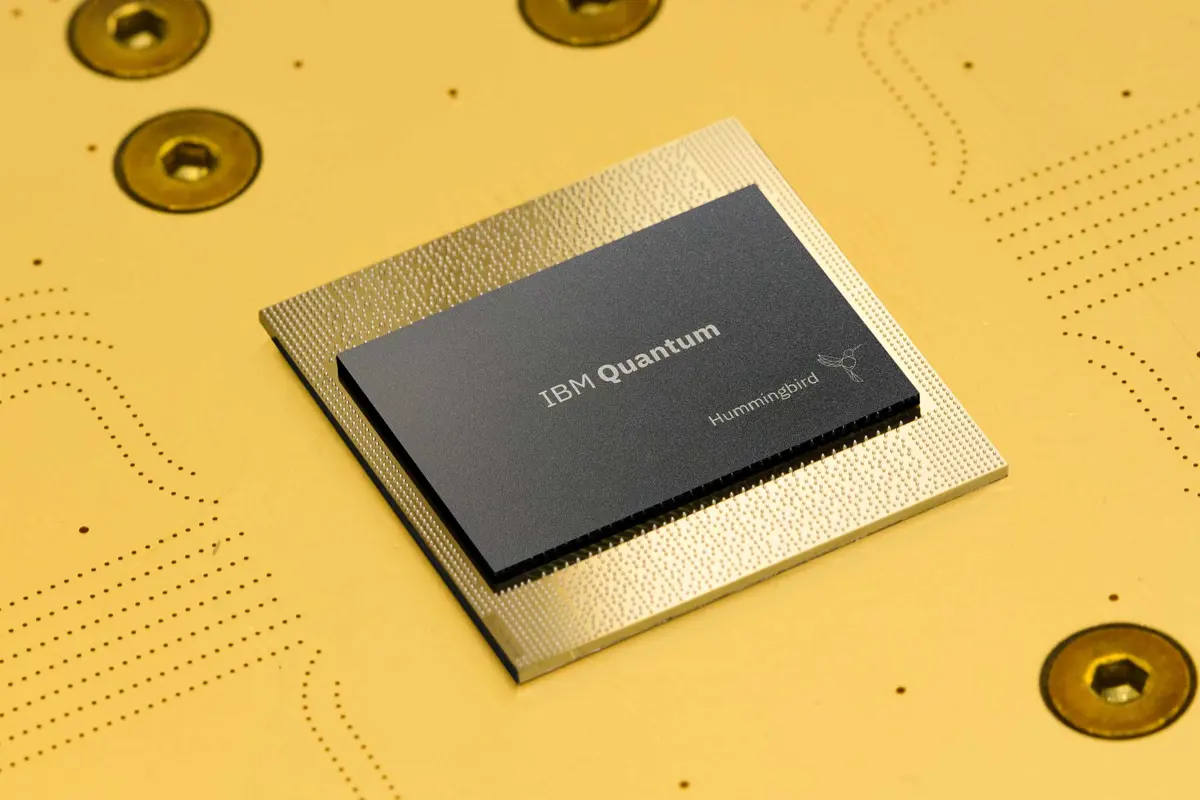
IBM unveiled its Nighthawk processor in November 2025, a 120-qubit chip with 218 next-generation couplers that runs circuits 30% more complex than its predecessor. IBM's stated goal is for Nighthawk to enable verified quantum advantage - a quantum computer demonstrably outperforming classical hardware on a practically useful problem, confirmed by independent researchers - by the end of 2026. Nighthawk currently supports 5,000 two-qubit gates per computation, with IBM targeting 7,500 by December 2026 and 10,000 in 2027.
Microsoft approached the hardware problem from a different direction entirely. Majorana 1, announced in February 2025, uses topological qubits based on Majorana zero modes - a state of matter that provides error protection at the hardware level rather than layering software error correction on top of inherently unstable qubits. Microsoft says the architecture can scale to one million qubits on a single chip, far beyond what superconducting approaches currently target. Topological qubits face their own manufacturing challenges, and independent researchers have raised questions about some of Microsoft's verification claims - but if the approach holds, it represents a fundamentally different path to fault-tolerant scale.
Three competing architectures - Google's superconducting qubits with below-threshold error correction, IBM's superconducting Nighthawk with enhanced couplers, and Microsoft's topological Majorana qubits - each have different error profiles, qubit lifetimes, and scaling limits. No consensus has formed on which approach wins at large scale. That three major companies with different technical bets are all pushing simultaneously suggests the field has genuinely moved past theoretical exploration, even if hardware maturity varies significantly between them.
Near-Term Practical Uses Are Narrower Than the Coverage Suggests
In 2025, IonQ and Ansys ran a medical device simulation on a 36-qubit trapped-ion quantum computer that outperformed classical high-performance computing by 12%. Researchers documented this as one of the first verified cases of practical quantum advantage outside a constructed benchmark. The simulation modeled mechanical stress in a device component - a problem type that involves many interacting variables simultaneously, exactly where quantum parallelism helps most.
Drug discovery, molecular modeling, and logistics optimization are the three application areas where quantum researchers expect early practical results. Pharmaceutical companies have been running hybrid quantum-classical workflows on protein folding and drug interaction problems since 2023, though results remain incremental. Financial portfolio optimization is a second active area - the optimization problems involved map naturally onto quantum algorithms, and a handful of investment firms have published early results suggesting improvements over purely classical approaches.
IBM's fault-tolerant Starling processor, targeted for 2029, will run 200 qubits at 100 million gates per computation - the scale most researchers agree is necessary for broadly applicable quantum work. Until then, quantum and classical hardware will operate as hybrids: quantum handles specific subproblems where it has a structural advantage, classical infrastructure handles everything else. For most enterprise applications, 2026 and 2027 will be years of validated proof-of-concepts, not production deployments.
NIST Finalized Post-Quantum Standards in 2024 - RSA-2048 Has a 2030 Deadline
Quantum computing's most immediate practical consequence for developers has nothing to do with computation speed. Shor's algorithm, published in 1994, shows that a sufficiently powerful quantum computer can factor large integers exponentially faster than classical methods - which breaks RSA and elliptic curve encryption, the protocols securing most of the internet's authentication, HTTPS traffic, and data-at-rest today. Analysts estimate quantum hardware capable of breaking 2048-bit RSA at scale will arrive around 2035.
But adversaries do not need quantum capability today to start exploiting the threat. "Harvest now, decrypt later" describes the active strategy of capturing encrypted communications now and storing them for future decryption once quantum hardware matures. Classified government communications, healthcare records, and financial transactions encrypted under RSA today could be retroactively exposed in a decade. State-level actors are assumed to be running these collection programs already.
On August 13, 2024, NIST released its first three finalized post-quantum cryptographic standards: FIPS 203 (ML-KEM), FIPS 204 (ML-DSA), and FIPS 205 (SLH-DSA). RSA-2048 and ECC-256 will be deprecated by 2030 and fully disallowed after 2035. For development teams managing TLS certificate infrastructure, long-lived signing keys, or any stored data with a sensitivity window beyond five years, migration to post-quantum algorithms is not a future planning item - it is an active compliance deadline. Most teams have not started. That gap is probably the most consequential quantum computing problem engineers will touch before Nighthawk ever produces a verified advantage.