General Fusion began trading on Nasdaq today under the ticker GFUZ, becoming the first publicly listed pure-play fusion energy company in history. Shares debuted up 40% from $12.85. About $150 million in cash funds the company's technical program - assembled from $108 million in private placement proceeds and what remained of the SPAC trust after high redemptions cut the take well below the $230 million possible without them.
SPAC mergers let private companies go public faster than a traditional IPO by merging with a blank-check entity already listed on an exchange. High redemptions are the tradeoff. Investors holding SPAC shares can return them for cash before any merger closes, and most do. General Fusion could have added $230 million from the Spring Valley Acquisition Corp. III trust without redemptions - the Globe and Mail estimates less than $30 million actually arrived from the trust, with the $108 million private placement covering the gap.
Magnetized Target Fusion Uses Liquid Lithium and Pistons - Not Lasers or Superconducting Magnets
Most fusion headlines describe one of two approaches. Tokamaks use superconducting magnets to hold plasma in a donut shape long enough to sustain a reaction - ITER, the international megaproject in France, is the most visible example. Laser fusion fires high-energy pulses at a tiny pellet of fuel to trigger compression - NIF's 2022 breakeven demonstration used this method. General Fusion does neither.
Magnetized Target Fusion starts by creating a magnetized plasma - a soup of superheated ionized particles - inside a chamber lined with liquid lithium. Synchronized mechanical drivers then push the lithium inward, compressing the plasma until fusion conditions are met and atoms release energy. No superconducting magnets. No laser arrays. Existing industrial materials build the chamber components - a deliberate design choice that matters when scaling to hundreds of commercial power plants rather than a handful of research machines.
LM26 Has Reached 8.4 Million Degrees. Ten Million Is the Next Milestone.
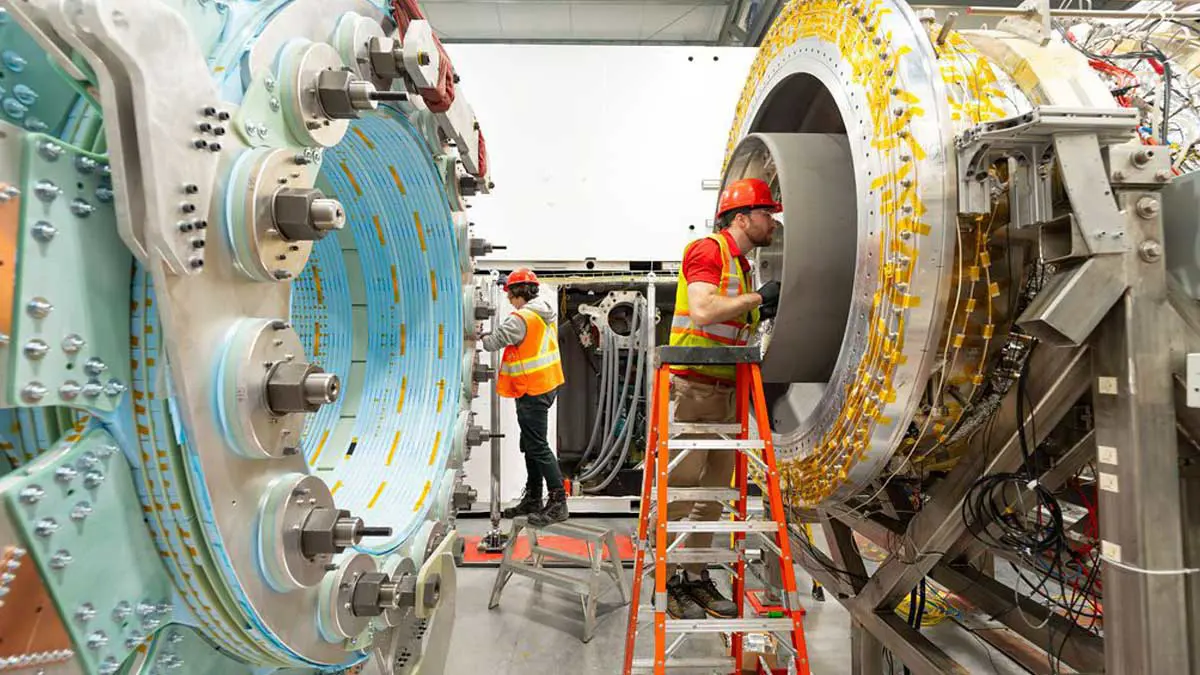
General Fusion's current machine, LM26, operates at its Vancouver facility and is the first MTF demonstration device built at commercially relevant scale - compressing plasma with a lithium liner at 50% of the diameter a commercial power plant would use. Assembly took under two years. Recent results show plasma electron temperatures of 0.72 keV - approximately 8.4 million degrees Celsius - driven by mechanical compression.
Those numbers sit on a clear technical ladder. One keV (10 million degrees Celsius) is the next milestone, then 10 keV (100 million degrees), and finally the Lawson criterion - the combination of temperature, density, and confinement time that produces net fusion energy in the plasma. General Fusion says $150 million funds the program through those 2028 milestones. Whether that cash proves sufficient depends on how efficiently LM26 climbs the temperature curve between now and then.
AI Data Centers Created a Fusion Market That Did Not Exist Five Years Ago
General Fusion's press release names powering AI and data centers as a target application alongside climate change and energy security. Meta just committed $50 billion to build a 5GW data center campus in Louisiana that will consume as much electricity as a mid-sized American city - and that is one campus among dozens under construction globally. Fusion would solve a problem that solar and wind cannot: carbon-free power that runs continuously regardless of weather or time of day. No battery storage equation. No grid intermittency.
General Fusion is not the only fusion company racing toward a public listing. TAE Technologies, backed by Trump Media in a $6 billion deal announced in December, plans to reach a major exchange within months. Commonwealth Fusion Systems and Helion Energy remain private. Fusion has carried the same critique as quantum computing for decades - always promising, always a decade away from actually delivering. Twenty-three years from founding to Nasdaq, with more than 200,000 plasma experiments behind it and a machine producing real temperature results, gives General Fusion more ground to stand on than the critique usually allows. Whether $150 million is enough to reach the 2028 milestones is the question the market just agreed to let it answer in public.