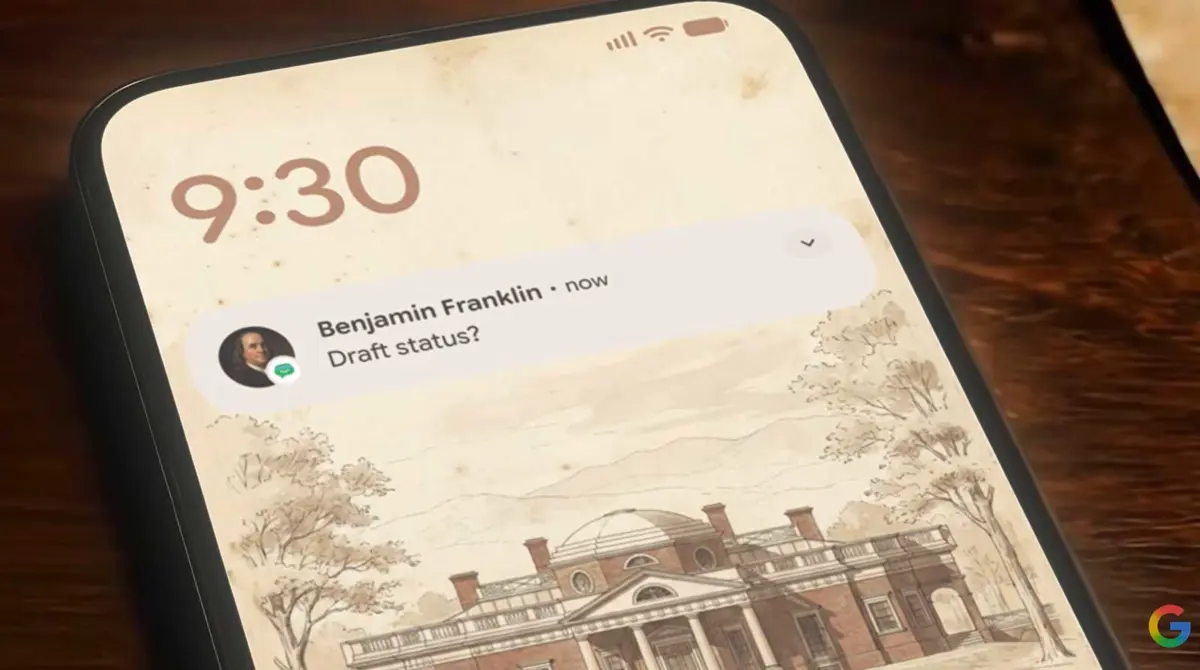
Google celebrated America's 250th birthday with a commercial that imagines Thomas Jefferson drafting the Declaration of Independence in Google Docs while Gemini takes the meeting notes. Reaction to the Google Declaration of Independence ad split by platform within hours of its July 4 release. YouTube and Instagram viewers mostly liked the joke. Bluesky called it "cringey" and "stunningly tone deaf."
"Group project, but make it 1776," reads the tagline. Anthony Ha at TechCrunch, who covered the spot the day it dropped, described its AI evangelism as relatively discreet next to the wave of AI commercials that filled Super Bowl 60 in February.
Timing did most of the work. July 4, 2026 marked 250 years since the signing, and every brand in America chased the semiquincentennial.
Jefferson Drafts in Docs While Franklin Texts His Complaints
Thomas Jefferson, largely unseen, sits mid-draft when a nagging text from Ben Franklin pulls him into a full collaboration workflow. Edits land as suggestions in Docs. A meeting appears on Google Calendar, runs remotely on Google Meet with every attendee's camera off, and the finished document collects e-signatures before the fireworks start.
Gemini carries the AI load. Google threads three of its AI features through the gag:
- "Help me visualize" tests different animals for the national seal
- Gemini writes up the meeting notes automatically
- Founders consult the chatbot before rejecting King George III's document access request
Sam Adams lands the best line. "Can we settle this over beers?" he asks as the revisions pile up. Beneath the jokes, every gag maps to a feature Google already sells to Workspace customers, which makes the spot a product demo aimed less at consumers than at office workers who already live in Docs and Calendar.
For Workspace customers, nothing here is fictional except the wigs. Gemini's meeting notes, AI image generation, and chat advice on sharing permissions all ship in paid Workspace plans today, so Google's marketing challenge is less about awareness than about persuading teams that the features belong in serious work.
Google Learned Its Lesson From "Dear Sydney"
Anyone who remembers Google's 2024 Olympics ad will notice what this one avoids. "Dear Sydney" showed a father asking Gemini to write his daughter's fan letter to a track star, and Google pulled the spot after viewers objected to AI replacing a child's own words. Two years later, Gemini schedules, summarises, and illustrates - but never touches Jefferson's prose.
None of that looks accidental. Google has spent 2026 wiring Gemini into everything from Apple's rebuilt Siri to restaurant orders in Google Maps, so a Google Workspace ad that keeps AI away from the writing itself reads as a calculated pitch - and probably the smartest decision in the spot.
Google's caution shows in what the ad never claims. At no point does anyone suggest Gemini could improve the actual text of the Declaration - the exact line the 2024 spot crossed when it put AI between a child and her own words.
| Ad | AI's role | Public outcome |
|---|---|---|
| "Dear Sydney" (2024 Olympics) | Gemini writes a child's fan letter | Pulled after backlash |
| Super Bowl 60 spots (Feb 2026) | Assistants front and center | Mixed reception across brands |
| "1776" (July 2026) | Notes, scheduling, images - not the writing | Still running; verdict split by platform |
Bluesky Saw AI Hype. A Historian Saw Barely Any AI.
Platform choice shaped the verdict. Comments on Google's YouTube upload and Instagram post ran mostly positive, while Bluesky - a network whose users skew sharply against generative AI - supplied the harshest reviews and the "stunningly tone deaf" label.
Skepticism toward AI marketing has hardened all year. Ford rehired 350 engineers in June after AI missed defects its veterans used to catch, and AI took the blame for 31% of June's US job cuts. An ad that jokes about AI co-authoring the country's founding document walks straight into that mood.
Historian Angus Johnston pushed back from a different angle, writing on Bluesky that it is "amazing how little of this is actually AI." Most of the imagined workflow is ordinary software: shared documents, calendars, video calls, e-signatures. His point cuts at the ad's central conceit, since the collaboration on display comes from tools that predate the AI boom by two decades.
Even in a corny fantasy joke, it's impossible to make the case that AI is a useful tool for political organizing, writing, or human collaboration.
Angus Johnston, historian, on Bluesky
Ha spotted one more irony. To his eye, the footage itself carries the uncanny glow of AI-generated video - meaning the place AI may have shaped the ad most is the one part Google never mentions.
Google Has Not Responded, and the Ad Is Still Running
Google has not publicly addressed the criticism, and the Google Declaration of Independence ad keeps running on YouTube and Instagram. "Dear Sydney" lasted only weeks. Nobody at Google has said whether this spot, released for the country's semiquincentennial, earns a longer run.