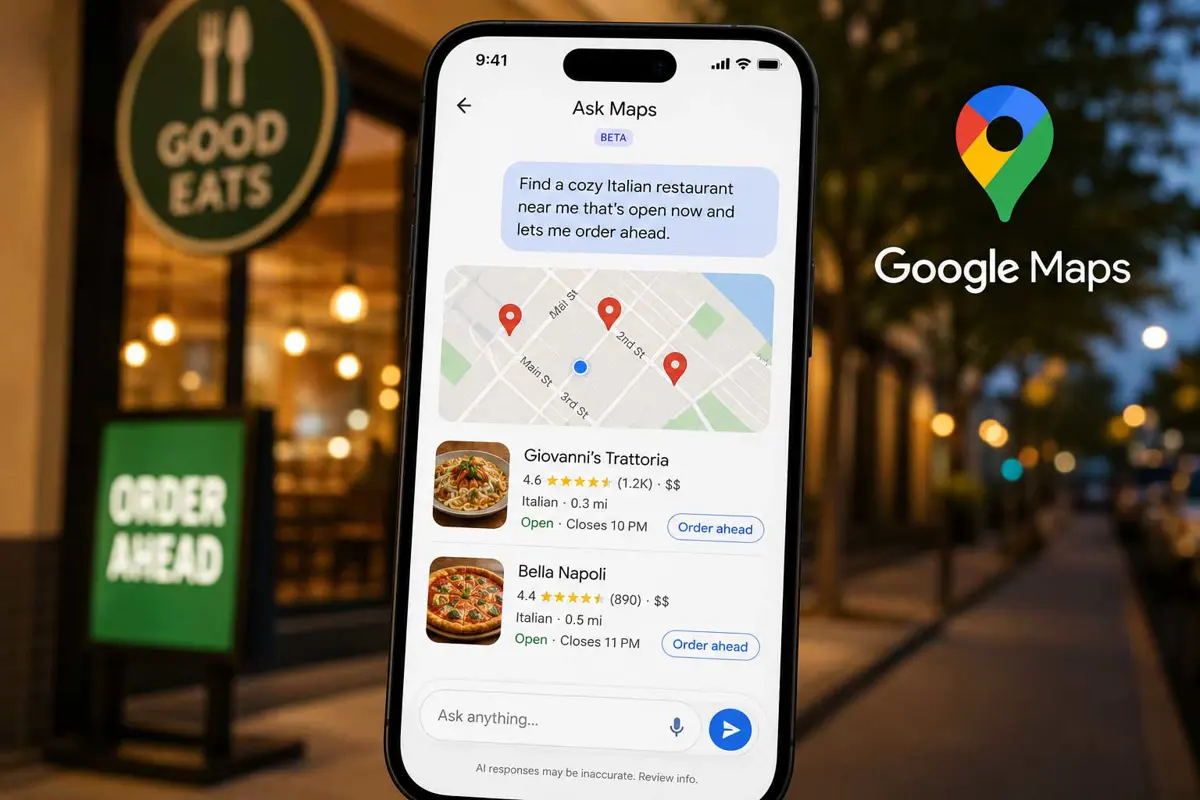
Google Maps is building a feature that lets Gemini place food orders on the user's behalf. Android Authority found the evidence in an APK teardown of version 26.27.00.941319029 for Android. Among the code strings: "Say what you're craving, discover local favorites, and Maps will order for you - even while you're on the go." Two UI buttons appear alongside: "Try it out" and "Maybe later." Google confirmed nothing. No launch date exists.
Ask Maps Moves From Showing Results to Completing Transactions
Ask Maps launched as a conversational discovery layer inside Google Maps - you describe what you want, Maps surfaces restaurants. Food ordering pushes that further. From a user's side, Maps would stop at recommendation and start at checkout: menu browsing, item selection, and payment completion, all without switching to a separate delivery app. Developers building food-adjacent products watch this closely, because Google moving into the checkout layer changes every assumption about where third-party apps fit.
Five strings. Together they describe the full intended flow - user states a craving, Ask Maps finds a match, Gemini places the order. Whether that final step routes through an existing delivery platform like DoorDash or Uber Eats - or connects directly to restaurant POS systems - is the question nobody outside Google can answer yet. Direct integration gives Google full control over pricing, timing, and order data. Routing through an existing platform is faster to launch but keeps Google operating as a layer on top of layers, dependent on DoorDash and Uber Eats staying cooperative.
Device Compatibility and the Pixel 10 Question
Google has been shipping agentic AI features to the Pixel 10 that run on-device - locally processed, without sending requests to a cloud server. If the food ordering feature requires that same hardware, availability at launch narrows to a fraction of the Android install base. Pixel 10 ownership is a small percentage of active Android devices. Cloud processing would widen reach to everyone, but hands over order details - what you eat, when, where you are - to Google's servers in a way that privacy-conscious users will notice.
Google has not indicated which processing approach the feature uses. Android Authority's teardown found interface strings only - no architecture documentation, no server config. Feature strings in APK teardowns describe what a product does for users, not how it does it.
Why Google's 2022 Track Record on This Matters
Google Food Ordering launched in 2019 with DoorDash integrations and a simple premise: order food inside Maps without switching apps. That experiment ended quietly in 2022. Adoption never scaled past a handful of US cities, because the friction was never the interface - it was fragmented menus, inconsistent POS systems, and delivery margins that made direct integration economically painful for every party involved. Gemini changes how users state the request; getting restaurants and delivery networks on the other end to reliably accept and route it is the same unsolved problem it was four years ago.
Google's pace on Gemini integration across its apps has been faster than any comparable period in the company's history. Ask Maps shipped, expanded, and kept adding conversational capabilities on a cadence where previous Google assistant features typically stalled. That pattern is the most optimistic reading of this teardown - and the one that makes the food ordering mode feel like when, not if. For developers building food delivery integrations, a smarter question is whether Google will partner with the existing platforms or try to absorb them, because the answer shapes the entire competitive map.