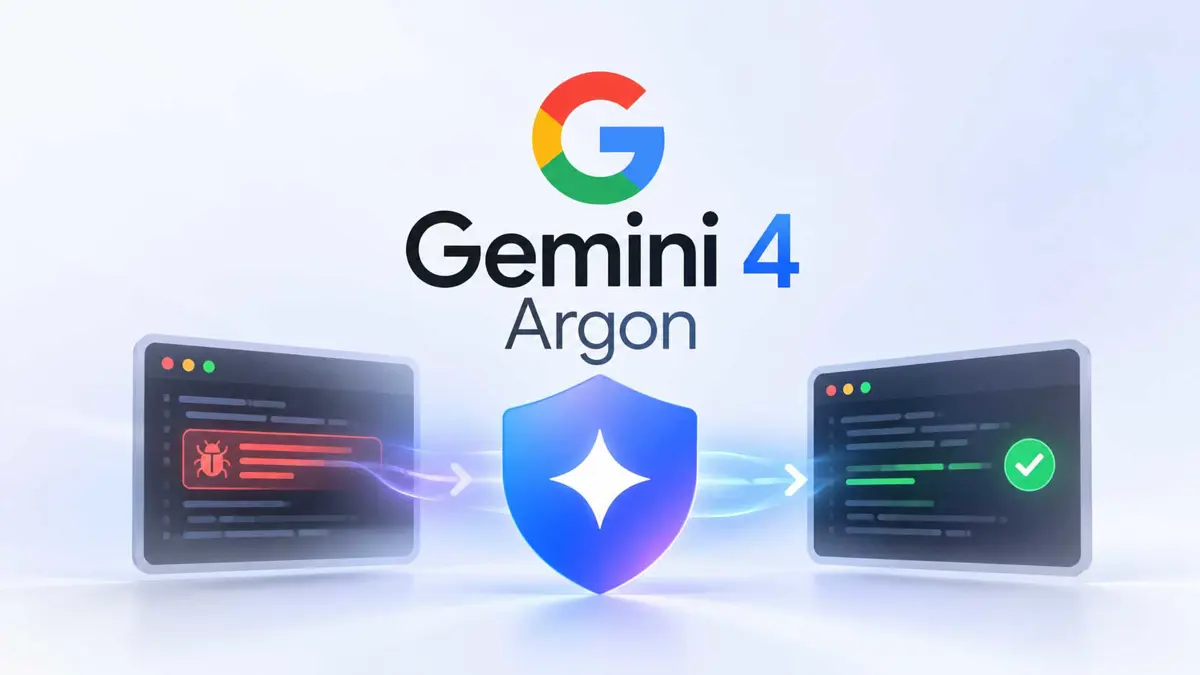
Google's Gemini 4 Argon is not being positioned as just another smarter chatbot. The model is aimed at tasks where an AI needs to reason through a large problem, work across many steps, and produce something useful at the end.
Cybersecurity is where that approach becomes especially interesting. Google says Argon can find hidden vulnerabilities, validate them, and automatically generate code fixes. That turns vulnerability research from a detection-only workflow into a potential find-to-fix loop.
Argon Is Built for More Than Security
Google describes Gemini 4 Argon as a frontier model for complex software engineering, enterprise knowledge work, and cybersecurity defense. It also has a 1-million-token context window for long, multi-step workloads.
| Capability | Why it matters |
|---|---|
| Software engineering | Handles complex coding and debugging workflows |
| Enterprise work | Targets tasks such as financial research and legal drafting |
| Cybersecurity | Finds, validates, and patches vulnerabilities |
| Long context | Keeps more information available during extended tasks |
| Visual reasoning | Can analyze charts, documents, and long videos |
The important shift is that Google is describing Argon as a system that can carry a task further than simply suggesting the next step.
The Find, Prove, Fix Loop
A security bug is much more useful to a defender when an AI can demonstrate that the issue is real and then produce a workable repair. Google says Argon is designed around that progression.
- Find a potentially exploitable weakness in a codebase.
- Validate the vulnerability and produce evidence that it is real.
- Generate a code-level fix.
- Help defenders neutralize the exposure before attackers can exploit it.
Google says Argon tied for first on CWE-bench v1 with a 68% score, a benchmark focused on remediating security vulnerabilities. On Google's internal testing and a Wiz black-box penetration-testing benchmark, the company also reports improvements over Gemini 3.8 Flash Cyber.
This Builds on Google's CodeMender Work
Argon's security story also connects to Google's existing CodeMender work. CodeMender is a specialized code-security agent that helps automate software fixes, and Google says Fairwind partners can use Gemini 4 Argon with CodeMender to strengthen vulnerability research and patching.
Saganote has already covered Google CodeMender's preview as an AI agent for finding, proving, and fixing vulnerabilities. Argon makes that direction more significant because the model itself is being trained and evaluated for high-end defensive cybersecurity.
Google Found a Real-World Vulnerability With Argon
Google says Argon uncovered a critical vulnerability affecting healthcare software used by hospitals worldwide. The flaw exposed sensitive personal information, and Google says previous frontier models had missed it.
The healthcare vulnerability is an early demonstration reported by Google. It should not be treated as evidence that Argon can reliably discover every vulnerability or replace professional security teams.
Why Google Is Restricting Access
Argon is initially rolling out to trusted cyber defenders through Google's Fairwind Program rather than opening immediately to everyone. Google says the program is designed to give defenders an early advantage while models are deployed responsibly.
That caution makes sense for a model with strong offensive-adjacent capabilities. The same reasoning that helps a defender find and patch a bug could potentially help someone understand how to exploit it.
Google says it is strengthening safeguards against misuse, prompt injection, misalignment, and unsafe testing environments before wider availability. Fairwind access also has controls around authentication, employee access, and the use of the model for internal cybersecurity, incident response, or penetration testing.
Argon Fits a Bigger Google Security Strategy
Google has been moving toward AI-assisted defensive security for some time. Its Threat Intelligence Group has described using AI agents such as Big Sleep to detect vulnerabilities and Gemini reasoning with CodeMender to help fix them.
That makes Argon look less like a standalone security experiment and more like the next layer of Google's broader AI security stack.
It also follows Google's earlier Gemini security work. Gemini security testing reached three real companies, while Google's earlier Gemini cyber models showed the company was already pushing specialized models toward defensive security tasks.
The Bigger Change Is the Role of AI in Security
Traditional security tools can flag suspicious code, but someone still has to investigate the finding, reproduce it, understand the impact, and prepare a fix. Argon is aimed at compressing more of that workflow into one AI-driven process.
That does not mean security engineers disappear. The more useful interpretation is that AI can become a high-speed research and remediation layer while humans remain responsible for validating changes, managing risk, and deciding what gets deployed.
Saganote's security coverage shows why that distinction matters: finding a vulnerability is only one part of the security process. Proving it, understanding the blast radius, and safely fixing it are separate jobs.
When Can Developers Use Gemini 4 Argon?
Not yet in the normal sense. Google says Argon is first being released to trusted cyber defenders through Fairwind, with broader access planned for developers, enterprises, and consumers after additional testing and safeguard improvements.
Google says the model will initially launch at $2 per million input tokens and $10 per million output tokens, with the introductory pricing eventually moving to $4 and $20 respectively.
Saganote has also covered Gemini 4 Argon's 1-million-token output limit, which helps explain why Google is positioning Argon for unusually long, multi-step tasks.
For now, the more important takeaway is not the price. Gemini 4 Argon shows Google moving toward AI systems that can investigate a technical problem, prove what they found, and make a concrete repair instead of stopping at an answer.