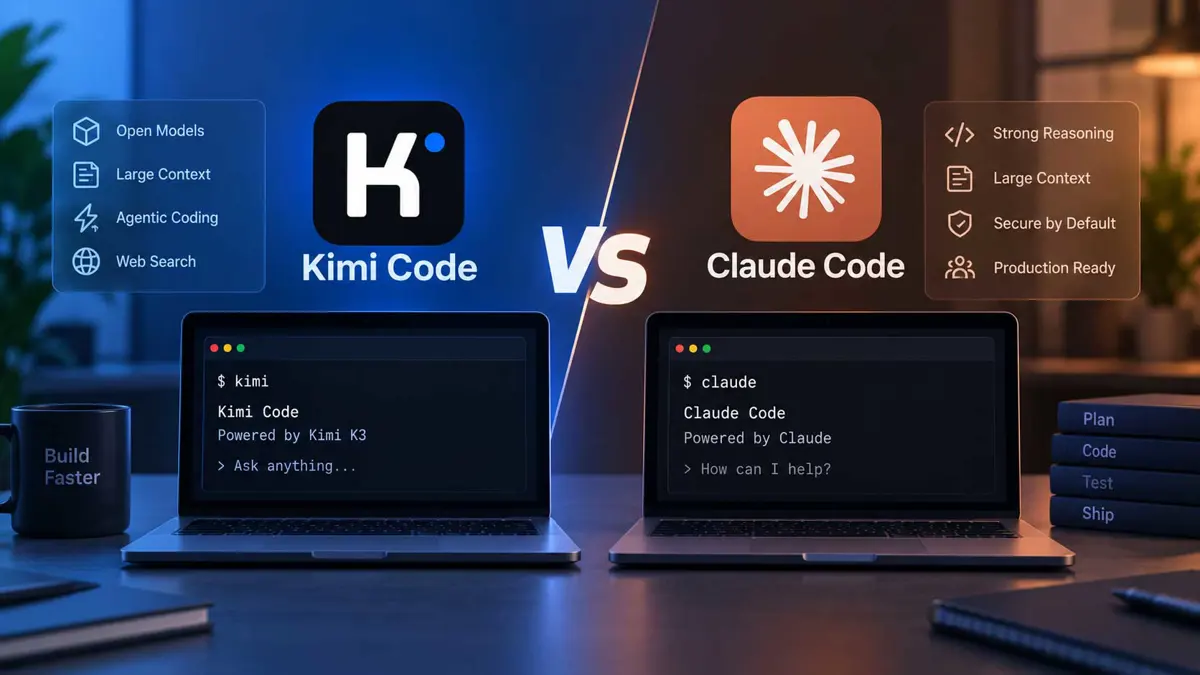
Kimi Code vs Claude Code: Which AI Coding Tool Is Better?
A practical comparison of Kimi Code and Claude Code for coding, codebase analysis, agentic workflows, context, permissions, and price.

Kimi Code vs Claude Code is not simply a comparison between two chatbots. Both are agentic coding tools that can inspect a repository, read files, edit code, run commands, and work through multi-step development tasks. The bigger difference is the ecosystem behind each tool, the models you can use, how access is priced, and which workflow fits the way you build software.
If Kimi Code is new to you, start with our guide to using Kimi K3 for coding. For a closer look at the model behind Kimi Code, see our Kimi K3 overview.
TL;DR:
- Kimi Code is the better fit if you want Kimi's K3 models, very large context options, and Kimi membership benefits in the same subscription.
- Claude Code is the stronger fit if you want Anthropic's broader Claude Code ecosystem, mature integrations, and flexible access across terminal, IDE, desktop, web, and team workflows.
- Both tools can read repositories, edit files, run commands, use Plan mode, and connect to external tools through MCP.
- Neither should be treated as an autonomous replacement for code review. Keep permissions enabled and review important changes and commands.
Kimi Code vs Claude Code at a glance
Both tools solve the same broad problem: giving an AI agent access to the development environment so it can do more than generate a code snippet in a chat window. Kimi Code is built around Kimi's coding models and Kimi membership. Claude Code is built around Anthropic's Claude models and is available across more development surfaces.
| Feature | Kimi Code | Claude Code |
|---|---|---|
| Main models | Kimi K3 and Kimi coding models | Claude Sonnet, Opus, and Haiku families |
| Primary workflow | Terminal CLI, VS Code, supported third-party tools | Terminal, IDEs, desktop, web, Slack, CI/CD and other integrations |
| Large context | K3 supports up to 1M tokens on eligible plans | 1M context is available for supported models and plans |
| Read-only exploration | Yes | Yes |
| File editing | Yes, with permission controls | Yes, with permission controls |
| Shell commands | Yes | Yes |
| Plan mode | Yes | Yes |
| MCP | Yes | Yes |
| Sub-agents | Yes | Yes |
| Membership model | Included in Kimi membership plans | Included with eligible Claude plans |
| Best fit | Kimi model access, long-context coding, Kimi ecosystem | Claude ecosystem, broad integrations, complex coding workflows |
The feature sets overlap heavily, so the decision is less about whether either tool can perform basic agentic coding and more about which model and ecosystem you prefer.
What is the difference between Kimi Code and Claude Code?
Kimi Code is Kimi's AI programming service. Its CLI can read code, edit files, run commands, search projects, use web tools, and delegate work to sub-agents. Kimi's current documentation lists K3 as its flagship model and offers both standard and high-speed coding models. Kimi Code is included with Kimi membership plans.
Claude Code takes a similar agentic approach but is built around Anthropic's Claude model family. Anthropic describes it as a coding tool that can read a codebase, edit files, run shell commands, search the web, use Git, and connect to external services. It is available through the terminal as well as IDE, desktop, browser, and other workflows.
The practical distinction is important: Kimi Code is closely connected to the Kimi product and membership system, while Claude Code is a more broadly distributed coding environment built around Claude and Anthropic's developer ecosystem.
Kimi Code vs Claude Code for everyday coding
For small coding tasks, the two tools feel surprisingly similar. You can start in a repository, describe the change in natural language, let the agent inspect the relevant files, approve edits, and then run tests.
A typical request might be:
Find the authentication middleware, explain how failed logins are handled, then add a test for the existing rate-limit behavior.
Do not change production code until you show me the plan.
Both tools are designed for this kind of workflow. Claude Code describes its agentic loop as gathering context, taking action, and verifying the result. Kimi Code provides a similar workflow through file tools, shell execution, Plan mode, and approval controls.
For routine tasks, model preference matters more than the basic interface. If you already prefer K3's coding behavior, Kimi Code is the natural choice. If you already use Claude extensively and want the same model family in your coding workflow, Claude Code is the more direct option.
Which is better for large codebases?
This is one of the most important differences to evaluate because context size can affect how much of a repository an agent can reason about in one working session.
Kimi's current K3 documentation lists a context window of up to 1,048,576 tokens for eligible higher-tier members. Kimi also offers a 256K K3 variant for more routine work. Kimi positions the larger K3 context for large codebase analysis, multi-file refactoring, and long-document processing.
Claude Code also supports 1 million-token context on supported models and plans. Anthropic's current documentation lists 1M context variants for Opus 4.7, Opus 4.6, and Sonnet 4.6, with availability depending on the model and subscription.
So there is no simple "one has 1M and the other does not" conclusion. Both now offer very large context options. The more useful question is which model handles your repository and workflow better at the context size you actually have access to.
A larger context window does not automatically mean better coding results. Agents still need to find the right files, understand dependencies, follow project instructions, and verify their changes. A focused prompt and a clean repository structure can matter more than the maximum context number.
Kimi Code vs Claude Code for agentic workflows
Both tools go beyond autocomplete. They can decide which files to inspect, use tools, make multiple edits, run commands, and check results.
Kimi Code supports built-in file, search, shell, planning, and task tools. Its current CLI can also dispatch sub-agents for exploration, planning, and coding work. Kimi's Plan mode is designed to keep the agent in a constrained planning state before implementation.
Claude Code uses a similar agentic loop and supports subagents, skills, hooks, MCP, web access, and other extensions. Anthropic also provides checkpoints that let users rewind file changes made during a session.
For straightforward coding, this difference may not matter. For larger projects, the ecosystem around the agent can become more important. Claude Code has a particularly broad extension and deployment story, while Kimi Code is attractive if you want Kimi's model stack and Kimi's coding service in one place.
Permissions and safety: Kimi Code vs Claude Code
Both tools recognize that an AI coding agent needs more control than a normal chat assistant. Reading a repository is relatively low risk. Editing files or executing shell commands can have side effects, so both products use permission systems.
Kimi Code's default Always Ask mode allows read-only tools automatically while asking for approval before file writes and shell commands. It also has Ask When Needed and Never Ask modes, plus Plan mode for read-only planning.
Claude Code similarly uses a tiered permission system. Read-only file operations do not normally require approval, while shell commands and file modifications can prompt for confirmation. It also provides Plan mode, allow and deny rules, and additional permission modes.
| Safety feature | Kimi Code | Claude Code |
|---|---|---|
| Read-only work without repeated approval | Yes | Yes |
| Approval before edits | Yes in default mode | Yes in default mode |
| Approval before shell commands | Yes in default mode | Yes in default mode |
| Plan mode | Yes | Yes |
| Fine-grained allow/deny rules | Yes | Yes |
| MCP permission controls | Yes | Yes |
| Automatic modes | Available | Available |
The important point is that both tools give developers ways to reduce approval friction. That convenience should not be confused with removing the need for review. For destructive commands, production credentials, deployment files, database migrations, and other high-impact work, manual review remains the safer workflow.
Which has the better context and model options?
Kimi Code currently gives developers access to K3 and other Kimi coding models through its model configuration. K3 supports low, high, and max reasoning effort, while the available context and model tiers depend on the Kimi membership level.
Claude Code gives developers model aliases such as sonnet, opus, and haiku, with current model resolution handled by Anthropic. Supported models can also use 1M context variants, and the model can be changed during a session.
This makes the choice partly about model philosophy. Kimi Code is compelling when K3 is the model you specifically want to use. Claude Code is more compelling when you want to switch among Claude model tiers depending on whether the task favors speed, everyday coding, or deeper reasoning.
Pricing: Kimi Code vs Claude Code
Pricing is one area where the two products are structured quite differently.
Kimi currently lists four membership plans. Andante is ¥49 per month, Moderato is ¥99, Allegretto is ¥199, and Allegro is ¥699. Kimi Code is available across the membership plans, but Kimi says all membership features share a common credit pool. Kimi Code also has a separate five-hour-per-week usage limit.
Claude includes Claude Code with its paid Pro and Max plans. Anthropic currently lists Pro at $20 per month or $200 per year, Max 5x at $100 per month, and Max 20x at $200 per month. Max plans provide substantially more usage than Pro.
| Pricing factor | Kimi Code | Claude Code |
|---|---|---|
| Entry paid plan with coding access | Andante, ¥49/month | Pro, $20/month |
| Higher usage tiers | Moderato, Allegretto, Allegro | Max 5x, Max 20x |
| Coding included with membership | Yes | Yes |
| Usage accounting | Shared Kimi credit pool plus Kimi Code weekly limit | Claude subscription usage limits |
| 1M K3 context | Higher-tier Kimi membership | Supported Claude models and plans |
| Best pricing angle | Lower listed entry price and Kimi ecosystem | Clear Claude-focused subscription tiers |
These prices should not be treated as a direct currency conversion or a claim that one service is universally cheaper. The products use different usage systems, model mixes, regional pricing, and limits. If price is the deciding factor, compare the plan you would actually use rather than the headline monthly number.
For a closer look at Kimi's model and plan structure, see our Kimi K3 pricing guide.
Where Claude Code has the edge
- Broader development surfaces: Claude Code is available across terminal, IDE, desktop, web, Slack, and CI/CD workflows.
- Model flexibility: Claude Code can switch among Claude model tiers for different types of coding work.
- Extension ecosystem: Skills, MCP, hooks, subagents, and other integrations make Claude Code highly configurable.
- Established team workflows: Anthropic provides permission controls, managed settings, and organization-focused controls for team deployments.
- Checkpoint workflow: Claude Code can create local checkpoints for file changes, giving developers another way to undo edits during a session.
Where Kimi Code has the edge
- K3 access: Kimi Code gives you a direct path to Kimi K3 and Kimi's coding model lineup.
- Large context: Eligible K3 plans support up to 1M-token context, aimed at large repositories and long tasks.
- Kimi ecosystem: One Kimi membership can cover Kimi Code alongside other Kimi features.
- Multimodal coding input: Kimi Code supports image and, for compatible models, video input inside the coding workflow.
- Flexible agent controls: Plan mode, permission modes, sub-agents, skills, and MCP provide multiple ways to shape the agent.
Which one should you choose?
Choose Kimi Code if you specifically want Kimi K3, work with large codebases, and prefer having coding inside the broader Kimi membership ecosystem. It is especially interesting if long context and Kimi's model behavior are more important to you than having the widest possible third-party development surface.
Choose Claude Code if you already rely on Claude, want access to multiple Claude model tiers, or need a broad agent workflow that spans terminal, IDE, desktop, web, and organizational tooling. It is also the stronger choice when Anthropic's extension, permission, and team-management ecosystem fits your existing stack.
If you are choosing among AI coding assistants more broadly, our 2026 AI coding assistant comparison puts Kimi Code and Claude Code in the larger context of tools such as GitHub Copilot and Cursor.
A simple way to test both
If you already have access to both tools, the most useful comparison is a controlled test on the same repository. Give each agent the same task and ask it to explain its plan before making changes.
- Create a clean Git branch or copy of the project.
- Give both agents the same repository and the same prompt.
- Ask each one to inspect the project before editing anything.
- Compare the implementation plan, not just the final code.
- Review the files each agent changes.
- Run the same test suite and compare failures or regressions.
- Repeat with a larger multi-file task before deciding which tool fits your workflow.
A useful test prompt is:
Understand this repository before making changes. Find the relevant files for [task], explain the current implementation, propose a minimal plan, and wait for approval before editing.
After the change, run the relevant tests and summarize exactly what changed.
The bottom line
Kimi Code vs Claude Code is a close comparison because both products have moved beyond simple code generation into full agentic development workflows. The deciding factor is usually not whether an agent can edit a file. Both can. The more important questions are which models you prefer, how much context you need, which integrations matter, and how the pricing and usage limits fit your workload.
Kimi Code is the more natural choice for developers who want K3 and Kimi's long-context coding workflow. Claude Code is the stronger fit for developers who want Anthropic's broad model and integration ecosystem. If you are unsure, run the same real repository task through both and judge the results by the code, tests, explanations, and amount of cleanup required.