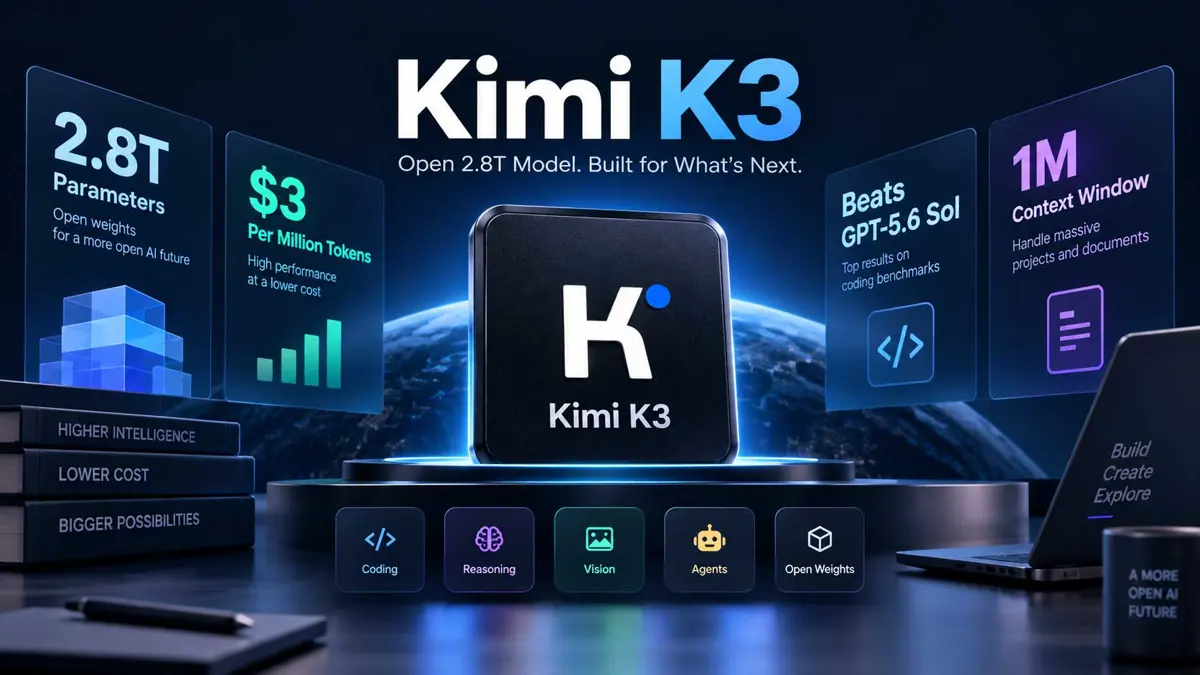
Kimi K3 is no longer just a launch-day benchmark story. Moonshot AI released the model as an open-weight 2.8T-class system and built its surrounding developer ecosystem around the same model: Kimi.com for general use, Kimi Code for terminal-based software work, and API access for applications. The original launch performance still matters, but the more useful question now is what K3 actually offers and where it fits.
If you are coming to K3 for coding, start with our Kimi Code guide. If you are comparing coding agents, see Kimi Code vs Claude Code. For the model's long-context behavior, our Kimi K3 context window guide goes deeper into the 1M-token and 256K variants.
What Is Kimi K3?
Kimi K3 is Moonshot AI's flagship open-weight model in the Kimi family. Moonshot describes it as a 2.8-trillion-parameter model built around Kimi Delta Attention (KDA) and Attention Residuals, with native vision and a 1-million-token context window. It uses a Mixture-of-Experts architecture rather than activating the entire parameter count for every token.
That distinction matters. "2.8 trillion parameters" describes the total model size, not the amount of computation used for every token. The released architecture uses 896 routed experts and activates a subset for each token, which lets K3 operate as a very large model without treating the full parameter set as dense computation on every step.
Moonshot positions K3 around three workloads in particular: long-horizon coding, knowledge work, and reasoning. Its native multimodal design also lets it work with visual input rather than treating images as a separate add-on.
Why the 2.8T Parameter Count Matters
K3's headline number is useful, but it should not be read as a simple performance score. Model quality depends on architecture, training, inference setup, context length, tool use, and the task being measured.
K3's architecture combines Kimi Delta Attention with Gated MLA and Attention Residuals inside a sparse Mixture-of-Experts design. The released model has 93 layers, 896 routed experts, and 16 routed experts selected per token. That design is aimed at keeping a large model practical while supporting long-context workloads.
The practical takeaway is simpler: K3 is built to spend significant compute on difficult, multi-step work rather than behaving like a small, fast completion model. That is why coding agents, long documents, research tasks, and extended reasoning are central to the product.
Kimi K3's Coding Performance
The launch received most of its attention because of coding benchmarks. Moonshot reported a head-to-head GPU-kernel optimization test in which K3 worked independently on kernel tasks for extended runs. In that evaluation, Moonshot reported K3 outperforming GPT-5.6 Sol, GPT-5.5, and Opus 4.8, while matching Fable 5 in the tested setup.
Moonshot's own broader evaluation also provides an important counterweight to the launch headline: the company says K3 still trails the strongest proprietary models on some broader evaluations. That makes the coding result more interesting, not less. K3's strength is not simply "being bigger"; it is the combination of a very large sparse model, long context, reasoning, and agent-oriented training.
Kimi K3 and the 1M-Token Context Window
One of K3's most important technical features is its 1,048,576-token context length. A context window is the amount of information a model can consider within a single working context. In practical terms, a large context lets you keep more source code, documentation, conversation history, or research material available without repeatedly removing older material.
That matters most when the task has dependencies spread across many files. A coding agent can inspect a larger repository, trace relationships between modules, and keep more of the surrounding project in context. The same idea applies to long technical documents and research workflows.
There is an important distinction between the model's maximum context and what you receive in every Kimi product. Kimi Code currently exposes both K3 and a 256K version, while access to the 1M version depends on the product and plan. Our Kimi K3 context window explainer breaks down the difference in more detail.
Kimi K3 Is Now Part of Kimi Code
Kimi Code turns K3 from a general-purpose model into a coding-agent workflow. Instead of pasting individual files into a chat, the terminal client can work with a repository, inspect files, reason about changes, and carry out development tasks through an agentic loop.
The Kimi Code guide covers installation and a safe first workflow. K3 can also be used alongside other model options in supported Kimi Code clients, so the coding product should be thought of as a tool layer around the underlying models rather than as a separate model family.
For developers already using GitHub's tooling, K3 is also available as a model option in supported GitHub Copilot clients. See our Kimi K3 in GitHub Copilot guide for the current model-selection workflow.
Kimi K3 API: From Model to Application
K3 is also available through Moonshot's developer API. The API is useful when you want K3 inside an application rather than inside Kimi's consumer interface or a terminal coding agent.
The current Kimi API exposes K3 with a 1M-token context window and OpenAI-compatible and Anthropic-compatible integration paths in Kimi's developer tooling. That makes it possible to connect K3 to existing application frameworks without rebuilding an entire integration around a proprietary interface.
For setup, authentication, model selection, and example application workflows, see our Kimi K3 API guide.
How Much Does Kimi K3 Cost?
K3's cost depends on how you use it. Consumer access is tied to Kimi's membership plans, while API usage is billed by tokens. Kimi's current API pricing lists K3 at $3 per million input tokens on cache misses, $0.30 per million cached input tokens, and $15 per million output tokens.
The pricing story is more complicated on the consumer side because the 1M-token context window is not included with every membership tier. Our Kimi K3 pricing guide tracks the current membership tiers, API rates, context access, and Kimi Code usage separately from this model overview.
That separation is important when comparing K3 with other AI products. A low API rate does not automatically mean a low total application cost, and a large context window does not mean every subscription includes it.
Kimi K3 vs Other Frontier Models
K3 entered the market with benchmark results aimed directly at leading proprietary models, including GPT-5.6 Sol, Claude Fable 5, and other frontier systems. But comparisons depend heavily on the task.
For coding agents, the useful comparison is often Kimi Code versus Claude Code rather than K3 versus Claude as a raw chatbot matchup. Our Kimi Code vs Claude Code comparison looks at repository work, agentic workflows, context, permissions, and usage structure.
For model-level benchmark and pricing context, our Kimi K3 vs Claude Fable 5 comparison focuses specifically on the two models and how their reported capabilities and costs differ.
What Changed After the K3 Launch?
The original July launch story was about the model itself and the promise of open frontier intelligence. The picture is broader now. K3 has moved into a practical developer stack that includes terminal coding, API access, GitHub Copilot integration, and self-hosted inference support.
The model weights also moved from a promised release to an actual open-weight release after launch. That changes who can work with K3: developers and infrastructure teams can evaluate deployment paths rather than relying only on Moonshot's hosted services.
At the same time, Kimi's product ecosystem has had to manage demand. We covered the period when Kimi K3 subscriptions were paused because GPU capacity was full. That episode is useful context for understanding that model availability and infrastructure capacity are separate from the model's headline capabilities.
What Kimi K3 Is Best Suited For
- Large codebases where relationships between files and modules matter.
- Long-running coding and agentic tasks that require multiple steps.
- Technical research and documents that benefit from keeping more source material in context.
- API applications that need a large context window and strong reasoning.
- Multimodal workflows that combine text with visual input.
- Developers who want an open-weight model that can also be accessed through hosted tools.
K3 is less interesting when the task is simply a short autocomplete, a tiny classification job, or another workload where a smaller model can respond faster and at lower cost. The value of K3 is tied to the amount of reasoning, context, and agentic work the task actually needs.
Kimi K3: The Bottom Line
Kimi K3's significance is not just the 2.8T number. It combines a very large sparse architecture with long context, native vision, reasoning, and an open-weight release. Moonshot's launch benchmarks showed that combination can be highly competitive on difficult coding workloads, while the company's broader evaluation results show that K3 should not be treated as universally ahead of every proprietary model.
The more useful way to understand K3 today is as the foundation of a broader developer ecosystem. Use Kimi Code when the work belongs in a repository and terminal, the Kimi K3 API when the model belongs inside an application, and the context window guide when the 1M-token limit is central to the workflow.
That is the real K3 story after launch: a large open model becoming a practical platform for coding, long-context work, and AI applications rather than remaining only a benchmark headline.
FAQ
What is Kimi K3?
Does Kimi K3 really have 2.8 trillion parameters?
What is Kimi K3's context window?
Is Kimi K3 open source?
Can I use Kimi K3 for coding?
Is Kimi K3 better than GPT-5.6 Sol?