
Grok 4.5 vs Claude Fable 5 vs GPT-5.5 is the question every developer building a coding agent faces today. SpaceXAI launched Grok 4.5 on July 8 and positioned it as its strongest model yet for software engineering, agentic work, and office tasks. On paper the benchmarks are close at the top. On pricing and token efficiency, the gaps are much wider.
What the Benchmarks Actually Say
SpaceXAI published four coding evaluations in the Grok 4.5 launch post. Three use different harnesses and measure different things - none of them gives a single clear winner. The table below uses numbers from xAI's official announcement; where noted, they were run by third-party DataCurve on a standardized harness.
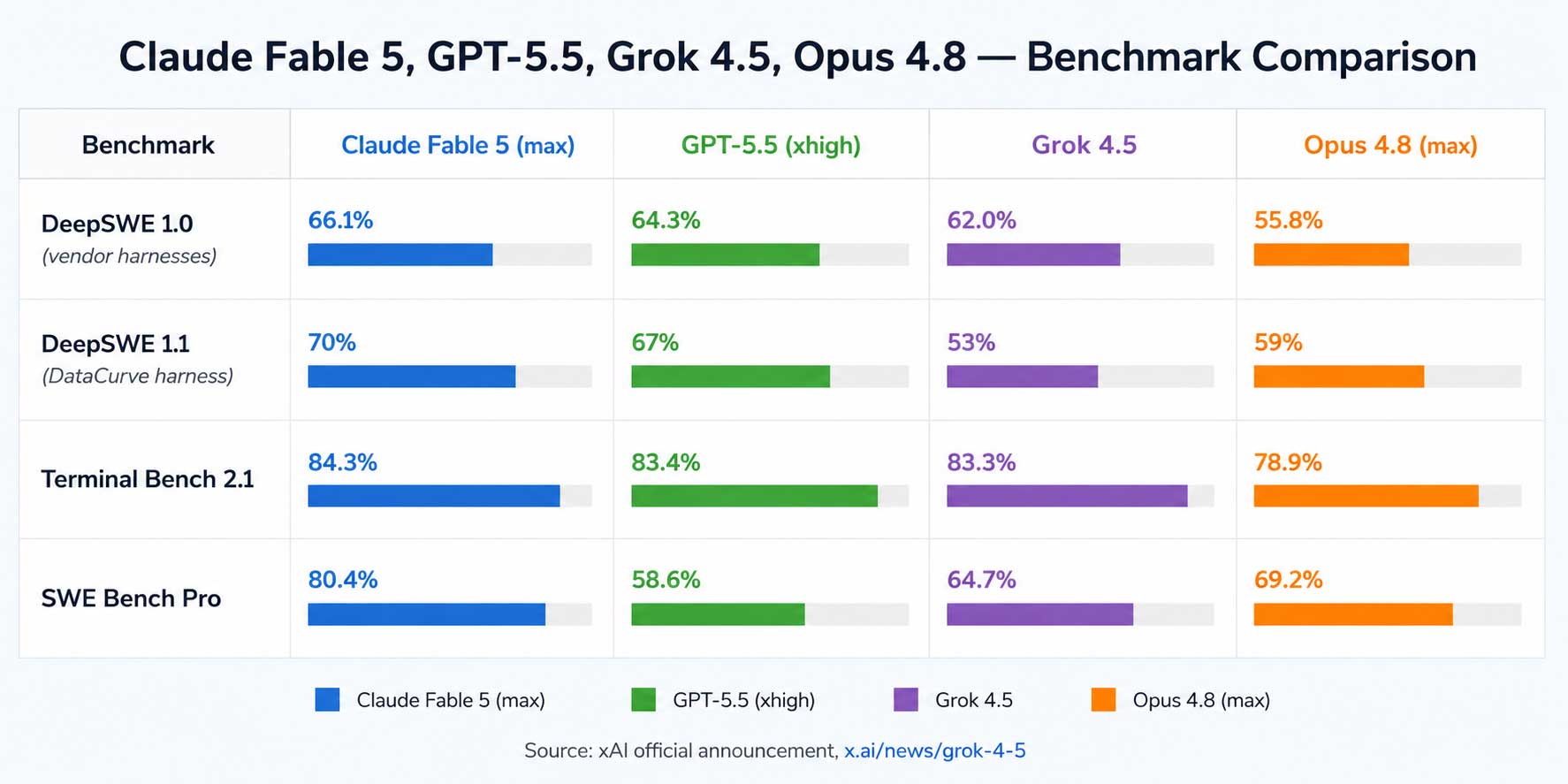
Two things stand out from these numbers. On DeepSWE 1.1 - the most comparable evaluation because DataCurve ran all models through the same harness - Grok 4.5 drops from third to fourth, falling behind Opus 4.8. On SWE Bench Pro, Grok 4.5 beats GPT-5.5 by six points but trails Opus by four. Terminal Bench 2.1 is the only evaluation where all three models cluster within one point of each other, with Fable 5 still leading. Grok 4 launched with a heavy reasoning tier that topped Humanity's Last Exam - Grok 4.5 trades some of that reasoning depth for coding efficiency and speed.
One outlier worth noting: xAI claims Grok 4.5 ranks first on Harvey's Legal Agent Benchmark. No public Harvey leaderboard exists with independent verification, but if accurate it's a meaningful signal for teams evaluating legal workflow automation.
Where the Real Difference Is - Pricing and Token Efficiency
Grok 4.5 costs $2 per million input tokens and $6 per million output tokens. For comparison, Claude Sonnet 5 runs at $2 input with much lower output costs, while Opus 4.8 sits at the premium tier of Anthropic's lineup. GPT-5.5 xhigh at frontier reasoning is priced at OpenAI's highest tier. The Grok 4.5 pricing puts frontier-adjacent performance at fast-model costs.
The more interesting number is token efficiency. According to xAI's data, Grok 4.5 resolves SWE Bench Pro tasks using an average of 15,954 output tokens. Opus 4.8 uses 67,020 - 4.2× more. At $6 per million output tokens for Grok 4.5 versus Opus 4.8's premium output pricing, a coding agent running thousands of tasks per day sees a cost difference that compounds fast. GitHub Copilot's first metered billing cycle caught developers off guard precisely because token volume at agentic scale was invisible until the invoice arrived. Output token efficiency is now a first-class cost variable.
Available in Cursor Today - Not in EU Until Mid-July
Grok 4.5 is live now in Grok Build, available in Cursor on all plans, and accessible via the SpaceXAI API console at $2/$6 pricing. SpaceX acquired Cursor for $60 billion with the deal expected to close in Q3 - but Grok 4.5 is already in Cursor today through a model training partnership that incorporated Cursor's developer workflow data. That gives Grok 4.5 direct distribution to one of the largest active developer tool audiences without waiting for the acquisition to close.
EU users are excluded at launch. SpaceXAI notes that Grok 4.5 is not available in EU products or the API console, with mid-July as the expected timeline. Teams in Europe building on the SpaceXAI API should factor that into any integration plans.
How to Think About This for Your Stack
Grok 4.5 is not the best coding model by benchmark. Fable 5 leads every evaluation where both appear. Agentic AI tasks that require deep multi-step reasoning will still favor Fable max or GPT-5.5 xhigh on raw accuracy. But for teams running high-volume coding agents - automated code review, PR generation, test writing at scale - Grok 4.5's combination of $2/$6 pricing, 80 TPS throughput, and 4.2× output token efficiency changes the economics meaningfully.
The honest framing is that Grok 4.5 is competing on a different axis than its benchmark position suggests. It runs at flash speeds with near-frontier coding accuracy and at a price point that makes GPT-5.6's three-tier structure look expensive for pure coding volume. Whether that trade-off is worth it depends entirely on what your agent does and how often it does it.