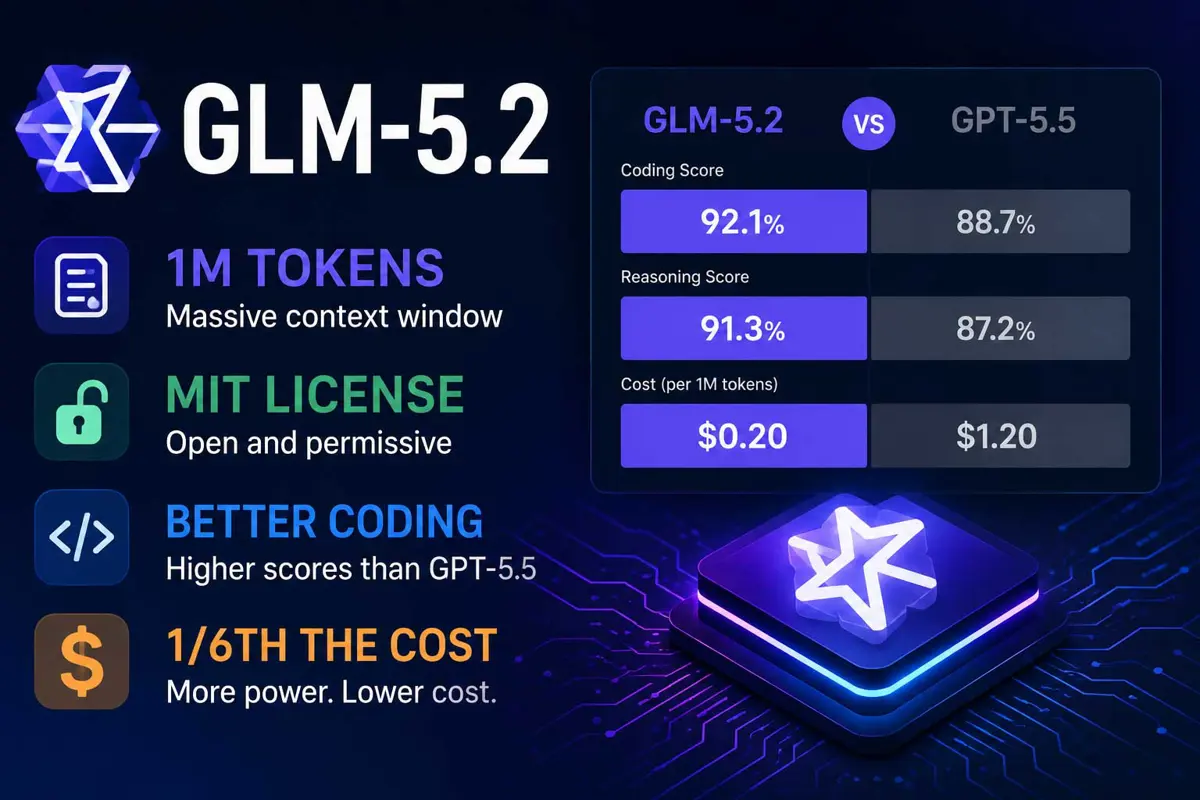
Zhipu AI launched GLM-5.2 on June 13 - a 750-billion-parameter model with a one-million-token context window and an MIT license that lets anyone download and run the weights without restriction. GLM-5.2 is open. Independent rankings from Artificial Analysis place it fourth overall among all LLMs globally, behind Claude Fable 5, Opus 4.8, and GPT-5.5 - and first among open-weight models, by a margin. API pricing through Z.ai is $1.40 per million input tokens, about one-sixth of what GPT-5.5 costs, for benchmark scores that match or exceed it on the coding tasks most developers actually care about.
750 Billion Parameters, 40 Billion Active - How the Architecture Works
GLM-5.2 runs a Mixture-of-Experts architecture. 750 billion total parameters, roughly 40 billion active per token. Zhipu built a sparse-attention technique called IndexShare on top of that MoE backbone to keep inference costs manageable at million-token context lengths - without it, routing attention across one million tokens would push per-token compute costs well past what most API operators can absorb. Developers get two reasoning modes: High and Max, with Z.ai recommending Max for complex, multi-step coding tasks that require planning and revision across long sequences. Maximum output per response is 131,072 tokens.
| Spec | GLM-5.2 |
|---|---|
| Total parameters | ~750 billion |
| Active parameters per token | ~40 billion |
| Architecture | Sparse MoE + IndexShare attention |
| Context window | 1,000,000 tokens |
| Max output tokens | 131,072 |
| Reasoning modes | High, Max |
| License | MIT (open weights) |
| Released | June 13, 2026 |
Benchmark Scores: Where GLM-5.2 Leads and Where It Still Trails
On Terminal-Bench 2.1, GLM-5.2 scores 81.0 - trailing only Claude Opus 4.8 at 85.0 and ahead of every other model tested, including Gemini 3.1 Pro. SWE-bench Pro measures real-world GitHub issue resolution; GLM-5.2 reaches 62.1 there, up from 58.4 on its predecessor GLM-5.1. No openly available model scores higher. On MCP-Atlas, which tests model-to-tool coordination for agentic workloads, GLM-5.2 scores 77.0, landing just below Opus 4.8 at 77.8 and ahead of GPT-5.5 at 75.3.
| Benchmark | GLM-5.2 | Claude Opus 4.8 | GPT-5.5 |
|---|---|---|---|
| Terminal-Bench 2.1 | 81.0 | 85.0 | - |
| SWE-bench Pro | 62.1 | - | - |
| MCP-Atlas | 77.0 | 77.8 | 75.3 |
| Artificial Analysis Index | 51 (#4 overall, #1 open-weight) | 56 (#2) | 55 (#3) |
Artificial Analysis puts GLM-5.2 at 51 on its Intelligence Index. Fourth overall. Claude Fable 5 leads at 60, followed by Opus 4.8 at 56 and GPT-5.5 at 55, with GLM-5.2 one point behind - and the only model in the top four that anyone can download, host, and run locally without API keys, usage agreements, or a billing account. Among all models with publicly available weights, nothing currently sits higher.
Cybersecurity: GLM-5.2 Beats Claude Code on Vulnerability Detection at $0.17 a Finding
Semgrep ran GLM-5.2 against Claude Code on IDOR (Insecure Direct Object Reference) vulnerability detection. GLM-5.2 scored an F1 of 39%. Claude Code scored between 32% and 37% on identical tasks. Cost per vulnerability found with GLM-5.2: $0.17, versus roughly one dollar for Claude-based workflows on the same benchmark. A Chinese open-weight model beating the leading American proprietary model on security benchmarks - while American models were simultaneously export-controlled out of reach internationally - is the kind of opening the market rarely signals so plainly. Anthropic's Fable 5 cybersecurity safeguards, published in July, detail exactly how Anthropic approaches offensive capability risk in its own models; on operational vulnerability detection tasks, GLM-5.2 is currently scoring higher and costing less.
$1.40 Per Million Input Tokens: What the Price Gap Means at Scale
API pricing via Z.ai is $1.40 per million input tokens and $4.40 per million output tokens. GPT-5.5 costs roughly six times more on input. Running one million input tokens through GLM-5.2 costs $1.40; the equivalent GPT-5.5 workload costs approximately $8.40. For teams processing large codebases, running nightly agentic sweeps, or routing high volumes of code review through an LLM, that spread compounds into real budget at production scale. Teams self-hosting on Hugging Face can push the number even lower - the MIT license carries no usage fee.
| Model | Input per 1M tokens | Output per 1M tokens | Weights available |
|---|---|---|---|
| GLM-5.2 (Z.ai) | $1.40 | $4.40 | Yes - MIT |
| GPT-5.5 | ~$8.40 (est. 6x) | higher | No |
| Claude Opus 4.8 | proprietary | proprietary | No |
US Export Controls Gave GLM-5.2 a Bigger Launch Than Benchmarks Alone Would Have
US government orders cut off access to Claude Fable 5 and Claude Mythos internationally, leaving developers outside the US without the frontier models they had been building on. When Claude Fable 5 returned to international markets in July, the disruption had already made the argument for alternatives. No regional locks exist on GLM-5.2. Zhipu released it under MIT with weights on Hugging Face for any developer in any country - no export control exposure, no API dependency, no usage restrictions. That combination gave the launch a tailwind the technical merits alone would not have produced.
Knowledge Atlas Technology (HKEX: 2513), the listed entity tied to Zhipu AI, jumped 48% at open after the launch week and closed up 32.8%, with JPMorgan raising its price target from 950 to 1,400 Hong Kong dollars. GLM-5.2 was designed for the workloads that matter most to developers in 2026 - long-context coding, tool use, agentic pipelines, and security analysis. Weights are on Hugging Face, available since June 13. Whether the next version of GLM extends the gap to Claude Opus 4.8 on Terminal-Bench or closes the remaining four-point deficit is what Z.ai's roadmap now has to show.
--- POST-IMPORT MANUAL STEP — RELATED ARTICLES Add a Related Articles block manually in the CMS editor after import. Suggested articles: 1. /what-is-agentic-ai — What Is Agentic AI - And Why It's About to Change How You Work 2. /fable-5-cybersecurity-safeguards-jailbreak-severity-scale — Anthropic Published Fable 5's Cybersecurity Rulebook and a Scale for Grading Every AI Jailbreak 3. /project-akrites-linux-foundation-open-source-vulnerabilities-ai — Fewer Than 5% of AI-Found Open Source Vulnerabilities Get Patched. Akrites Is the Industry's Fix. ---