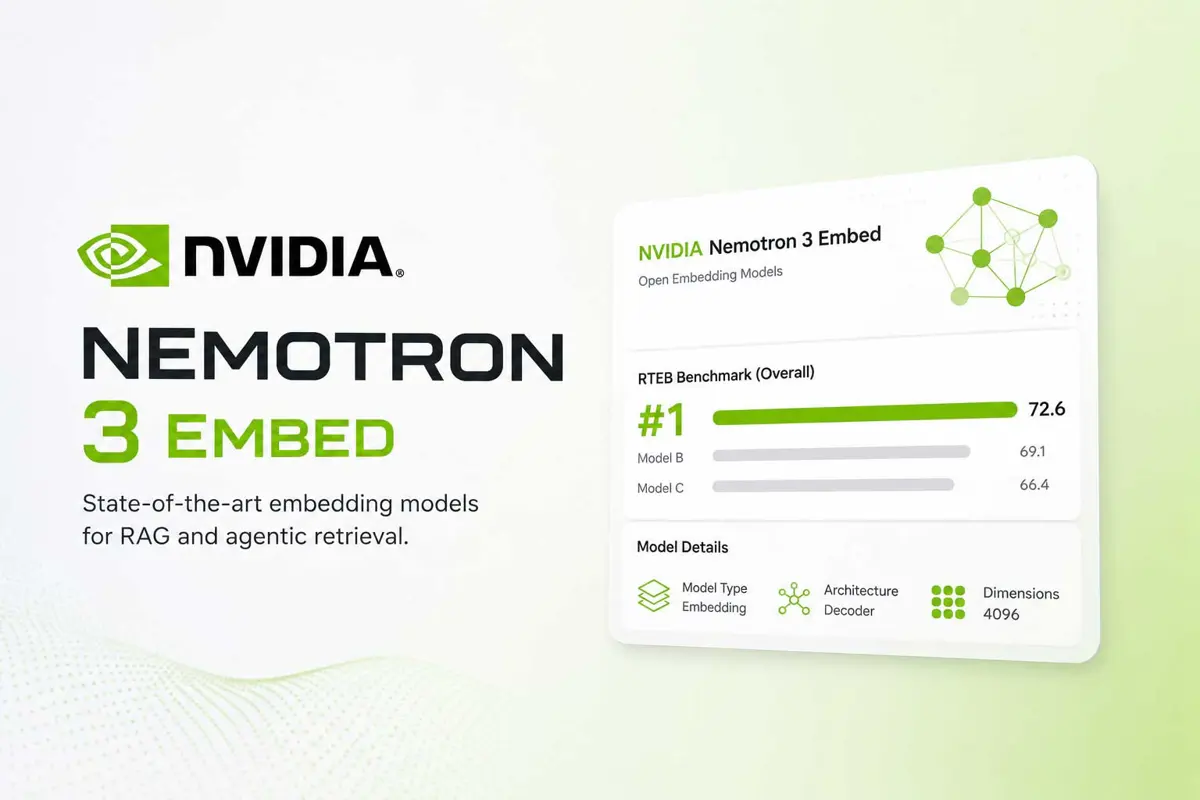
NVIDIA released Nemotron 3 Embed on July 15. Three open embedding models, commercial license included, all available now on HuggingFace under OpenMDW-1.1. The 8B checkpoint ranks #1 on the RTEB multilingual leaderboard as of this week, scoring 78.46 NDCG@10 across 16 retrieval tasks - a 17-point jump over the previous NVIDIA embedding flagship in a single release cycle. Nemotron 3 Embed did not arrive with a research paper announcement or a press event; it appeared on HuggingFace with a full model card, code samples, and benchmark tables that speak for themselves.
Three Models Cover Accuracy, Efficiency, and Blackwell
NVIDIA structured this as a three-tier collection. Each tier serves a distinct deployment profile. Nemotron-3-Embed-8B-BF16 is the accuracy-first option: 8B parameters, 4096-dimensional output embeddings, and a 78.46 score on RTEB. Nemotron-3-Embed-1B-BF16 runs the same design in a smaller footprint and still reaches 72.38 - the previous NVIDIA embedding flagship peaked at 61.98, so the new 1B alone already beats where the old 8B-class models sat. Nemotron-3-Embed-1B-NVFP4 takes the 1B architecture and quantizes it to 4-bit precision optimized for Blackwell GPUs, giving teams running GB100 or GB200 hardware a purpose-built path without full BF16 memory overhead.
Bidirectional Attention and 32K Context Separate It From Most Embedding Options
Nemotron 3 Embed uses bidirectional attention masking - not the causal attention most LLMs use. Bidirectional attention lets every token attend to every other token in the input simultaneously, which produces richer contextual representations for retrieval than causal encoders can. The final embedding comes from average pooling over token-level outputs, producing a single 4096-dimensional vector per input. Max sequence length is 32,768 tokens, which covers most real-world document chunks without forcing aggressive truncation.
Training covered 50M+ samples across text, code, and multilingual data. Code retrieval was explicit, not incidental - NVIDIA used CoIR datasets (apps, cosqa, stackoverflow-qa, codetrans-dl, codetrans-contest), SWE-bench, and synthetic text-to-SQL pairs. On the multilingual side, 34 languages were covered in evaluation including Arabic, Chinese, Japanese, Korean, Hindi, and Vietnamese, with MIRACL and MLDR as primary multilingual datasets. Synthetic training pairs were generated by Qwen3 (multiple sizes), Gemma 4, OpenAI GPT-OSS models, and NVIDIA's own Nemotron generation models - the same synthetic-data-from-frontier-models approach that open labs like Moonshot used to train Kimi K3 and that has become standard practice for high-quality embedding fine-tuning at scale.
Three Deployment Paths - Pick the Right One
Sentence Transformers is the fastest path to working retrieval. Load the model with SentenceTransformer("nvidia/Nemotron-3-Embed-8B-BF16"), call model.encode_query(queries) and model.encode_document(documents) - the library handles the query: and passage: prefix injection automatically. For manual control over tokenization and pooling, the raw Transformers path works with AutoModel and AutoTokenizer, but you add the prefixes yourself. For production serving at scale, vLLM is the right choice - use the /v2/embed endpoint with input_type: "query" or "document", not the /v1/embeddings path, which requires manual prefix management. Embeddings are L2-normalized, so dot product and cosine similarity are equivalent.
The 17-Point Jump From the Previous NVIDIA Embedding Means Re-Evaluation Is Overdue
Nemotron 3 Embed's performance gap over the previous NVIDIA lineup is not marginal. A 17-point RTEB jump in a single release - from 61.98 to 78.46 - means any team that ran baseline benchmarks in early or mid-2026 using the older llama-nemotron-embed models is now comparing against a ceiling that has moved well above what they measured. More practically, the 1B model at 72.38 now delivers accuracy that required an 8B model in the previous generation. Teams doing cost-sensitive edge deployment or building retrieval pipelines on tighter compute budgets should re-run their evals before finalizing model selection - the 1B model alone now clears what used to require an 8B slot.
No inference provider supports Nemotron 3 Embed on HuggingFace yet - local deployment is the current path. NVIDIA tested on A100 80GB and H100 80GB hardware. The minimum software stack is Transformers 5.2.0 and sentence-transformers 5.4.1, tested inside the nvcr.io/nvidia/pytorch:26.06-py3 container. Blackwell deployment uses the NVFP4 checkpoint; the BF16 variants are validated on Ampere and Hopper. The base architecture is Ministral-3-8B (Apache 2.0), which carries through to the OpenMDW-1.1 licensing on the final models.