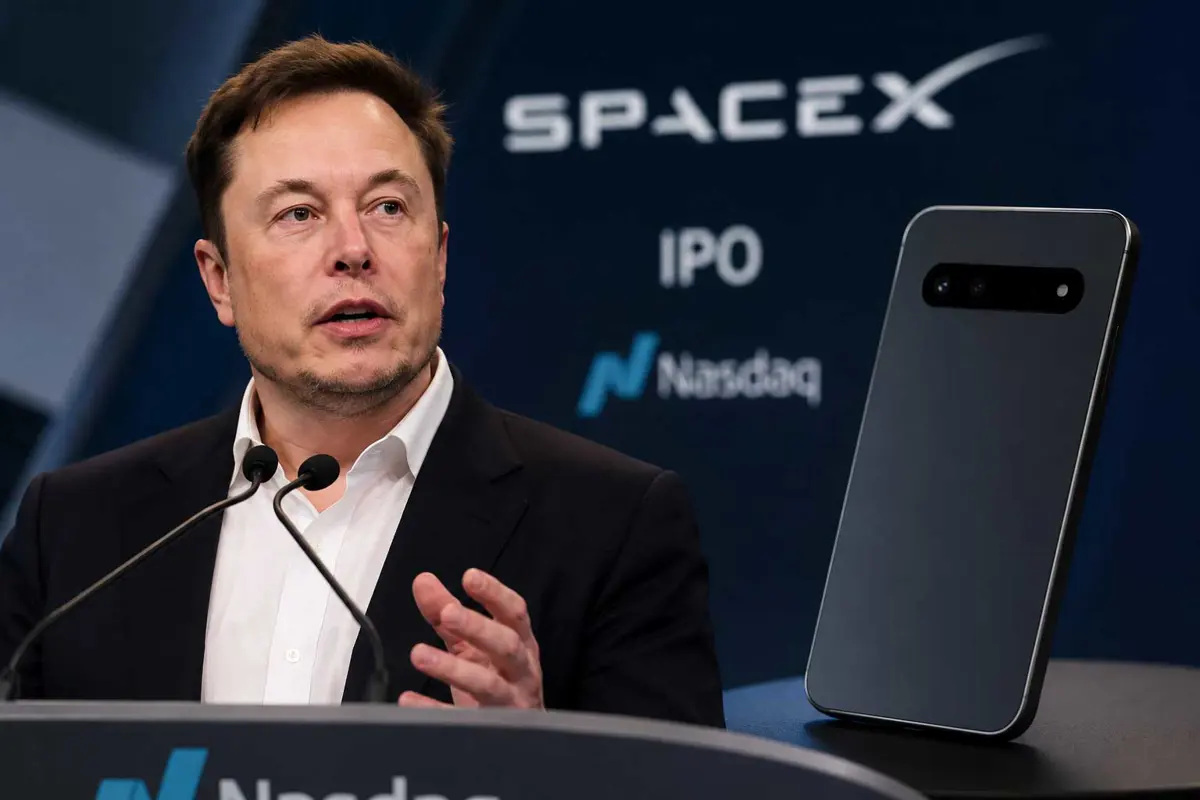
Wall Street Journal reported Tuesday that SpaceX showed investors a handset-like SpaceX AI device prototype before the company's $75 billion IPO in June. Sleeker and slimmer than an iPhone, the prototype reportedly runs on a proprietary SpaceX operating system and integrates xAI technology - SpaceX absorbed xAI earlier this year. Elon Musk called the report "utterly false." SpaceX stock dropped 8%.
What Investors Saw Before the IPO
People who attended SpaceX's pre-IPO briefings described something between a small touchscreen phone and a Rabbit R1 - lighter and thinner than an iPhone, but similar in form. SpaceX told investors the design is still early enough to change, meaning no production timeline has been set. Qualcomm chips reportedly power the device's on-device compute.
Running on a proprietary OS means the device would bypass Android entirely - no Google Play Store, no Android APIs, no dependency on Google's platform layer. Developers targeting it would need to build for SpaceX's own environment, with Grok as the native AI layer. SpaceX's $60 billion acquisition of Cursor in June - its first major post-IPO move - already gives it an AI coding tool that could run natively on such a device.
Musk Denied It. His Stock Fell 8% Anyway.
Musk posted "utterly false" on X in response to the WSJ story. SpaceX stock fell 8% after the denial - which is an odd market reaction to a report that, if false, should have no bearing on valuation. In February, he called a similar Reuters report about SpaceX building a phone "false." Both denials came after WSJ and Reuters sourced their stories from people inside SpaceX's own investor communications.
Reporters at the Wall Street Journal do not typically stake their credibility on misidentified sources from a pre-IPO roadshow. Either SpaceX showed investors a prototype it later shelved, the sources misread early hardware experiments, or Musk is calling something "false" that technically is not a phone yet.
OpenAI Is Building One Too - and SpaceX Knows It
OpenAI has spent more than a year developing an AI device with Jony Ive, Apple's former chief design officer. Last week, Paul Meade - Apple's VP who ran the Vision Pro hardware program - joined OpenAI's hardware team. OpenAI's device aims for native AI interfaces rather than porting AI onto a smartphone. SpaceX's prototype, per WSJ, has the same design philosophy.
Humane's AI Pin and Rabbit R1 both launched commercially in 2024 and struggled. Neither had SpaceX and Tesla's combined manufacturing scale, and neither had a satellite network to handle connectivity without carrier partnerships. Starlink Mobile already signals SpaceX's ambition to compete with Verizon and AT&T directly. An AI device that runs on Starlink would be a full-stack hardware play - network, chip, OS, and AI all controlled by one company - that no existing handset maker can replicate today.
SpaceX went public at $75 billion in June, giving it the balance sheet to pursue hardware at scale. SpaceX has not said whether the device will ever ship to consumers.