
VPN Speed Tests 2026: What the Numbers Actually Mean
Protocol choice determines most of the speed gap - server distance and ISP throttling account for the rest.

A VPN speed test without a baseline is a single data point with no reference. What makes it useful is a before-and-after comparison: connection speed without the VPN active, then the same measurement with the VPN connected, on the same test server, within the same window. Three variables account for most of what separates a fast VPN from a slow one - protocol, server distance, and ISP throttling. Running one number addresses none of them on its own.
Run a Baseline Before Connecting to Any VPN
Baseline speed changes throughout the day. ISP networks carry more traffic during evening hours; wireless interference from neighboring networks affects Wi-Fi at unpredictable intervals. A baseline run at 7 a.m. does not represent afternoon conditions. For a reliable VPN speed test, run three baseline measurements on Speedtest.net or Fast.com within a 10-minute window, targeting the same test server each time. Average those results - that figure becomes the reference point for every comparison that follows.
Closing background apps before testing matters more than most guides acknowledge. Streaming, cloud sync, and software updates all consume bandwidth. One update running in the background can make a 5% VPN overhead look like 30%.
Five Steps for a Reproducible Speed Test
- Close all background apps and pause any active downloads or cloud sync services.
- Run three speed tests on Speedtest.net, targeting the same server each time. Record download speed, upload speed, latency (ping), and jitter.
- Connect to the VPN on the nearest available server using WireGuard protocol - NordLynx for NordVPN, Lightway for ExpressVPN, standard WireGuard for Proton VPN and Surfshark.
- Run the same three speed tests against the same Speedtest.net server without changing any other settings.
- Divide the VPN download average by the baseline average to get speed retention percentage. 90% or above is excellent; below 70% signals a meaningful performance penalty.
Three Numbers to Record: Download, Latency, and Jitter
Download speed in Mbps gets the most attention, but latency matters more for gaming, video calls, and any real-time application. Latency is the round-trip time a packet takes from device to server and back, measured in milliseconds. Research studying WireGuard in production networks found WireGuard introduces a mean latency overhead of 2.23ms, bringing average latency to 10.04ms - a 28.5% relative increase, but an absolute figure low enough to be imperceptible in most applications.
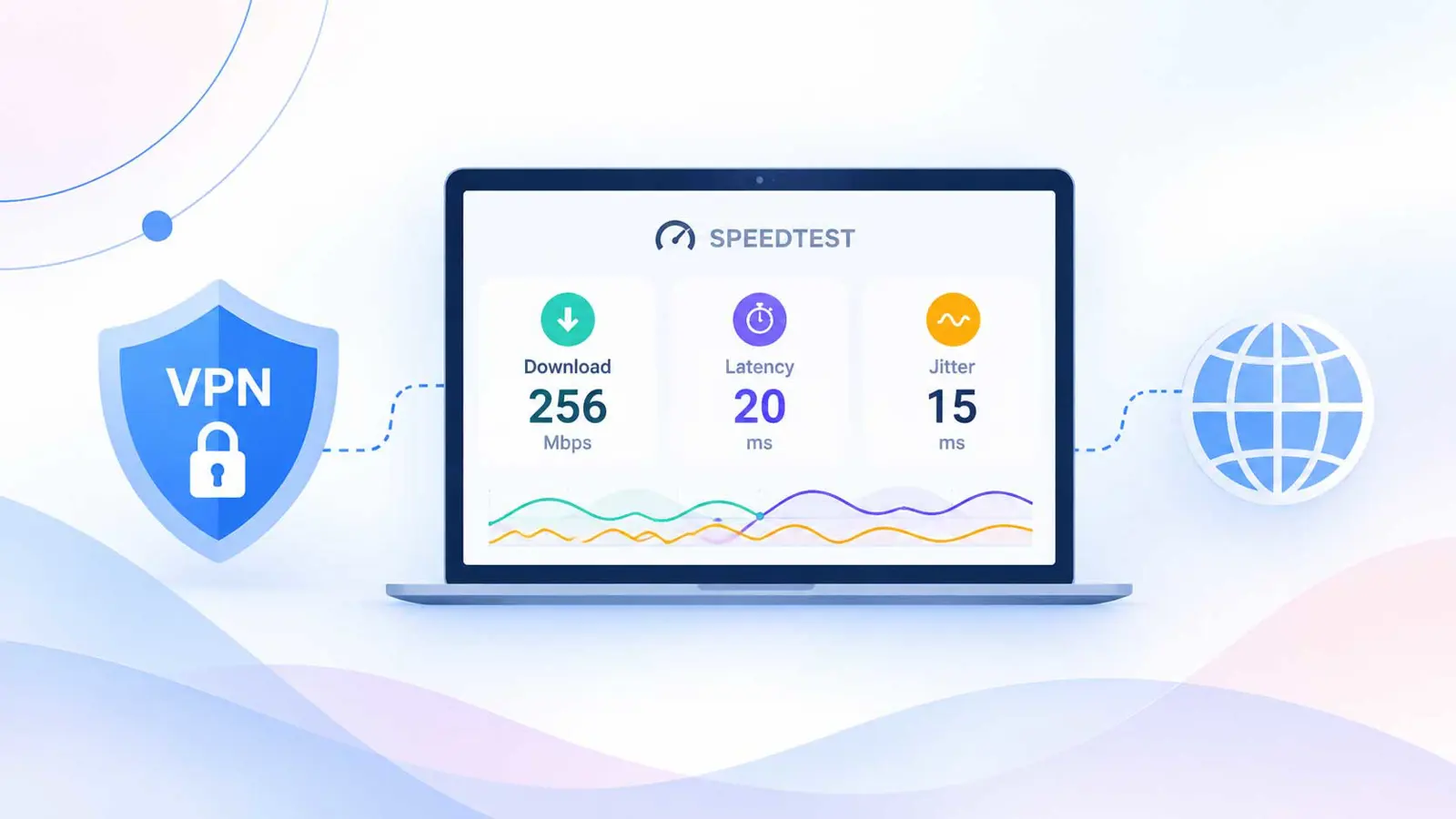
Jitter - the variation in latency from packet to packet - is the number most consumers skip and the one that most directly causes video call freezes and audio dropouts. A connection averaging 20ms latency with 15ms jitter is worse for calls than one averaging 35ms with 2ms jitter. Speedtest.net reports all three numbers. Recording all three for both the baseline and VPN runs produces a complete picture.
Protocol Determines Most of the Speed Gap
WireGuard and OpenVPN are not interchangeable for speed. Tom's Guide's 2026 speed tests on an uncontested 10 Gbps network show the gap precisely: Proton VPN reached 1,548 Mbps on WireGuard; on OpenVPN, the same provider dropped to 449 Mbps. NordVPN's NordLynx (WireGuard-based) hit 1,249 Mbps; its OpenVPN reached 688 Mbps. Surfshark: 1,021 Mbps on WireGuard, 851 Mbps on OpenVPN with DCO. Protocol alone accounts for a two- to three-times speed difference across every provider in that test.
Proprietary protocols add a further layer. ExpressVPN's Lightway Turbo reached 1,177 Mbps in Tom's Guide's 2026 testing - but Lightway Turbo is Windows-only. On macOS, iOS, and Android, ExpressVPN's standard Lightway protocol peaked at 428 Mbps in the same round, slower than the provider's own OpenVPN implementation running at 1,038 Mbps with DCO. Platform coverage is the variable that proprietary speed claims routinely omit. Full protocol breakdown is in the WireGuard vs OpenVPN comparison.
Why Home Speed Test Results Differ From Lab Benchmarks
Published lab benchmarks run on uncontested 10 Gbps lines with no competing traffic and enterprise-grade routing. Home connections share bandwidth with neighbors, route through consumer-grade routers with limited CPU, and carry Wi-Fi overhead. Proton VPN's lab figure of 1,548 Mbps fell to 51 Mbps in Tom's Guide's domestic Wi-Fi testing - and the same tester's unprotected Wi-Fi baseline clocked 32 Mbps. Proton VPN actually delivered faster effective speeds than the connection without any VPN active. Proton attributes this to VPN Accelerator, which routes around ISP throttling by encrypting traffic before the ISP can classify and slow it. Returning faster than a throttled baseline is a more meaningful result for most subscribers than any 10 Gbps lab figure - because ISP throttling affects video streaming and large downloads daily, and encryption removes it.
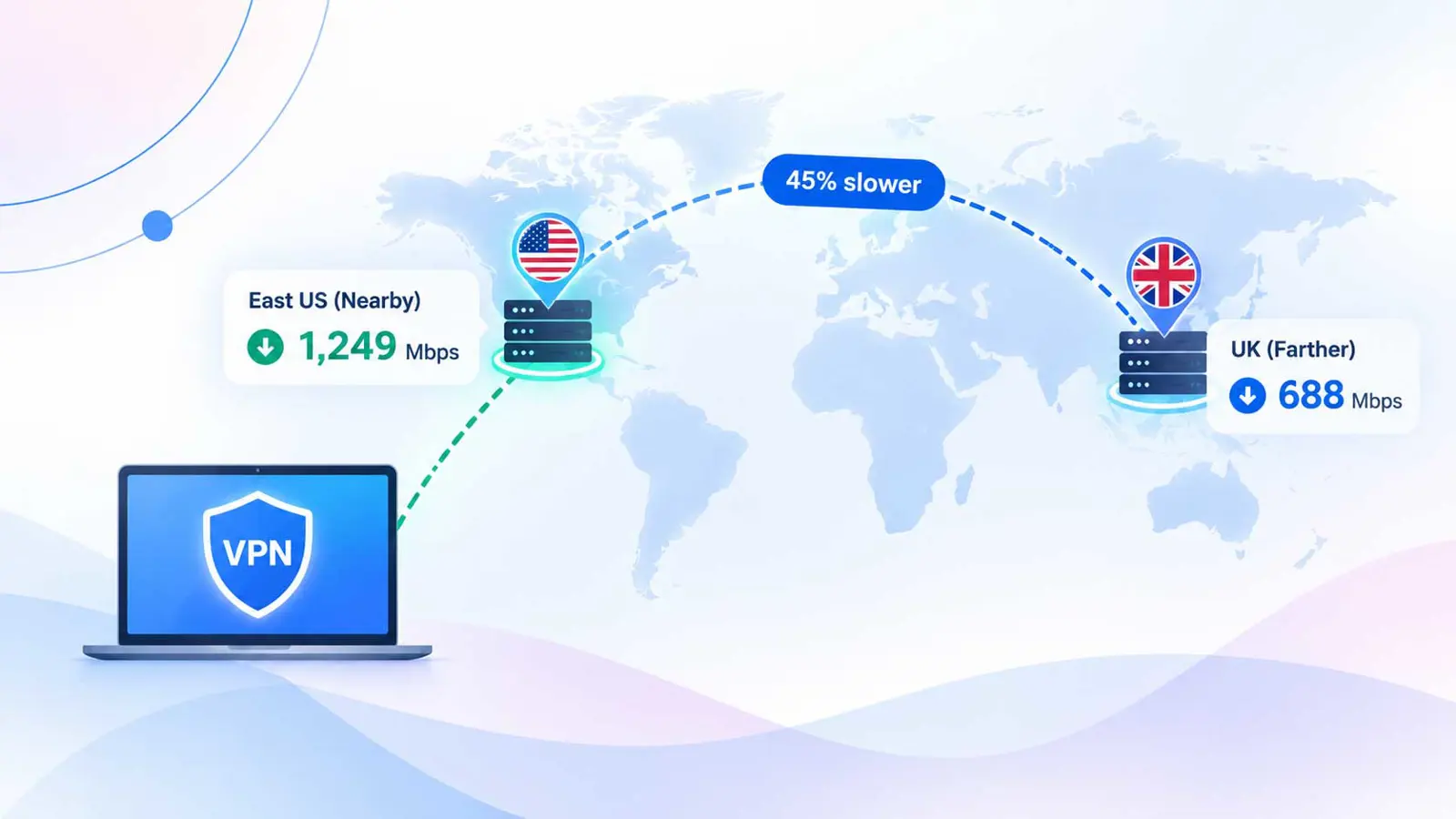
Server distance is the other major variable lab headlines bury. NordVPN clocked 1,249 Mbps connecting to a nearby East US server in Tom's Guide's 2026 testing, then 688 Mbps on the same protocol connecting from East US to a UK server - a 45% drop from distance alone, with no change in provider or protocol. Connecting to a server in the same country minimises this loss; connecting across continents adds routing hops that no protocol fully recovers.
Fastest VPNs in 2026, Based on Independent Testing
| Provider | Best Protocol | Peak Speed (10 Gbps) | Long Distance | OpenVPN Peak |
|---|---|---|---|---|
| PrivadoVPN | WireGuard | 2,334 Mbps | 1,389 Mbps | 405 Mbps |
| Proton VPN | WireGuard | 1,548 Mbps | 1,475 Mbps | 449 Mbps |
| NordVPN (NordLynx) | WireGuard | 1,249 Mbps | 688 Mbps | 688 Mbps |
| ExpressVPN (Lightway Turbo) | Proprietary* | 1,177 Mbps | 1,117 Mbps | 1,038 Mbps |
| Surfshark | WireGuard | 1,021 Mbps | — | 851 Mbps |
*Lightway Turbo: Windows only. Standard Lightway (other platforms) peaked at 428 Mbps in the same test.
PrivadoVPN's peak WireGuard figure of 2,334 Mbps is the highest number in any 2026 benchmark, but its OpenVPN speeds (405 Mbps local, 196 Mbps long-distance) are the weakest on this list, and it failed to unblock multiple streaming platforms in the same test cycle. Proton VPN's ranking at #1 overall reflects consistent WireGuard speeds, the fastest obfuscated protocol in the comparison (Stealth at 479 Mbps), and a real-world domestic result that outpaced the un-VPN'd baseline. Raw peak speed on a single protocol is context, not a purchase reason.
VPN speed test benchmarks are point-in-time snapshots - providers update protocol implementations regularly, and results shift between lab rounds. For a current comparison that pairs speed with audit credibility, jurisdiction, and kill switch depth, the best VPN guide covers every recommended provider with sourced specs in one place. For platform-specific speed picks, the best VPN for gaming guide covers providers with the lowest latency profiles for competitive play.
Frequently Asked Questions
How often should a VPN speed test be run?
Why does a VPN sometimes speed up a connection?
What speed retention percentage is good for a VPN?
Does server location affect VPN speed?
Which VPN protocol is fastest?