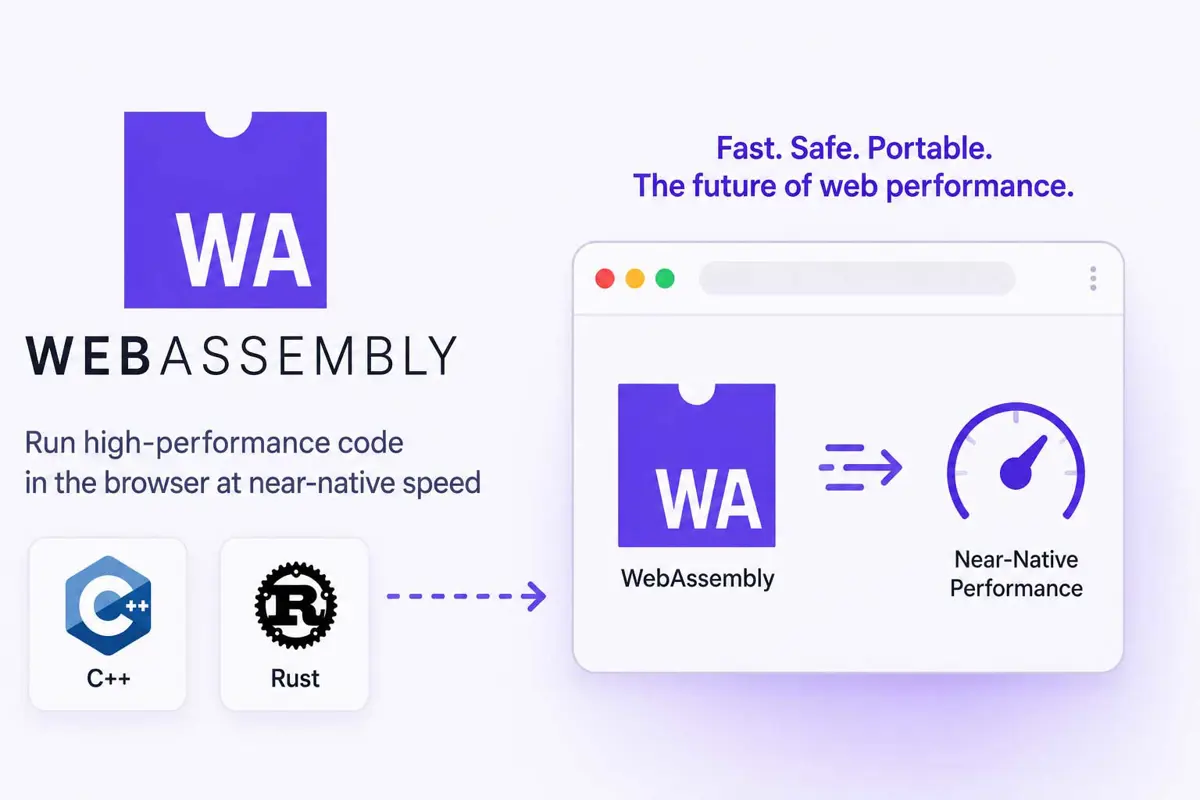
JavaScript has powered the web for 30 years. WebAssembly arrived in 2017 as a binary format that browsers could decode and execute far faster than any JavaScript alternative - Firefox and Chrome shipped support that year, with Edge and Safari following shortly after. Now a W3C standard - version 3.0 ratified in September 2025 - WebAssembly runs in production at companies from Adobe to Zoom.
WebAssembly Runs Code at Near-Native Speed - Without Replacing JavaScript
WebAssembly (abbreviated Wasm) is a binary instruction format - a compact set of low-level instructions that browsers decode and execute on a virtual machine built into every modern browser. Developers do not write Wasm by hand. Instead, they write code in C, C++, Rust, or Go, then compile it to Wasm. Wasm binaries land in the browser smaller and faster to parse than equivalent JavaScript - the WebAssembly spec notes parse speeds roughly 20 times faster than asm.js.
Wasm modules run inside the browser's existing sandbox. A module cannot read files, touch the network, or call any browser API unless JavaScript explicitly hands it that capability - which means a compromised Wasm dependency has nowhere to go once it exhausts its allocated memory.
WebAssembly does not replace JavaScript. Wasm handles computation; JavaScript handles the DOM, events, and browser APIs. A typical production app uses both - JavaScript for UI logic and event handling, Wasm for the compute-intensive parts that would otherwise block the main thread for hundreds of milliseconds. Figma's rendering engine is Wasm; its collaboration layer is JavaScript.
Figma, Photoshop, and Google Earth Already Run on WebAssembly
Figma migrated its C++ graphics engine to WebAssembly and cut load times by more than 3x. Every pixel on a Figma canvas is Wasm. Figma Code Layers took it further in 2026, using esbuild and Tailwind v4 compiled to Wasm and running inside Web Workers for real-time bundling and style compilation without any round-trip to a build server.
Photoshop's web version uses Rust compiled to Wasm for image processing. Processing a 4K image in JavaScript takes about 180 milliseconds; the same task in Rust-to-Wasm takes 22 milliseconds, and drops to 8 milliseconds when WebAssembly SIMD instructions are available. Eight milliseconds. Adobe could not have shipped blend modes, real-time selection previews, and non-destructive filters at browser speeds without it.
Google Earth renders 3D geospatial data at 85 to 95 percent of native desktop performance in the browser, using Wasm's direct memory access and SIMD for coordinate transformations across massive datasets. Before WebAssembly, running Google Earth in a browser meant accepting severe performance compromises or installing a native plugin. Neither option was acceptable at scale.
WebAssembly Beyond the Browser: WASI and the Component Model
Running Wasm outside the browser requires a runtime - a program that hosts the Wasm module the way a browser does. Wasmtime and WasmEdge are the two dominant runtimes. Cloudflare Workers runs on Wasm at the edge; Fastly's Compute platform does the same. Cold starts are 1 to 5 milliseconds, compared to hundreds of milliseconds for a Lambda container cold start.
WASI 0.2, released January 2024, added HTTP and TCP networking and the Component Model - a formal interface type system described in WIT (WebAssembly Interface Types). No glue code. A Rust component and a Python component that share a WIT interface can be linked at the Wasm layer directly, with memory safety preserved across the language boundary. WASI 0.3 adds native async I/O through futures and streams; its first release candidate shipped in November 2025.
For the first time, a Rust library author can compile once to Wasm and ship to browsers, edge functions, mobile runtimes, and Linux servers from a single artifact - without maintaining separate build targets per platform. One binary. That portability is what makes Wasm worth watching beyond the browser performance angle.
How Developers Get Started With WebAssembly
Most Wasm projects start in Rust. Rust's ownership model maps well to Wasm's linear memory, wasm-pack handles compilation and JavaScript bindings automatically, and the Rust Wasm ecosystem is mature. C and C++ compile to Wasm via Emscripten, the original toolchain that ports OpenSSL, SQLite, and thousands of existing C libraries to the browser. Go has experimental Wasm support; Java and Kotlin compile to Wasm through toolchains like TeaVM and Kotlin/Wasm, both of which rely on WasmGC - a 2024 spec addition that lets GC languages delegate memory management to the browser's own garbage collector rather than bundling their own.
WebAssembly works best for workloads that crunch numbers, process media, or run algorithms that do not need constant DOM access. Pick the right problem. Image processing, video encoding, cryptography, physics simulations, and data visualization at scale are all good fits. Porting a React component to Wasm for a marginal speed gain is not - the bridge overhead and toolchain complexity are not worth it for anything that already runs comfortably in JavaScript.
What WebAssembly Still Cannot Do
Wasm modules cannot touch the DOM directly. Every DOM call - selecting an element, appending a child, firing a custom event - must go through a JavaScript bridge, which adds a small but real cost per call. For compute-heavy tasks this is a reasonable trade-off; Wasm handles the expensive computation and hands the result to JavaScript, which updates the page with whatever changed. Code that constantly interacts with the DOM, however, will find the bridge overhead wipes out Wasm's speed advantage.
Server-side Wasm has no native multi-threading. Browsers work around this with SharedArrayBuffer and Atomics, enabling parallel execution inside a single Wasm module split across multiple Web Workers - a pattern that requires careful shared memory management. WASI still lacks this threading model, which means databases, video transcoders, and any workload that needs real parallel compute runs into a hard wall. That excludes a substantial class of backend applications from Wasm today.
Debugging Wasm is harder than debugging JavaScript. Source maps exist and browser DevTools support them, but the experience remains rougher than stepping through TypeScript in VS Code. DWARF debug info helps when working from C++ or Rust, and tools like wasm-bindgen and wasm-pack reduce the integration friction. Practically, most teams debug the source language and drop into Wasm-level inspection only when they have to.
WebAssembly 3.0 is a W3C standard. WASI 0.3 addresses the async gap that blocked server-side Wasm for years - threading in WASI is still pending, which is the biggest remaining wall for backend workloads. For most developers, the right approach pairs Wasm with JavaScript: Wasm for the compute, JavaScript for the DOM, and the browser's sandbox keeping everything contained.