Claude Found a CRISPR-Like Enzyme System by Searching 200,000 Proteins
Anthropic says Claude searched more than 200,000 reverse transcriptases, spotted a CRISPR-like pattern, and helped researchers identify a previously uncharacterized enzyme system.

Claude has been used to write code, analyze papers, and operate software. Anthropic is now showing a different kind of use: letting the model search biological data for patterns that scientists may not have noticed.
Anthropic says Claude found a previously uncharacterized enzyme system after searching more than 200,000 reverse transcriptases in a large DNA database. The search took about 21 hours and involved roughly 950 Claude agents processing around 210 million tokens.
The result is called array-associated reverse transcriptases, or ART. It has features that Anthropic says are reminiscent of CRISPR, including a long array of evenly spaced DNA repeats. But this is not being presented as a new CRISPR editing tool: Anthropic says it does not yet know what the system does.
Anthropic's experiments provide initial evidence that the repeat array is expressed as distinct short RNAs, but the biological role of ART has not yet been established.
Claude Enzyme Discovery Started With 200,000 Reverse Transcriptases
Anthropic's biology research team started with a broad question: could Claude search a huge collection of DNA sequences and find reverse transcriptases with unusual features?
Claude examined more than 200,000 reverse transcriptases, collected information on the surrounding genetic regions, and selected about 3,500 candidate systems for closer inspection. It eventually narrowed those down to 20 systems that looked especially interesting.
The scale matters because this kind of search can involve a huge number of possible combinations. Instead of asking a model to inspect one paper or one gene at a time, Anthropic used many Claude agents to divide the search into smaller tasks, compare results, follow promising clues, and refine the candidates.
This is part of Anthropic's broader push to build AI tools for scientific work. The company recently introduced Anthropic Launches Claude Science, an AI Workbench Built for Scientists and has also opened the Anthropic Life Sciences Verification Program for Biology Researchers Using Claude.
Claude Spotted a CRISPR-Like Pattern
The key clue was not simply the reverse transcriptase itself. Anthropic says Claude noticed that one unusual reverse transcriptase sat next to a non-coding DNA repeat array and another accessory protein whose function was unknown.
Claude then investigated the pattern instead of treating the repeat sequence as an isolated detail. It counted the repeats, measured their spacing, compared the arrangement with known reverse transcriptase systems, searched the scientific literature, and assembled the evidence into a candidate biological system.
That led Anthropic to the ART system: a reverse transcriptase paired with another gene and a long array of evenly spaced DNA repeats.
The repeat architecture is what makes the comparison with CRISPR interesting. CRISPR systems also use repeated DNA sequences arranged in arrays, although the underlying biology is different. Anthropic is describing ART as CRISPR-like in its organization, not as a replacement for CRISPR.
Humans Still Had to Test the Discovery
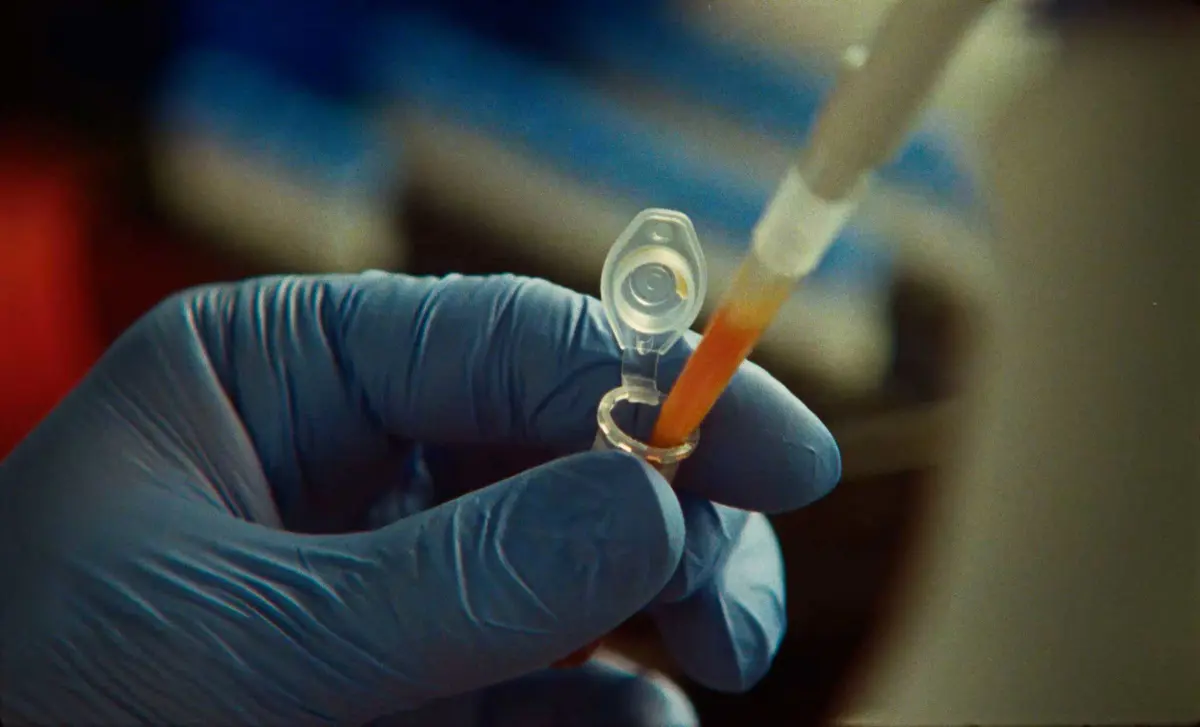
Claude did not independently run the wet-lab experiments. Anthropic's human scientists took the computationally identified candidates into the laboratory and tested the proposed system.
Those experiments produced an early clue: the ART repeat array was expressed as distinct short RNAs. That result gives researchers something concrete to investigate, but it does not yet explain what those RNAs or the overall system do.
Anthropic says its biology lab operates at BSL-1 and BSL-2 and does not handle pathogens that infect humans. The company also says the physical laboratory work in this project was performed by human researchers.
That division of labor is an important part of the story. Claude searched the data, connected unusual biological features, and generated a hypothesis. Scientists still had to decide what was worth testing and perform the experiments needed to establish whether the computational prediction held up.
Scientists Don't Know What ART Does Yet
There is an obvious temptation to turn a CRISPR-like discovery into a story about a new gene-editing technology. The available evidence does not support that conclusion yet.
Anthropic says the reverse transcriptase at the center of the system had already appeared in previous research. What Claude appears to have contributed was recognizing the larger pattern around it: the repeat array, the accessory protein, and the way those components appeared together.
The central unanswered question is function. Researchers do not yet know what ART naturally does, why the repeat array exists, or how the system's components interact.
That makes the discovery scientifically interesting without requiring a claim that it is already a practical biotechnology. The next stage is characterization: determining what the system does and whether its unusual architecture has a biological purpose that can be understood or used.
The Bigger Change Is How AI Can Search Biology
The Claude enzyme discovery is interesting partly because of the workflow Anthropic is demonstrating. Biology contains enormous databases of sequences, proteins, structures, and experimental results. Finding something useful can depend on noticing a relationship between pieces of evidence that are individually easy to overlook.
Claude's role in this project was not simply to summarize existing research. It searched a large biological dataset, generated candidates, compared them, followed a promising pattern, and turned that pattern into a testable hypothesis.
That is closer to an AI research assistant than a traditional chatbot. It also connects with Anthropic's recent effort to put Claude directly into scientific workflows rather than treating science as a special case of general-purpose prompting.
The company's recent work around Claude Science and its AI workbench for scientists and its Life Sciences Verification Program points in the same direction: give researchers models that can handle more of the searching and reasoning involved before a human decides what deserves an experiment.
What Happens Next
Anthropic says its work on ART is ongoing and is inviting scientists to collaborate. The immediate task is straightforward: determine what the system actually does.
- Characterize the proteins and repeat-derived RNAs in the ART system.
- Determine whether the repeat array has a functional role.
- Establish how the reverse transcriptase and accessory protein interact.
- Compare ART with other known reverse transcriptase systems.
- Test whether the system has any useful biological activity beyond the initial observations.
If the system turns out to have a distinctive biological function, the discovery could become more significant. For now, the strongest result is narrower: Claude found an unusual biological pattern at a scale that would be difficult to inspect manually, and human scientists turned that computational lead into a laboratory investigation.
Related Saganote Coverage
Anthropic Launches Claude Science, an AI Workbench Built for Scientists covers Anthropic's broader scientific workflow for Claude.
Anthropic Opens Life Sciences Verification Program for Biology Researchers Using Claude covers the company's biology-focused program for researchers.