Picking the best AI for coding depends on whether a team weighs benchmark rank, price per task, or open weights, and the published numbers disagree on all three. BenchLM's November 6 coding leaderboard anchors the ranking below, blended with vendor-reported Terminal-Bench scores and the few cost-per-run figures that exist. Last updated November 7, 2026, with monthly refreshes planned.
The Ranking at a Glance
BenchLM ranks 157 models, and the table shows 13. Scores are BenchLM's own weighted coding composite, not a vendor claim, though the page does not label the source of most of the numbers behind it.
| Model | BenchLM coding score | Input / output price per million tokens | Note |
|---|---|---|---|
| Claude Opus 5.5 | 82.8 | $4 / $20 | Top of the composite |
| Claude Sonnet 5.5 | 81.9 | $2 / $10 | Half the price of Opus 5.5 |
| Gemini 4 Carbon | 81.3 | $2 / $10 | BenchLM marks the score as estimated |
| Claude Fable 5.1 | 76.6 | $10 / $50 | Highest list price in the table |
| GPT-6 Astra | 74.8 | $10 / $50 | Same list price as Fable 5.1 |
| Gemini 4 Argon | 72.2 | $2 / $10 | Saganote reported limited access in October |
| Muse Wonder Full | 71.3 | Not listed | Sold through eligible Muse Code plans |
| GPT-6.1 Sol | 70.4 | $2 / $10 | Same price as Sonnet 5.5 |
| GPT-5.6 Sol | 67.3 | $4 / $20 | Promotional price per Morph |
| DeepSeek V4.1 Flash 1017 | 63.3 | $0.30 / $1.20 | Open weights |
| GPT-5.5 | 62.4 | $5 / $30 | Older OpenAI model |
| Kimi K3 | 58.9 | $3 / $15 | Open weights |
| Grok 4.6 | 58.6 | $2 / $6 | Cheapest closed model in the table |
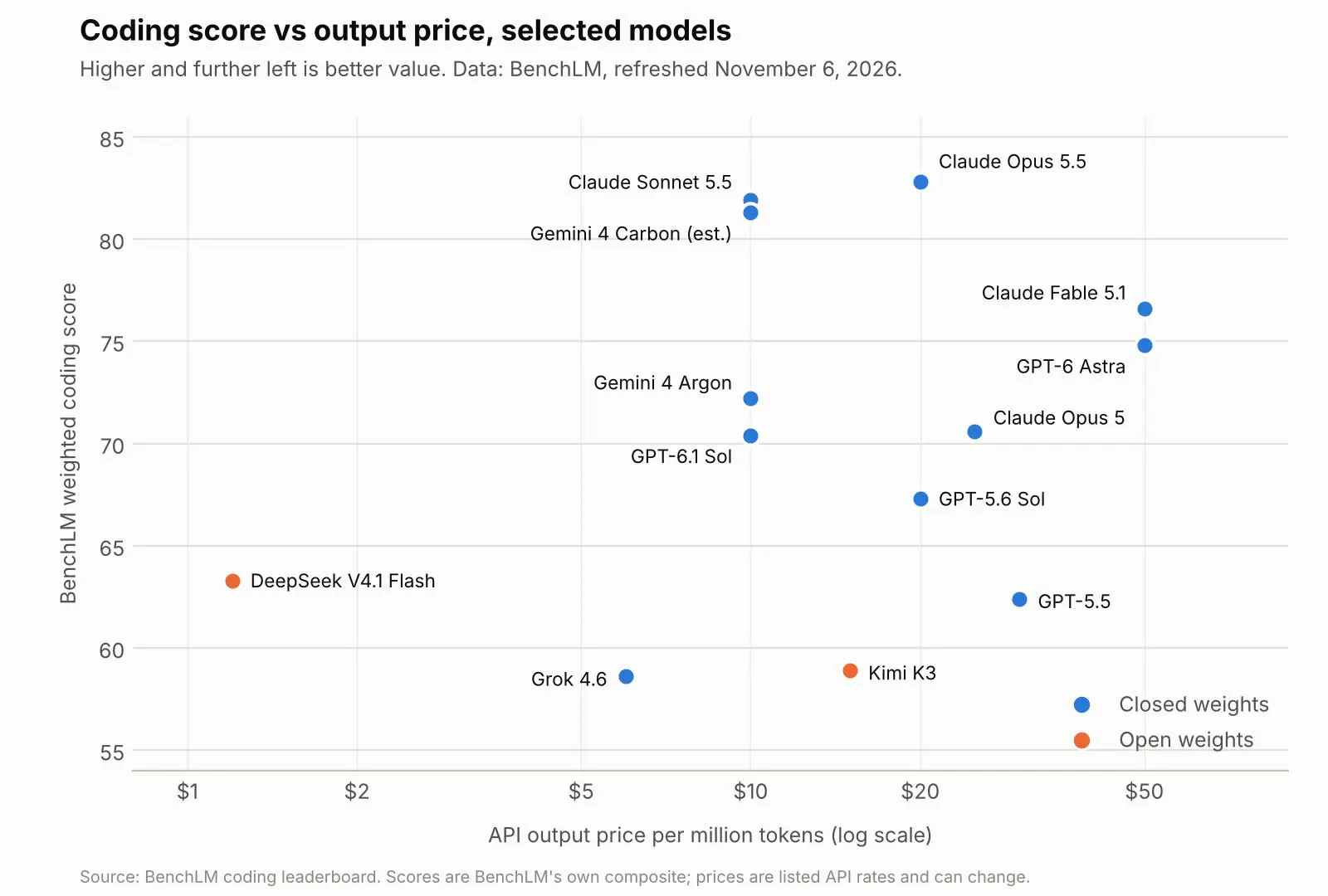
Sonnet 5.5 sits 0.9 points behind Opus 5.5. That gap costs half the price to close. Gemini 4 Carbon lands in the same tier at $2 and $10, though its score is an estimate, and Saganote's Gemini 4 Argon coding benchmarks report explains why Argon's listed price is hard to act on, since only a trusted-defender program had access on October 7.
How the Ranking Works
BenchLM describes its coding score as a weighted blend, with SWE-bench Pro and DeepSWE carrying the largest weights, and it tags evidence as Supported or Estimated. Weights were not read verbatim for this article. Four outside checks sit beside it, with limits.
- Scale's SWE-bench Pro board: a public leaderboard with a standardized scaffold, but its newest entry dates from July 9, 2026
- Vals AI's SWE-bench Verified: a bash-only harness where scores run from 88.6% to 97.0%, which Morph treats as saturated
- Arena.ai's Frontend Code Arena: blind human votes, with a September 22 snapshot of GPT-6 Astra at 1793, Fable 5.1 at 1755, Opus 5 at 1691, and Kimi K3 at 1658
- Artificial Analysis's Coding Agent Index: an equal-weight mean of FrontierCode v1.1, Terminal-Bench 4.0, and SWE-Atlas-QnA-AA with three attempts per task, though its scores are charts and were not readable here
Top Models for Agentic Coding
Terminal-Bench 4.0 changes the order. Claude Sonnet 5.5 scores above Opus 5.5 there, and every figure in the table below is vendor-reported, as Morph labels them, so independent checks would be needed to confirm any of it.
| Model | Terminal-Bench 4.0 | Reported by | Setting |
|---|---|---|---|
| Claude Sonnet 5.5 | 70.6% | Anthropic | Not stated |
| Claude Opus 5.5 | 66.4% | Anthropic | xhigh |
| GPT-6 Astra | 57.9% | OpenAI | high |
| Gemini 4 Argon | 57.4% | Not stated | |
| Claude Fable 5.1 | 55.8% | Anthropic | Not stated |
| Claude Opus 5 | 52.3% | Anthropic | Not stated |
| GPT-6.1 Terra | 50.3% | OpenAI | Max effort |
| Claude Haiku 5.5 | 39.2% | Anthropic | Not stated |
| Grok 4.7 | 38% | xAI | xhigh, Grok Build harness |
| DeepSeek V4.1 Flash | 31.2% | DeepSeek | Max |
Cost claims come with a vendor caveat. Anthropic says Opus 5.5 matches GPT-6 Astra on Terminal-Bench 4.0 at about 40% of the cost, according to Morph, which makes it a vendor claim. Saganote's GPT-6.1 Terra report covers the Terra figure and its cost side, and the earlier Grok 4.5 vs Claude Fable 5 vs GPT-5.5 comparison shows how the same vendors compared in July.
SWE-bench Pro numbers need extra care. BenchLM lists 89.9% for Opus 5.5, but Morph says that figure comes from llm-stats alone and that Anthropic does not report SWE-bench Pro. Scale's independent board, with its standardized scaffold, topped out at 61.5% for Muse Spark 1.1 as of its newest entry on July 9.
Best Value Models
Token price is only half of cost. For a team shopping for the best AI for coding on a budget, cost per finished task matters more than the rate card, and published per-task numbers are thin. Gathered below is what exists, and most of it comes from Saganote's earlier reports.
| Evidence | Figure | Source and limit |
|---|---|---|
| FrontierSWE v2 average cost per run | Opus 5.5 $98.87, Gemini 4 Argon $129.36 over 10.6 hours, GPT-6 Astra $1,029.65 | Proximal via OrcaRouter, as reported by Saganote on October 7; cache hit rates were low in a non-production setup |
| Artificial Analysis cost per task, Intelligence Index | GPT-6.1 Terra $0.40 against $1.40 for GPT-5.6 Terra | General tasks, not only coding, at max effort |
| Artificial Analysis cost per task, Intelligence Index | Mistral Large 4 $1.13 at standard price, about $0.57 at launch discount | Compared with DeepSeek V4.1 Flash at $0.27 and GLM-5.3-Flash at $0.25 |
| SWE-bench Pro output tokens per task | Grok 4.5 15,954 against 67,020 for Claude Opus 4.8 | xAI's announcement, older models |
| Output tokens per task | Argon about 62,000 against about 27,000 for GPT-6 Astra | Artificial Analysis, as reported by Saganote |
Sonnet 5.5 is the clearest value pick. That model scores within a point of Opus 5.5 on BenchLM at half the list price and tops the vendor-reported Terminal-Bench table. Cheaper tiers trade rank for price, with Claude Haiku 5.5 listed at $0.10 and $0.50 and a 39.2% Terminal-Bench score.
Prices move, so confirm them elsewhere. Saganote's AI API pricing comparison and AI pricing guide list current rates, and teams that want to try models without paying can start with the free AI tools guide. One low-priced option for long-running agents is Grok 4.6 at $2 per million tokens.
Open-Weight Options
- DeepSeek V4.1 Flash 1017: open weights at 63.3 on BenchLM, listed at $0.30 and $1.20 with a 1M context, and the top open-weight row in BenchLM's coding table
- Kimi K3: open weights at 58.9, listed at $3 and $15
- Ling 3.1 Flash: open weights at an estimated 58.3 with a 262K context, and BenchLM's link text describes MIT-licensed FP8 weights
- GLM-5.2: MIT-licensed weights released June 13, 2026, with a Terminal-Bench 2.1 score of 81.0 against 85.0 for Opus 4.8, in an older benchmark version than the table above
License terms need checking model by model. DeepSeek and Kimi licenses were not stated on the pages read, so their model cards are the place to check commercial terms. Saganote's GLM-5.2 report covers that model in detail, and its Mistral Large 4 report says weights were planned for the end of October, so a refresh should check whether they shipped.
What Benchmarks Miss
- Versions get mixed: Terminal-Bench 2.0, 2.1, 3.0, and 4.0 appear on different pages, and Morph says Gemini 3.8 Flash scores 89.4% on 2.1 but 19.1% on 4.0, both vendor-reported
- Vendor claims dominate: the Terminal-Bench 4.0 and CursorBench 4.0 numbers above come from the vendors, while Scale's board, Vals AI, Arena.ai, and Artificial Analysis are independent
- Effort settings differ: Morph lists Opus 5.5 at xhigh in its table but says Anthropic's headline numbers run at max effort
- Names and prices conflict: Morph calls a tier GPT-6 Luna at $0.10 and $0.50 while BenchLM lists GPT-5.6 Luna at $0.20 and $1.20, and Saganote's own pricing table lists GPT-5.6 Sol at $5 and $30 as of September 2
- Fallbacks exist: Artificial Analysis lists Opus 5.5 with default fallback, and Morph says it can fall back to Opus 5 on some tasks
Morph describes a GPT-5.6 Sol promotion through at least November 21 and an introductory Gemini 3.8 Flash price through December 31, so a table from one week can mislead the next. Treat the date stamp as part of the data.
How to Test Models on Real Repositories
No public leaderboard matches a team's own code. A short test on real repositories is the fastest way to find the best AI for coding for that specific work, because published benchmarks measure other people's code.
- Pick five to ten tasks from the team's own backlog, including a few that were hard to finish.
- Run each model through the same agent harness at the same effort level.
- Repeat each task five times, as Saganote's Argon report advises, since single runs vary.
- Record total cost per task, including retries and cached tokens.
- Count output tokens, because verbose models cost more per task at the same price.
- Score by accepted changes, not by whether the code ran.
- Repeat monthly, since prices and model versions change.
Tooling matters as much as the model. Saganote's Claude Code vs Codex vs Cursor vs Copilot comparison and the Copilot, Cursor, and Tabnine guide cover how the editors differ, and Saganote's Muse Wonder coding benchmarks report says third-party DeepSWE runs exist for Muse Wonder Full without quoting scores, so those results are the next entry to watch.
Frequently Asked Questions
What is the best AI model for coding right now?
Which coding model is the best value?
Is there a good open-weight coding model?
Are SWE-bench scores still useful?
How often does the ranking change?