ExpressVPN has completed 23 independent audits across eight years of external privacy verification - more than any other mainstream VPN. This ExpressVPN review covers what those audits actually prove, where the pricing gets complicated, and whether the premium over NordVPN and Surfshark is worth paying in 2026. Starting at $3.49/month on a two-year Basic plan, ExpressVPN costs slightly more than NordVPN ($3.39) and nearly double Surfshark ($1.99). What you get for that gap is a proprietary Lightway protocol that retained 92% of base download speed in Cyber Insider's 2026 benchmarks, a British Virgin Islands jurisdiction that sits outside all major intelligence-sharing alliances, and an audit depth that its closest rivals have not matched.
| Spec | Details |
|---|---|
| Starting price | $3.49/month (2-year Basic plan) |
| Monthly price | $12.99/month (Basic, no commitment) |
| Renewal price | $99.95/year (~$8.33/month, Basic after intro term) |
| Server locations | 214 locations across 113 countries |
| Protocols | Lightway (UDP/TCP), OpenVPN, IKEv2, L2TP/IPSec |
| Simultaneous devices | 10 (Basic), 12 (Advanced), 14 (Pro) |
| Jurisdiction | British Virgin Islands |
| Latest audit | KPMG no-logs audit, February 2025 (23rd total) |
| Netflix libraries unblocked | 18 |
| Refund window | 30 days |
Pricing: What You Actually Pay
ExpressVPN now offers three tiers. On the two-year plan, Basic runs $3.49/month, Advanced $4.49/month, and Pro $7.49/month. Monthly subscribers pay $12.99, $13.99, and $19.99 respectively - with no long-term commitment required.
Knowing the renewal rate before signing up is worth the 30 seconds it takes. After the intro term ends, Basic renews at $99.95/year (about $8.33/month), Advanced at $119.95/year, and Pro at roughly $199.95/year. ExpressVPN discloses this in the checkout flow, but the gap between intro price and renewal is one of the wider ones in the category - a $3.49/month plan that becomes $8.33/month on renewal looks different over a five-year horizon.
Basic covers 10 devices and the core VPN. Advanced adds Keys (ExpressVPN's password manager), identity monitoring with fraud alerts, and three days of complimentary eSIM travel data. Pro bumps simultaneous connections to 14 and includes a discount on Aircove, ExpressVPN's router product. For most households, Basic covers everything needed. All three tiers include a 30-day money-back guarantee, and ExpressVPN accepts credit cards, PayPal, and Bitcoin.

Speed and Performance
Lightway is ExpressVPN's proprietary protocol, and in 2025 the team rewrote its core in Rust, cutting the entire codebase to roughly 2,000 lines. A smaller codebase is easier for external auditors to review and faster to patch when vulnerabilities surface - that matters more than the marketing copy around it.
In Cyber Insider's 2026 benchmark tests, ExpressVPN on Lightway retained 92% of base download speed on nearby US servers and held 75-85% on long-distance connections. PCMag and TechRadar consistently placed Lightway in the top tier for speed in their 2025 and 2026 reviews, with consistent results across US and European server locations.
ExpressVPN shipped Lightway Turbo in May 2026, currently Windows-only. Turbo uses multi-lane tunneling to distribute traffic across multiple paths simultaneously. Early third-party tests found nearby US download speeds running 15% above unprotected baseline - meaning the VPN was faster than no VPN on some nearby connections. That is a narrow use case for now, but the rollout to macOS and mobile is expected later in 2026.
On streaming, ExpressVPN unblocks 18 Netflix regional libraries as of July 2026, covering the US, UK, Japan, Germany, France, Canada, and a dozen more. Testing by Cyber Insider and Tom's Guide confirmed consistent 4K playback without buffering on servers in the same region as the library being accessed.

Privacy and Security
ExpressVPN operates from the British Virgin Islands - a jurisdiction with no data retention laws and no membership in the Five Eyes, Nine Eyes, or Fourteen Eyes intelligence alliances. Kape Technologies, an Israeli-owned holding company, acquired ExpressVPN in 2021 for roughly $936 million. ExpressVPN holds user data in its own legal entity under BVI jurisdiction, kept separate from Kape's other VPN brands.
On logging: ExpressVPN does not collect browsing history, DNS queries, connection timestamps, or IP addresses. KPMG audited that policy in February 2025 - ExpressVPN's 23rd independent audit, conducted under the ISAE (UK) 3000 standard - and found no deviation from the published privacy policy. Twenty-three audits is not a marketing number; it represents a sustained commitment to external verification that NordVPN (eight audits) and Surfshark (four audits) have not matched in volume.
Cure53 audited the browser extension in June 2024 and identified two issues - one medium severity, one miscellaneous - both with low exploitation potential. Cure53 verified the fixes in a July 2024 re-test. A separate Cure53 audit of Aircove in November 2024 found no high or critical issues. Every server runs TrustedServer technology, meaning RAM-only operation that wipes data on every reboot.
ExpressVPN received 529 government data requests in 2025. According to its most recent transparency report, ExpressVPN handed over no user content data in response to any of them. Full details are at the ExpressVPN Trust Center:

Apps and Ease of Use
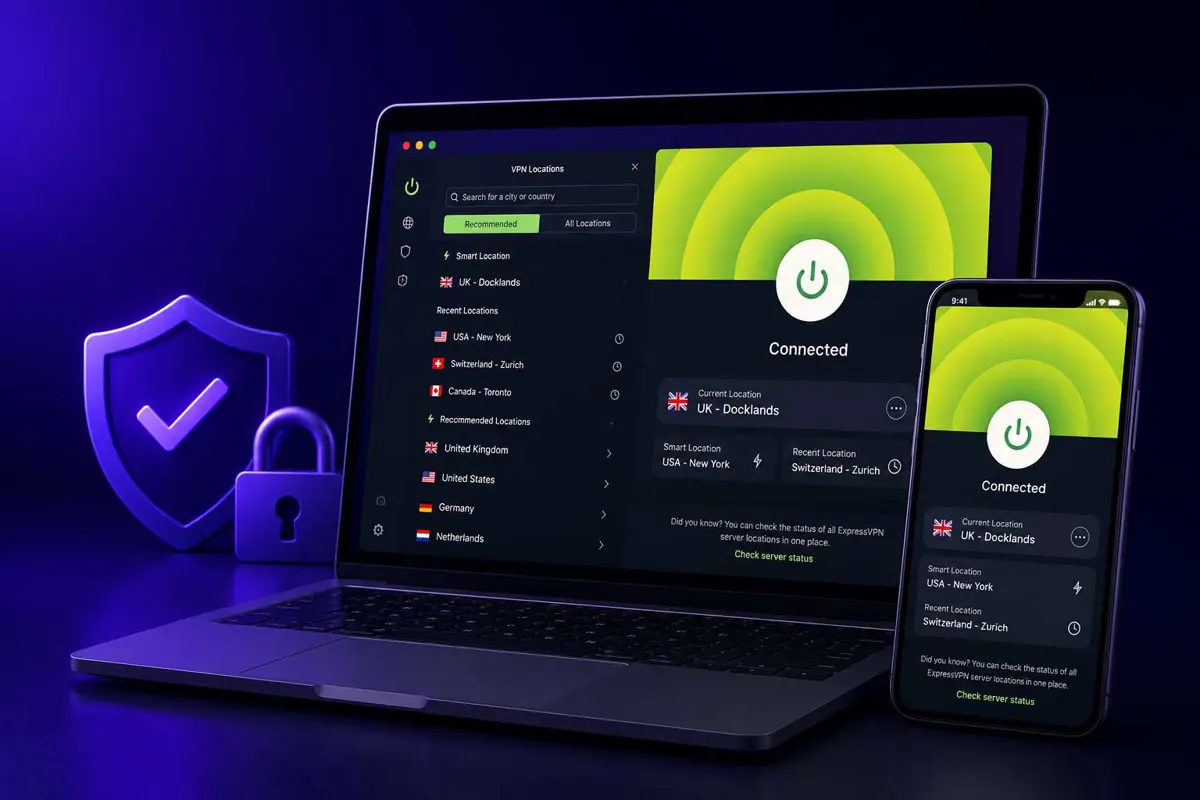
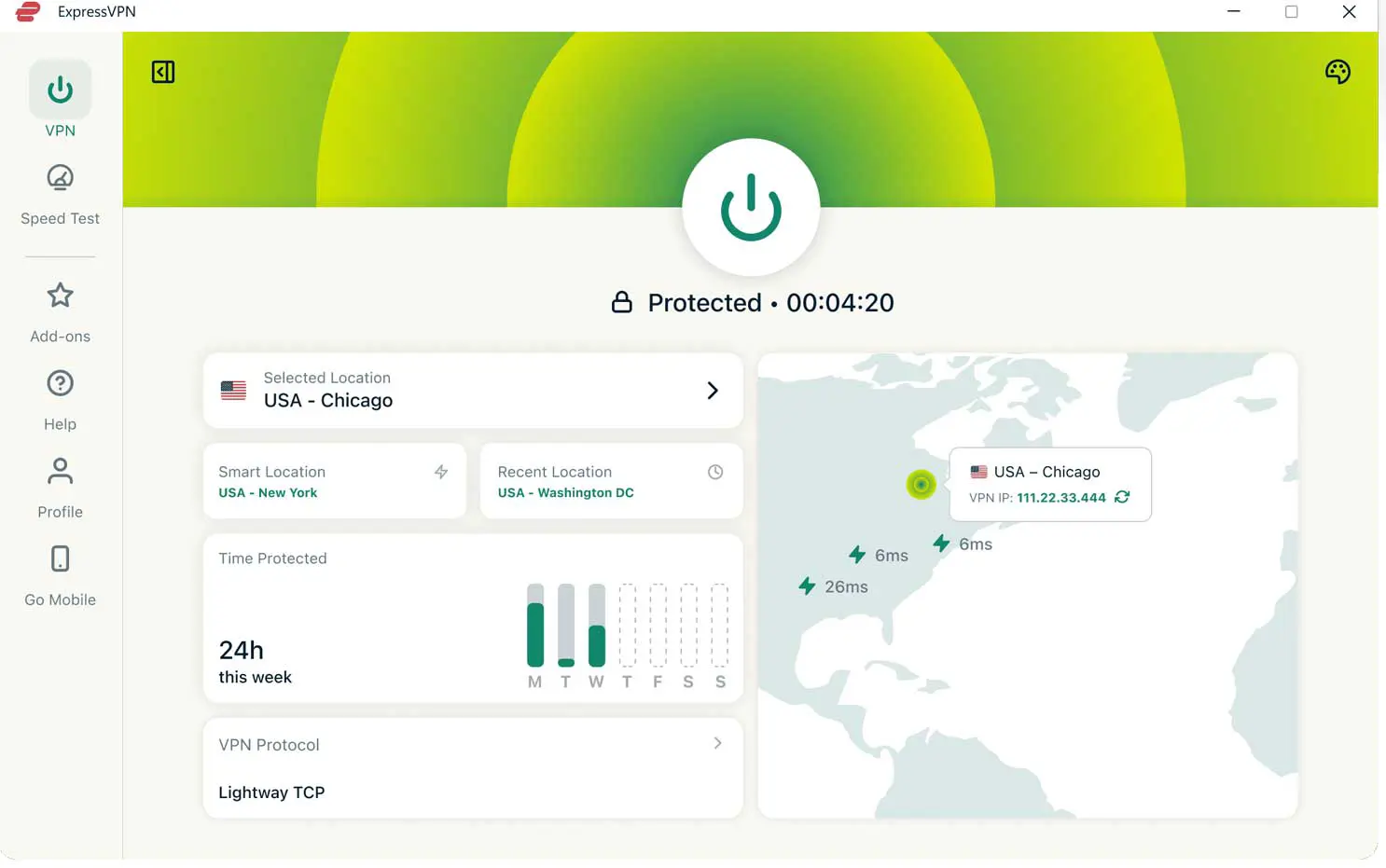
ExpressVPN publishes apps for Windows, macOS, Linux, iOS, Android, Apple TV, Fire TV, Android TV, and select routers. Setup takes under three minutes on most platforms. Pick a location, connect - the interface does not try to do too much, and that simplicity is part of what ExpressVPN charges for.
Split tunneling - the ability to route some apps through the VPN while others use a direct connection - works on Windows and macOS. iOS gets no split tunneling at all. Port forwarding is absent across all platforms. Advanced users who need either feature will find ExpressVPN limiting compared to Proton VPN or NordVPN.
The Basic plan covers 10 simultaneous devices, Advanced covers 12, and Pro covers 14. ExpressVPN's router support via Aircove extends coverage to every device on a home network without counting toward the device limit, which is worth knowing for large households.
Where ExpressVPN Falls Short
ExpressVPN does not publish its total server count - only its location count (214 across 113 countries). Every other top-tier VPN discloses server numbers. Not publishing the count makes independent capacity verification harder than it needs to be, and raises questions about whether some locations share infrastructure.
Price is the clearest weakness. At $3.49/month intro, ExpressVPN already costs more than NordVPN ($3.39) and nearly twice Surfshark ($1.99). After renewal, the gap widens further. Over a five-year horizon, Basic at $8.33/month renewal runs roughly 60% more than Surfshark's equivalent plan. For a premium that steep, the audit history and Lightway speed need to matter to you personally.
Feature development has also slowed since Kape's 2021 acquisition. NordVPN shipped multi-hop, meshnet, and a threat protection suite in the same period. ExpressVPN added Keys and identity monitoring to the Advanced and Pro tiers, but its core VPN feature set has seen fewer additions than rivals. No dedicated IP, no port forwarding, and incomplete split tunneling on mobile are all gaps that have existed for years without closing.

Verdict: Who Should (and Shouldn't) Buy ExpressVPN
Buy it if: you travel frequently across multiple countries, stream from many Netflix regional libraries, want the deepest audit record in the VPN category, or your expense account absorbs the premium. ExpressVPN's BVI jurisdiction, 23 KPMG-verified no-logs audits, and Lightway's proven speed retention make a strong case for users where privacy verification is the priority.
Skip it if: renewal price matters after year one, you need split tunneling on iOS, you want port forwarding, or you want a dedicated IP. For those gaps, the NordVPN review covers a provider that addresses all four at a lower renewal rate. For a zero-commitment starting point, the best free VPN guide covers five options worth testing before paying for anything.
ExpressVPN sits toward the top of any shortlist built on audit depth and speed consistency. For a full side-by-side comparison against every provider we recommend this year - with pricing, use-case breakdowns, and our top pick - the guide to the best VPNs for 2026 covers the whole category in one place.
Frequently Asked Questions
Is ExpressVPN safe in 2026?
Does ExpressVPN work with Netflix?
How much does ExpressVPN cost per month?
Who owns ExpressVPN?
How many devices can I connect with ExpressVPN?