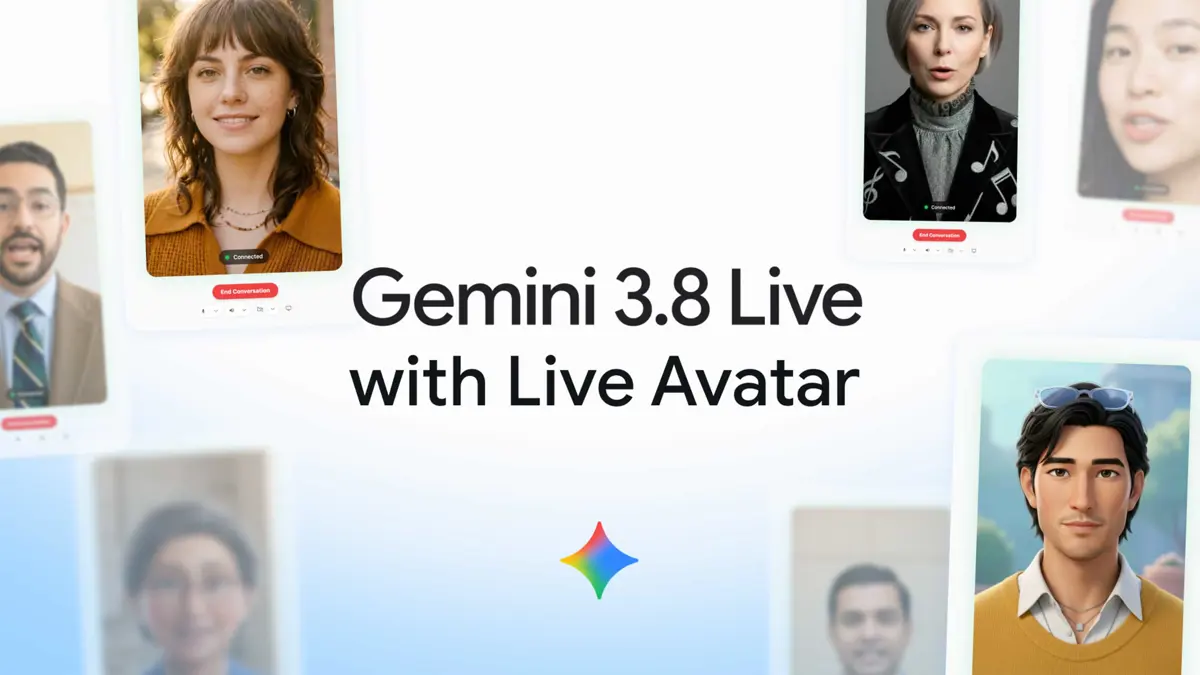
Google Gave Gemini Live Avatar a Face, But the Real Upgrade Is Behind It
Google’s new enterprise avatar keeps talking while its AI runs tools, sees live video, and handles work in the background.

Google has given Gemini Live a face, but the face is only the most visible part of the new system. Gemini Live Avatar combines near-real-time video generation with Gemini’s live speech capabilities so an enterprise AI agent can listen, see, speak, and appear on screen at the same time. Google announced the feature on September 24, 2026, and made it generally available through Gemini Enterprise.
The more interesting change happens behind the avatar. Google says Gemini Live Avatar can make API, CRM, or ERP calls asynchronously while the conversation continues. That lets an agent work on a task without forcing the user to sit through a silent pause while a backend system responds.
The avatar is the interface, but background work is the bigger change
A talking digital character is easy to understand. The useful part of Gemini Live Avatar is the combination of conversation and task execution. Google describes the system as an enterprise agent that can keep a live dialogue going while it works with external tools.
- Keep speaking while an API, CRM, or ERP request runs in the background.
- Process audio and visual input together during a live conversation.
- Use a visual avatar with synchronized speech, facial expressions, and lip movements.
- Switch between 97 supported languages while adapting the avatar’s lip-sync and expressions.
- Work with live camera feeds and screen shares so the agent can respond to what the user is showing.
That background execution builds on the earlier Gemini 3.8 Live release, which Saganote covered as a voice AI system designed to think and work while maintaining a conversation. Gemini 3.8 Live’s background reasoning provides useful context for why the new avatar is more than a cosmetic addition.
Gemini Live Avatar can see what the customer sees
Google’s system is also designed for conversations that include live visual information. The Gemini Live platform can process audio alongside camera feeds and screen shares, allowing an enterprise agent to use what is happening on screen or in front of a camera as part of the interaction.
Google Cloud gives an insurance claims example: a customer can speak with an intake agent and show damage on camera while the claim information is filled in. In the background, an agent team can check the policy, apply intake rules, and prepare an adjuster packet.
That example shows where the visual layer becomes useful. The avatar does not need to be the reason the system can complete the task. It gives the task a visible conversational interface while the underlying agent handles the work.
97 languages make the visual system more complicated
Google says Gemini Live Avatar can automatically detect and move between 97 supported languages. The avatar adjusts lip-sync and facial expressions as the language changes, with Google saying the transition is designed to avoid visual drift.
- Speech and video are generated as part of the same live interaction.
- Lip movements are synchronized with the generated speech.
- Facial expressions adapt as the conversation changes.
- Language changes can happen during the same conversation rather than through a separate manual mode.
The language support matters because a visual avatar has another synchronization problem that ordinary voice AI does not: the face has to keep matching the words. Google’s developer documentation lists 24 frames per second for Live Avatar video output, alongside asynchronous function calling for the Gemini 3.8 Live model.
This is built for enterprise agents, not the Gemini consumer app
One important detail can get lost in the avatar demos: Gemini Live Avatar is an enterprise feature. Google says it is available in Gemini Enterprise, with API access for developers. The Android Authority report that prompted this coverage also notes that the feature is not being introduced as a consumer Gemini product.
That distinction separates Live Avatar from recent consumer-facing Gemini releases. Saganote’s coverage of the Gemini app on Windows and Google’s broader Gemini model launches show how quickly Gemini features are spreading across products, but Live Avatar is aimed at organizations building customer-facing or interactive AI agents.
Google says Gemini 3.8 Live with Live Avatar is generally available in Gemini Enterprise. Custom avatar creation is currently restricted to enterprise allowlisting and verification.
What companies could use Gemini Live Avatar for
Google’s examples point toward situations where customers already need to talk to a business while sharing information or completing a process. The avatar can provide a consistent visual interface, while the agent connects that conversation to business systems.
- Customer support where the agent needs to look up account or order information while speaking.
- Insurance intake where a customer can show damage on camera and provide details by voice.
- Interactive product or service walkthroughs that combine spoken guidance with visual information.
- Hotel or service check-in flows that require backend system calls during the conversation.
- Virtual assistants delivered through a web page, mobile experience, or interactive kiosk.
These use cases also fit the broader definition of an AI agent: software that can interpret a request, use tools, and take actions instead of only returning a text or voice response. Saganote’s guide to AI agents explains that distinction in more detail.
The real shift is from answering questions to staying in the conversation while working
Traditional chat interfaces separate the answer from the work. A user asks for something, waits, and receives a response. Gemini Live Avatar is designed around a different interaction model: the agent can keep the conversation active while backend work happens in parallel.
That does not mean every task will be instant. External systems still have their own response times, permissions, errors, and business rules. The advantage Google is targeting is that those delays do not have to turn into dead air in the conversation.
The distinction is easier to see when compared with the previous Gemini 3.8 releases. Google’s September launch described Gemini 3.8 Live as a native speech-to-speech model for real-time interaction and task execution. Live Avatar adds a generated visual presence on top of that live interaction model.
Google is also putting safeguards around the avatar layer
Google says organizations can choose from preset avatars, while custom avatar creation requires enterprise allowlisting and verification. Google also says generated audio and video carry imperceptible SynthID watermarks intended to help identify AI-generated media.
Those measures do not remove every risk associated with synthetic video or voice, but they show that identity and provenance are part of the product design rather than an afterthought. For enterprise deployments, Google Cloud also lists US and EU endpoints, provisioned throughput, and enterprise security controls for Gemini 3.8 Live.
Why Gemini Live Avatar matters
The visual avatar will probably be the part people notice first. The more important technical change is the way Google combines three pieces in one interaction: real-time multimodal conversation, a visible video persona, and asynchronous tool execution.
- The face makes an AI agent easier to present as a live service representative, guide, or assistant.
- Live visual understanding lets the agent respond to cameras and screens instead of relying only on spoken words.
- Background tool calls let the agent continue speaking while business systems do their work.
- Multilingual speech and synchronized video make the same interaction model usable across many languages.
That is why Gemini Live Avatar is more interesting as an agent interface than as a digital character. Google is not simply adding a face to a chatbot. It is combining the face with an AI system that can see, speak, call tools, and keep a conversation moving while those tools run.
For now, the feature remains focused on enterprise deployments. The next question is not whether AI can look more human, but how often businesses will find a live visual agent more useful than a traditional chat, voice, or web interface.