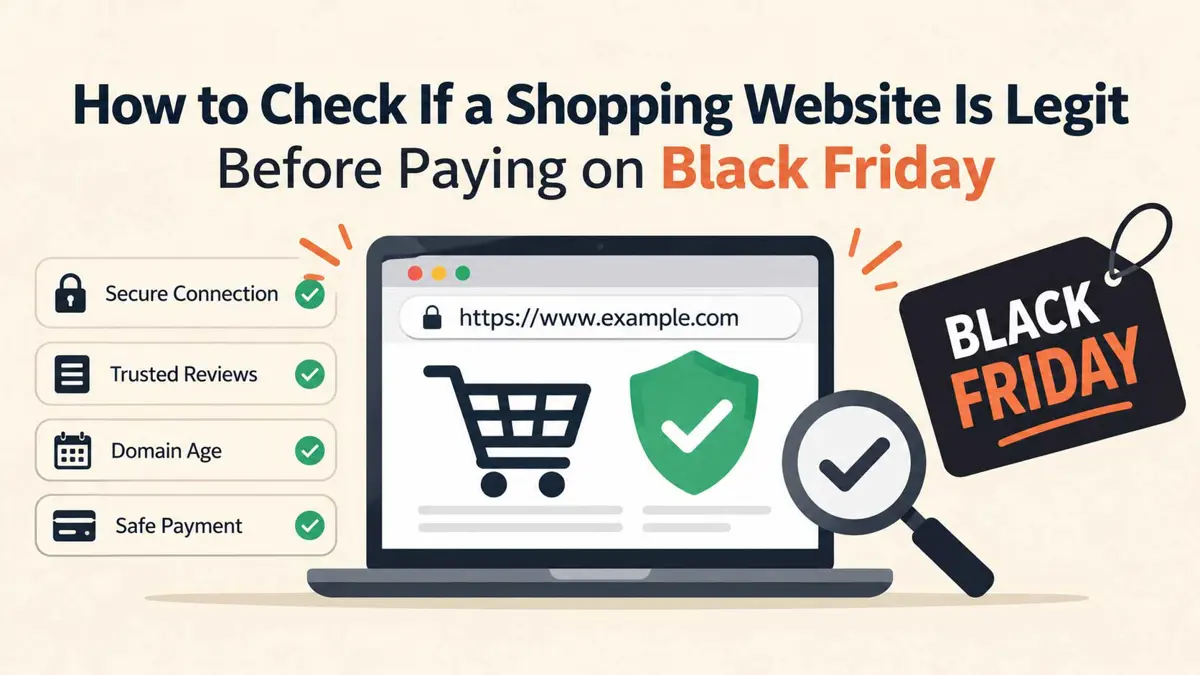
Shoppers who want to check if website is legit before paying can run seven quick checks in about five minutes, and none needs special software. Fake stores spike before Black Friday, which falls on November 27, 2026, with Cyber Monday on November 30. Saganote verified the sources below on November 11, 2026.
Fake Stores Multiply Before Black Friday
ConsumerAffairs reported on November 20, 2025, citing NordVPN data, that fake Amazon sites rose 232% in October from September, fake stores across all shopping sites rose 250%, and fake eBay pages rose 525%. NordVPN is a vendor, and the article does not describe its method. Treat the numbers as direction, not measurement.
Wider numbers come from the FBI. Its IC3 homepage chart lists complaint-reported losses of $16.6 billion in 2024, up from $12.5 billion in 2023, which is a big jump. Those totals cover every type of internet crime, not only shopping.
Ads are one entry point. A November 2, 2026 item on the FTC's consumer alerts page asks people to tell the agency about imposter ads, and its snippet says scammers impersonate businesses in social media feeds, search results, and shopping platforms. Only the headline and snippet were read.
Seven Checks Before Paying
- Read the full web address. ConsumerAffairs gives lookalikes such as "amazn-deals.shop" and "amazon-black-friday.online"; on a phone, tap the address bar to see the whole address.
- Question the price. A popular item "40%-70% cheaper than everywhere else (and only on this one site)" is a warning, per ConsumerAffairs.
- Look at how it wants payment. Wire transfers, Zelle, Venmo, Cash App, or crypto, or a discount for a special payment link, are red flags.
- Test the contact details. Look for a physical address, a working email or phone number, and return and privacy policies.
- Read reviews off the site. Sort worst to best and read recent ones, since generic all-five-star reviews may be copied or AI-generated.
- Notice the pressure. Countdown timers and "limited-time" prompts push people to pay before thinking.
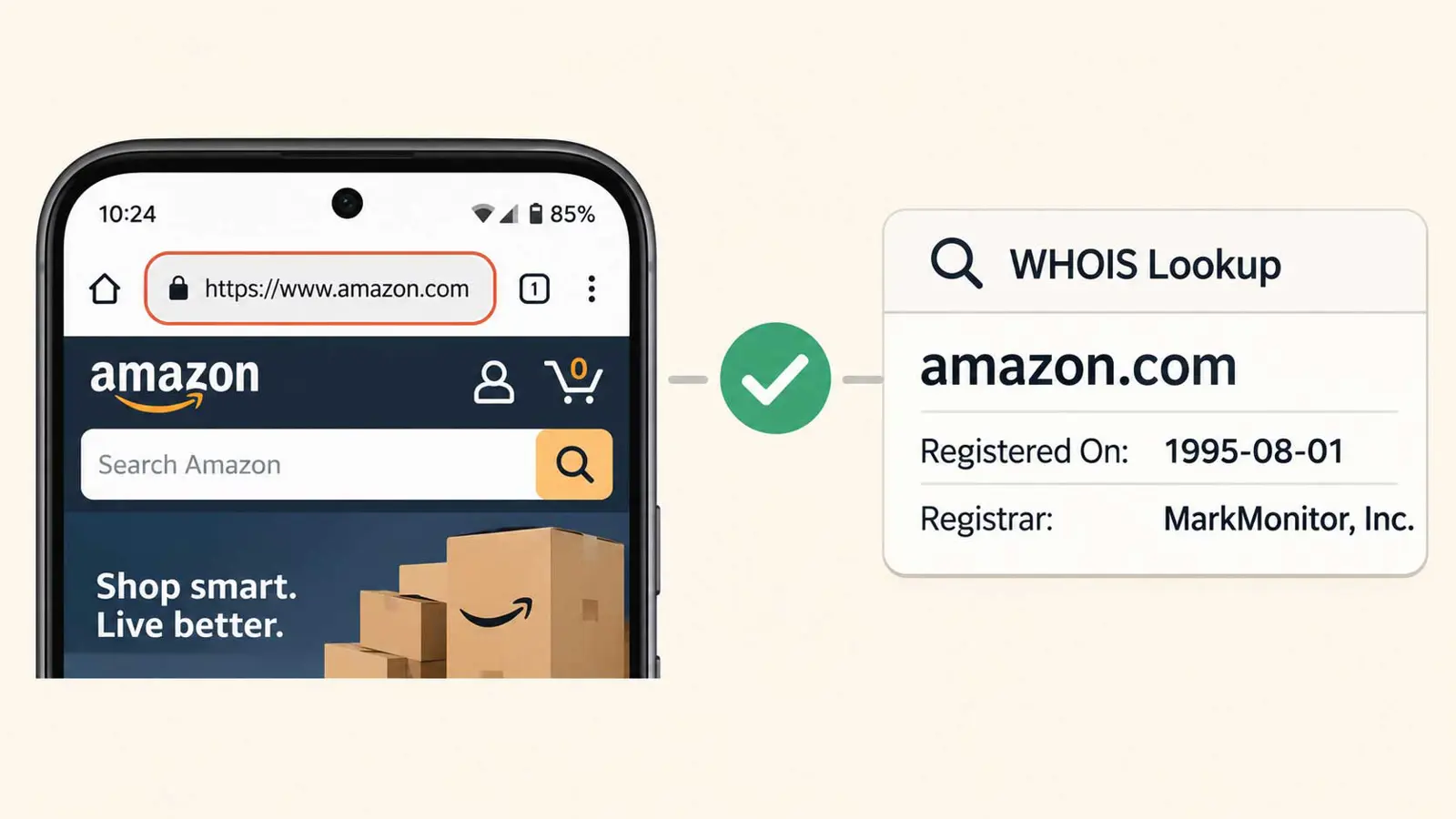
- Look up the domain. Registration records show when a domain was created and who the registrar is.
One check is rarely enough. ConsumerAffairs advises extra care for sites reached through email, text, or ads, and says a contact form with a vague Gmail address is a reason to walk away. Run all seven. Two failures mean stop.
Free Tools That Check a Domain
Whois.com's lookup says a record shows the registration date, expiry, registrar, and name servers, along with ownership and contact details when the registrar or registry does not hide them. Some registrars also offer privacy protection that masks contact details, and some registries conceal information to comply with privacy laws. A hidden owner proves nothing alone. Records vary by registrar, and Whois.com says unsolicited contact using the data it shows is forbidden under its service rules.
ScamAdviser offers a URL checker described as checking any URL in seconds. Its homepage did not explain how the score is calculated. A score is a hint, not a verdict. Anyone using tools to check if website is legit should treat results that way, and ICANN's lookup page, whose description says it shows current registration data, works as a second opinion.
Link checkers are arriving on phones as well. Saganote's Truecaller Scam Checker report says the tool follows shortened links and redirects, labels results Safe or Potential Fraud, and works on the web without sign-in, though its Android launch started in India. Google's Messages Enhanced protection guide covers clearer link warnings and Gemini Nano link checks on supported phones, and the Gemini scam protection report covers the wider feature.
Payment Methods That Offer Protection
ConsumerAffairs says credit cards offer the best fraud protections. Pages from the FTC and CFPB that would spell out dispute windows could not be read for this article, so a card issuer's own policy is the place to confirm deadlines. Saganote has not verified any dispute period.
Wallets add a layer, though not a guarantee. Saganote's Google Universal Cart report says Universal Cart can check out through Google Pay or the merchant's site, and its Google Wallet checks guide lists six checks before tapping to pay in a store. Prefer a method that can be reversed, and avoid sites that push anything else.
Apps need the same care. Saganote's TikTok Shop guide says to install from the official store and confirm the publisher is TikTok Ltd, and to avoid confusing the app with Seller Center. Shopping apps from unfamiliar publishers deserve the same publisher check.
A new domain can be genuine and an old one can be hijacked, and reviews can be faked at scale. Use the seven checks together, pay with a method that can be disputed, and stop if anything feels wrong. This article was verified on November 11, 2026.
Price and Deal Checks
Passing every step that helps check if website is legit does not guarantee a fair price. A real store can still run a fake discount. Saganote's guide to real Black Friday tech deals covers price history tools and says Which? found every one of 175 Black Friday 2024 deals at the same price or cheaper at another point in the surrounding six months. AI shopping answers need the same scrutiny, and Saganote's AI shopping assistant testing guide covers where they go wrong.
What to Do After Buying From a Fake Store
- Call the bank or card issuer, ask about blocking the charge, and ask for a new card.
- Change the password on any account that shared a password with the store, and turn on two-factor authentication.
- Watch statements for small test charges over the next few weeks.
- Report the site and any messages to the platform where the ad or message appeared.
- File a complaint with the FBI's IC3 at complaint.ic3.gov, and with the FTC if its reporting site is available.
Steps one to three come from ConsumerAffairs. Its advice followed a fake Amazon purchase. On the day of checking, ReportFraud.ftc.gov showed a notice that it was unable to offer the service due to a government shutdown and pointed to Consumer.ftc.gov. IC3's homepage says to file a report even when unsure whether a complaint qualifies.
Texts often follow a fake purchase. Saganote's delivery text scams guide lists where to forward fake notices, including 7726, and watch for texts about orders never placed. Retailers and agencies keep changing their rules, so check each site's current reporting page.
Frequently Asked Questions
Can a brand-new website still be legitimate?
Is a padlock icon proof that a store is real?
Which payment method is safest for new stores?
What should be done after paying a fake store?
Are free scam checkers accurate?