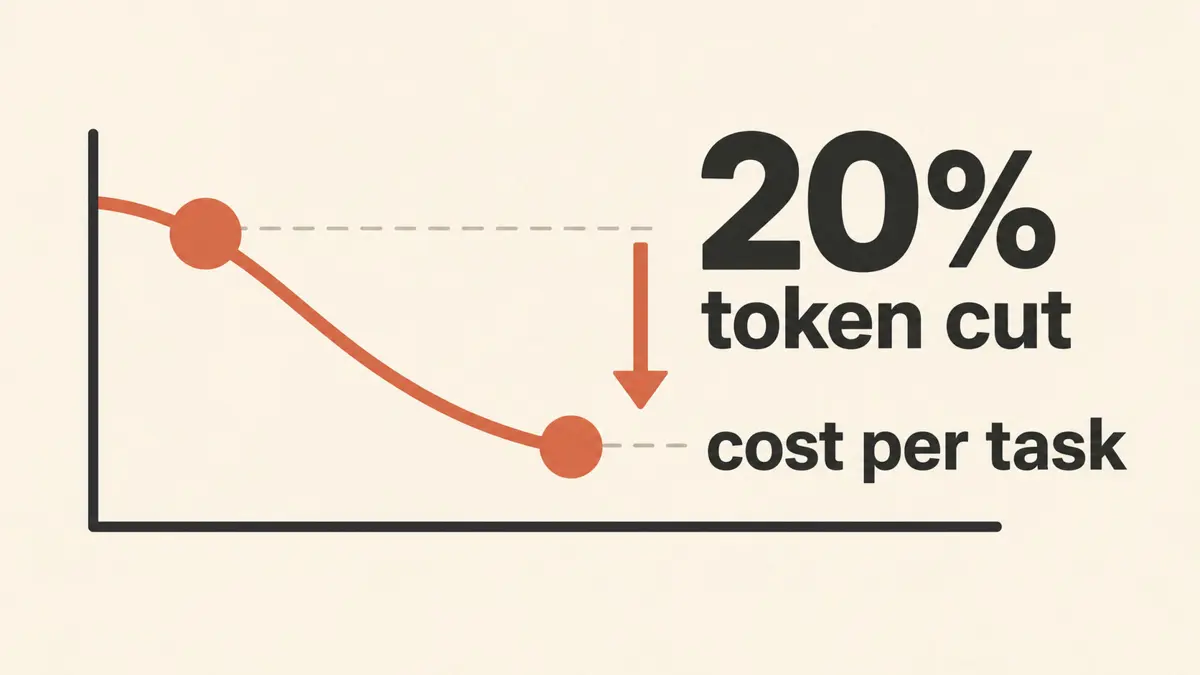
Fable 5.2 pricing fell 20% on Nov. 9, to $8 per million input tokens and $40 per million output tokens, yet Artificial Analysis measured a higher cost per task at the API's default effort. Effort decides which way the bill moves. Addy Osmani flagged the gap on X within hours of the launch, writing that the model "uses a lot of tokens," so per-task cost tends to land near Fable 5.1's despite the cheaper rate.
Anthropic cut every Fable rate by the same 20%: input, output, cache writes and cache reads all dropped from Fable 5.1's levels. A uniform cut has one consequence for the math. Any increase in cost per task has to come from the model consuming more tokens, not from a different price mix.
| Model | Input per million | Output per million | Cache read per million | Fast mode input / output |
|---|---|---|---|---|
| Fable 5.2 | $8 | $40 | $0.20 | $16 / $80 |
| Fable 5.1 | $10 | $50 | $0.25 | Not listed |
| Opus 5.5 | $4 | $20 | $0.20 | $8 / $40 |
| Sonnet 5.5 | $2 | $10 | $0.10 | Not listed |
Artificial Analysis Shows Fable 5.2 Cheaper Per Task at Low and Medium Effort, Costlier at High and Above
Artificial Analysis runs each model through the same Intelligence Index and publishes the cost and output tokens of every run, which makes per-setting comparison possible. Its figures for Fable 5.2 and Fable 5.1 appear below. Scores are index points.
| Effort | Fable 5.2 score | Fable 5.2 cost per task | Fable 5.2 output tokens | Fable 5.1 score | Fable 5.1 cost per task | Fable 5.1 output tokens |
|---|---|---|---|---|---|---|
| Medium | 56 | $3.80 | 41M | 43 | $5.56 | 49.2M |
| High | 62 | $9.08 | 85.3M | 47 | $7.54 | 69.6M |
| xhigh | 62 | $14.83 | 144M | 50 | $10.85 | 115M |
Medium is where Anthropic's launch claim holds. Fable 5.2 generated 41 million output tokens against 49.2 million for Fable 5.1, 17% fewer, and cost $3.80 per task against $5.56, 32% less. Anthropic made the claim for Medium, the default in Claude apps and Claude Code, so users of those tools start in the cheaper column.
High reverses the result. API default runs produced 85.3 million output tokens against 69.6 million, 23% more, and cost $9.08 per task against $7.54, 20% more. Fable 5.1 also defaulted to High, according to Anthropic's migration guide, which makes the team that changes only the model ID the one most likely to see its bill climb.
Fable 5.2 cost per task at High rose 20% on tokens that cost 20% less, which implies about 50% more billed token volume. Output tokens grew only 23%, so cache reads, cache writes and fresh input must have grown faster, a pattern consistent with longer agent loops that re-send context on every turn. Treat that as inference from published totals.
xhigh widens the gap to $14.83 against $10.85 per task, 37% more, for the same 62 index score as High. Anthropic's effort documentation advises stepping up to xhigh only for the hardest long-running coding work and only where testing shows a gain, and its migration guide warns that subagents at xhigh and max can account for a large part of a session's cost. Artificial Analysis data supports that caution.
Moving From Fable 5.1's High to Fable 5.2's Medium Cuts Cost 50% and Adds 9 Index Points
Lower effort is where the 20% price cut turns into real savings, because the extra capability of Fable 5.2 lets a lower setting beat Fable 5.1's higher ones. Each row pairs a Fable 5.1 setting with a Fable 5.2 setting and shows the change in cost per task and index score. Percentages come from Artificial Analysis figures.
| Fable 5.1 setting | Fable 5.2 setting | Cost per task change | Index score change |
|---|---|---|---|
| Medium (43, $5.56) | Medium (56, $3.80) | -32% | +13 |
| High (47, $7.54) | Low (54, $3.10) | -59% | +7 |
| High (47, $7.54) | Medium (56, $3.80) | -50% | +9 |
| High (47, $7.54) | High (62, $9.08) | +20% | +15 |
| xhigh (50, $10.85) | Medium (56, $3.80) | -65% | +6 |
Index gains do not guarantee workload gains. Anthropic's documentation tells developers to run an effort sweep on their own evaluations instead of carrying settings over from Fable 5.1, and to step down to Medium or Low only where quality holds, since a coding agent and a document pipeline can land at different points on the curve.
Opus 5.5 Halves the Token Rates, but Fable 5.2 at High Costs Less Per Task Than Opus 5.5 at Max
Token rates mislead. Opus 5.5 lists at $4 and $20 per million tokens, half Fable 5.2's rates, yet Artificial Analysis measured Opus 5.5 at max effort at $10.04 per task for a score of 59, against $9.08 for Fable 5.2 at High and a score of 62. Opus 5.5 generated 218 million output tokens in that run, against 85.3 million for Fable 5.2, which cancels its rate advantage.
Caveats apply. Artificial Analysis lists Opus 5.5 at max effort in the data collected here, while Anthropic sets Opus 5.5 to Medium by default, so Medium results could reverse the order. Anthropic's own FrontierCode 2.0 chart points the same way as the index: Fable 5.2 at High scores 45.3% against 45.5% for Opus 5.5's best result, at roughly half the cost per task.
Half-price siblings are an established pattern. Opus 5 launched at $5 and $25 against Fable 5's $10 and $50, and the Opus 5 versus Fable 5 benchmark comparison concluded most API workloads should move to Opus 5. Opus 5.5, launched Sept. 22 at $4 and $20, claimed typical workloads cost about 40% less than on Opus 5 in Anthropic's own testing.
Fast Mode Doubles the Rate for Up to 2.5x Output Speed and Skips Batch and Priority Tier
Fable 5.2 fast mode costs $16 per million input tokens and $80 per million output tokens, double the standard rates, for up to 2.5x higher output tokens per second. Anthropic says capability does not change. Speed gains apply to output rate, not time to first token.
Fast mode carries restrictions that change the bill. Batch API requests cannot use it, a Priority Tier commitment excludes it, and it has its own rate limit. Falling back from fast to standard after a rate-limit error causes a prompt cache miss, because requests at different speeds do not share cached prefixes, and a ClaudeDevs post says Claude Code bills fast mode through extra usage credits.
Rate cards alone show how the options stack up for a task with 100,000 input tokens and 20,000 output tokens, the same example that put a Fable 5 task at about $2 when free access ended after the June suspension. These are list-price calculations, not measured tasks.
| Setup | Input per million | Output per million | Cost for 100K input and 20K output |
|---|---|---|---|
| Fable 5.1 standard | $10 | $50 | $2.00 |
| Fable 5.2 standard | $8 | $40 | $1.60 |
| Fable 5.2 batch | $4 | $20 | $0.80 |
| Fable 5.2 fast | $16 | $80 | $3.20 |
| Opus 5.5 standard | $4 | $20 | $0.80 |
| Opus 5.5 fast | $8 | $40 | $1.60 |
Two matches stand out. Fable 5.2 batch pricing equals Opus 5.5 standard pricing, and Opus 5.5 fast mode equals Fable 5.2 standard pricing, so the cheaper model's fast mode costs the same per token as the pricier model's default.
Subscribers See Plan Limits and Effort Defaults, Not Token Rates
Subscribers on included plans do not see a per-token bill, so the 20% cut reaches them as limits instead. Anthropic says Pro plans and standard Team seats get Fable for up to 50% of weekly usage limits, and the company granted one to three Fable resets at launch based on subscription length. Medium is the default effort in the apps.
Rerouting adds a second variable. Fable 5.2 blocks about 55% fewer requests than Fable 5.1, per Anthropic, and sends blocked cyber queries to Opus 4.8 and blocked biology queries to Opus 5. Under Fable 5's credit billing in July, sessions rerouted by the safety classifier billed at Opus rates, and that classifier returned with Fable 5 on July 1.
A Six-Step Pricing Check Before Moving Workloads From Fable 5.1
A Fable 5.2 pricing review comes down to one test: run the workload at several effort levels and compare cost per task against quality. Each step below follows Anthropic's documentation.
- Re-run the workload on Medium and Low first, where Artificial Analysis shows cost per task falling.
- Compare High only after Medium, since High is the API default and cost per task rose 20% there in the index.
- Set a large max_tokens at High and above, because thinking tokens count toward the limit and a small value can stop a request before any text appears.
- Keep effort fixed within a conversation, because changing the top-level setting between requests invalidates prompt caching.
- Keep history append-only, since Fable 5.2 enforces a prefix check and edited earlier messages can return a 400 error.
- Budget for subagents at xhigh and max, where Anthropic says they can account for a large part of a session's cost.
Independent evidence has limits. Artificial Analysis blends many task types, Anthropic's benchmark figures are company-reported, and Osmani did not publish his test method, so each source covers one slice of real workloads. Production data will settle the question. Anthropic's migration guide tells developers to re-baseline cost and latency, so bills from real workloads over the coming weeks will show whether the 20% cut reaches budgets.
Frequently Asked Questions
What is Fable 5.2 pricing per million tokens?
Is Fable 5.2 cheaper than Fable 5.1?
What is the default effort for Fable 5.2?
Is Fable 5.2 cheaper than Opus 5.5?
Does fast mode work with the Batch API?