
A Black Friday tech deal is real when its price beats what the same product cost in the weeks before and after the sale. Retailers rarely show that history themselves. Price trackers, public rules, and a few repeat tricks make it checkable.
Studies Keep Finding That Genuine Lows Are Rare
Which?, the UK consumer group, checked 175 Black Friday 2024 deals against six months of prices on either side. Every one had been the same price or cheaper at some other point in that window, and about 35% were cheaper after the sale period ended. Which? concluded that "genuinely good deals are very rare."
Vendor studies agree, though they carry commercial interests. Visualping tracked 2,620 products from nine retailers between October 1 and December 1, 2025, and labeled 33% of the price changes it saw fake deals, priced on average 37% above the lowest observed price. A KnownHost study of 65 products, cited by How-To Geek, found that 29% rose in price before Black Friday, by an average of $51.
Samples differ by retailer and year. Even so, the pattern repeats, and checking any Black Friday tech deal takes only minutes, while skipping the check can cost real money on a laptop or a TV.
Price History Tools Compared
Two kinds of tools exist. History trackers keep a record of past prices, and page monitors start recording only after an item is added. Which?, How-To Geek, and other guides name the tools below, and the details come from those guides and the vendors' own pages.
| Tool | Covers | What it does | Notes |
|---|---|---|---|
| CamelCamelCamel | Amazon only | Price history for Amazon products and price-drop alerts | Named by Which? and How-To Geek |
| Keepa | Amazon | Price history charts, price-drop alerts, browser extensions | Free and paid tiers not confirmed here |
| Google Shopping | Many retailers | Compares prices across retailers | A comparison tool, not a long history |
| PriceSpy and Pricerunner | Many UK shops | Price comparison and history | Which? links the UK sites |
| Honey and Slickdeals | Varies | Named by How-To Geek | Details not confirmed here |
| Page monitors (Visualping, AlarmBot) | Any web page | Track a link and alert on change | History starts when tracking begins |
Coverage and pricing change. Each tool's own page decides what is available, and AlarmBot says its history starts only when a track is added, with no retroactive lookup. For a first check on an Amazon listing, a history tracker beats a monitor.
How to Read a Price History Chart
- Find the lowest price over the past 90 days and compare it with the sale price.
- Look for a spike shortly before the sale, which How-To Geek, DealStacker, and AlarmBot all describe as a common trick.
- Compare the advertised "was" price with the chart. Which? found an LG OLED shown at £2,499 that had sold at seven lower prices since.
- Widen the window beyond 30 days, as AlarmBot advises, so a short-lived bump does not hide the true floor.
- Check what happens after the sale ends, because Which? found about a third of deals cheaper afterward.
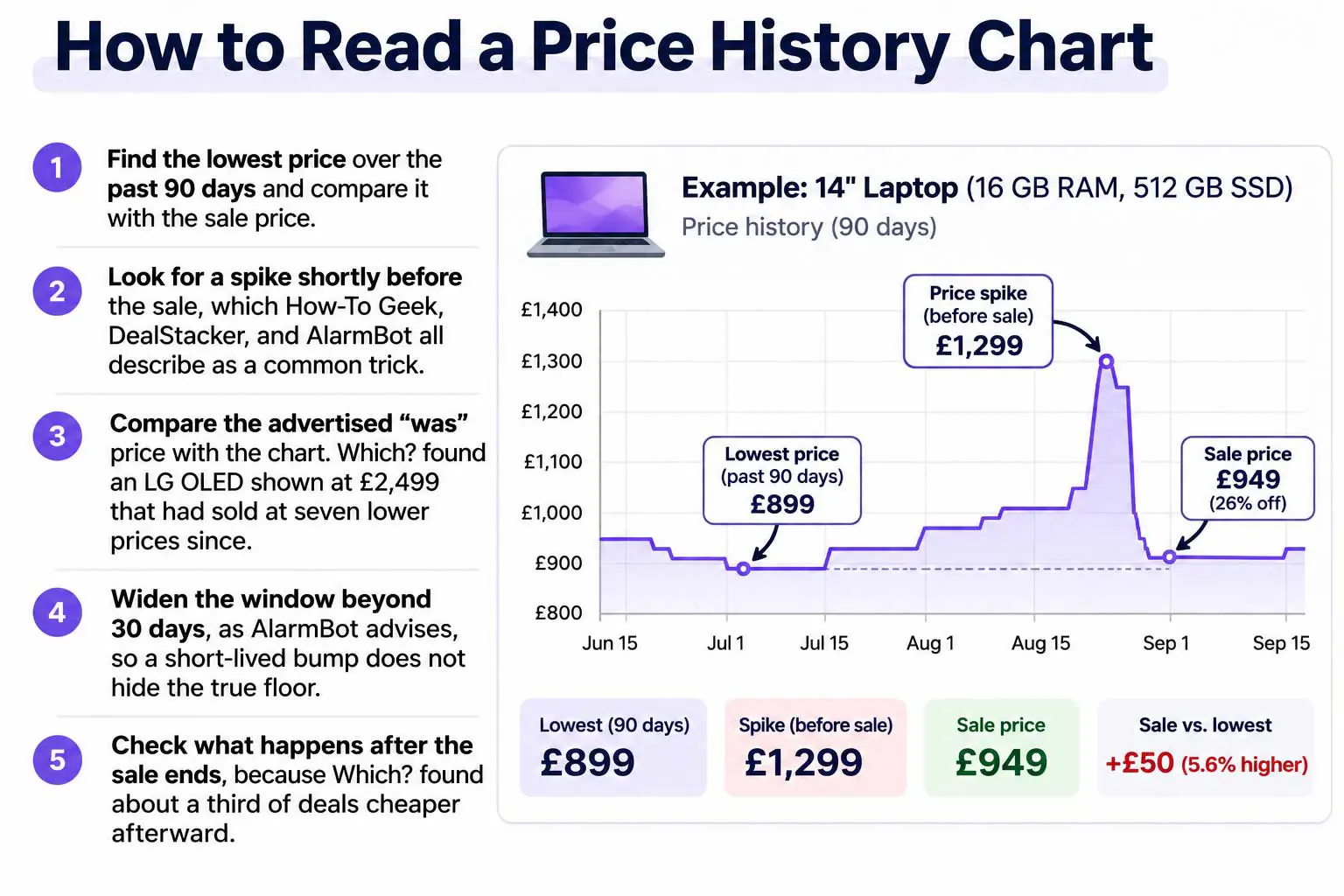
Flat history with a dip is a good sign. A sudden rise followed by a "discount" back to the old price is the pattern to avoid, because the sale price then matches what the product cost a month earlier. Charts also show whether a product dropped to this price repeatedly, which means the next sale could match it.
Fake Discount Tricks and Red Flags
- Raised, then cut: the price rises weeks before the event and returns to normal, which DealStacker and AlarmBot both describe
- A stale "was" price: Which? found some "was" prices dated from as far back as 11 months earlier
- An RRP the store never charged: Which? notes that an item does not have to have been sold at the RRP by that store
- A reset deadline: DealStacker says "the deadline is fake" when a countdown restarts
- A bundle that hides the price: How-To Geek cites a $1,000 TV with "free" accessories at $1,200, while the TV alone was $900 elsewhere
- A tiny reduction: the FTC's guides call a reduction too small to matter misleading, using a "reduced to $9.99" claim against $10 as the example
Tech has its own red flags. OrdinaryTech says advertised sequential speeds are "close to useless for comparison shopping" on SSDs, since a QLC drive can fall from a rated 7,000 MB/s to under 1,000 MB/s on sustained writes. That vendor sells PCs, so the point comes with interest attached, though the SSD behavior itself is widely reported.
What the Rules Say About "Was" Prices
US pricing rules start with the FTC. Its Guides Against Deceptive Pricing treat a former price as genuine when it is "the actual, bona fide price at which the article was offered to the public on a regular basis for a reasonably substantial period of time." Federal guidance sets no fixed day count, and it treats a price set to enable a large later reduction as fictitious.
Other markets differ. Under the EU's Omnibus Directive, the prior price shown with a reduction must be the lowest price in the preceding 30 days, according to AlarmBot. DealStacker says UK law bars misleading price comparisons and that the CMA can fine firms up to 10% of global turnover since April 6, 2025. Both are vendor summaries, so check the regulator for exact wording.
RAM and SSD Prices Change the Math in Late 2026
Memory prices are an extra factor this year. OrdinaryTech, citing a TrendForce forecast from September 30, expects conventional DRAM contract prices to rise 10% to 15% quarter over quarter in Q4 2026, NAND flash 15% to 20%, and enterprise SSDs 23% to 28%. Those are contract prices paid by module makers, not shelf prices, and the retail pass-through is "partial, delayed, and distorted by inventory."
A RAM or SSD discount in November may reflect stock bought months ago. Saganote's explainer on why RAM prices are so high covers the cause, and Google's Pixel price increase tied to RAM costs shows it reaching phones. These figures were not checked against TrendForce.
Timing also shapes value. A new model often follows an old one closely, as the MacBook Neo versus Neo 2 buy-or-wait comparison lays out. Pixel buyers can see launch pricing in coverage of the Pixel 11 event and price hike and every announcement from Made by Google 2026.
A Checklist Before Paying
- Confirm the exact model number, since a similar-looking model can carry a lower price for a reason.
- Open a price history for that model and note the 90-day low.
- Compare the sale price with the 90-day low and with the price after the last sale.
- Check the manufacturer's page for the original price, as How-To Geek advises.
- Add up bundles and accessories separately before counting them as savings.
- Compare monthly payments with the cash price, since financing deals such as Apple Upgrade leasing change what a device costs over time.
Page monitors record only from the day tracking starts. AlarmBot suggests starting six to eight weeks before a major sale, and a history tracker like Keepa or CamelCamelCamel can look back on Amazon listings immediately.
Black Friday 2026 falls on November 27. Cyber Monday follows on November 30, and trackers started now will have weeks of data on any Black Friday tech deal before either date. Which?'s finding that about a third of deals were cheaper after the sale suggests December prices deserve a look too.
Frequently Asked Questions
How can anyone tell if a Black Friday deal is real?
Which tools show Amazon price history?
Are Black Friday prices usually the lowest of the year?
What does the FTC say about "was" prices?
Do RAM and SSD discounts reflect current costs?