Why Are RAM Prices So High?
If you have recently looked for a new RAM kit, you may have noticed that memory is no longer as cheap as it used to be. Prices for some DDR4 and DDR5 products have increased significantly, raising the cost of PC upgrades and making memory a more important part of a new computer's budget.
The reason is not simply that more people are buying RAM. The memory industry is going through a much larger shift as manufacturers try to keep up with demand from artificial intelligence, cloud computing, and data centers.
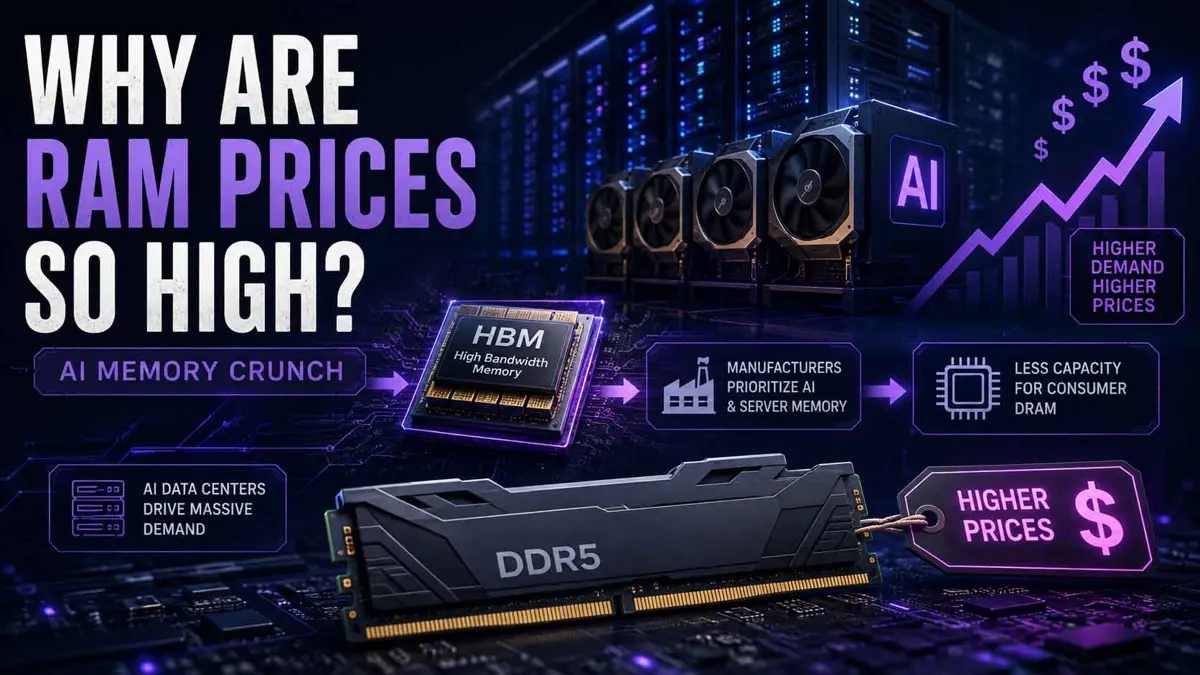
The biggest pressure is coming from the growing demand for high-bandwidth memory and server-grade DRAM. These products are essential for modern AI systems and can be more valuable to manufacturers than conventional consumer memory.
That means more manufacturing capacity is being directed toward AI and data-center products, leaving less supply available for the RAM used in everyday PCs and other consumer devices.
AI Is Changing the Memory Market
The simplest way to understand the current RAM price increase is to look at what is happening inside AI data centers.
Modern AI models require enormous amounts of memory. GPUs and AI accelerators need high-speed memory to process large datasets and model parameters efficiently, while servers also require large amounts of conventional DRAM.
As companies build more AI infrastructure, demand for these types of memory continues to increase.
The result is a chain reaction:
- AI companies build more data centers.
- Data centers need more GPUs and AI accelerators.
- AI accelerators require large amounts of high-bandwidth memory.
- Servers also need substantial amounts of DRAM.
- Memory manufacturers prioritize products with strong AI and server demand.
- Less manufacturing capacity remains available for conventional consumer DRAM.
- Tighter supply contributes to higher RAM prices.
This does not mean every gigabyte of consumer RAM is being directly used by an AI model. The issue is that the same memory industry is serving several markets at once, and manufacturers have limited production capacity.
What Is HBM and Why Does It Affect RAM Prices?
HBM stands for High Bandwidth Memory. It is a specialized type of memory designed to provide extremely high data-transfer rates while working closely with processors such as GPUs and AI accelerators.
HBM is particularly important for AI workloads because modern models move huge amounts of data between processors and memory. Faster memory can help AI accelerators keep their processing resources supplied with data.
HBM is different from the DDR4 and DDR5 RAM you install in a desktop PC, but the products are connected through the broader memory manufacturing ecosystem.
Manufacturers such as Samsung, SK hynix, and Micron have been investing heavily in HBM production because demand from AI infrastructure is growing rapidly.
As production resources shift toward HBM and server products, conventional DRAM can become more constrained. That is one of the main reasons the AI boom is affecting the price of memory that consumers buy for PCs.
Why Memory Manufacturers Are Prioritizing AI Servers
There is also a straightforward business reason behind the shift.
AI companies and large cloud providers are spending enormous amounts of money on data-center infrastructure. They need memory in very large quantities and often have long-term supply arrangements with manufacturers.
Memory companies therefore have a strong incentive to prioritize products that are in high demand from data-center customers.
This does not mean manufacturers have stopped producing consumer RAM. Instead, their production mix is changing as they try to balance consumer products with the much stronger demand for AI-related memory.
The shift is happening at a time when new memory manufacturing capacity cannot be added quickly.
Why Can't Companies Just Make More RAM?
One of the most common questions is why memory manufacturers cannot simply increase production and bring prices back down.
The answer is that semiconductor manufacturing is extremely expensive and takes years to expand.
A new fabrication facility requires large amounts of capital, specialized equipment, trained employees, and extensive testing before it can produce memory at scale.
Even existing facilities cannot instantly switch between different types of memory. Manufacturing processes, equipment configurations, packaging requirements, and product specifications all affect what a facility can produce.
HBM also has additional manufacturing and packaging requirements compared with conventional DRAM.
That means manufacturers cannot respond to a sudden increase in demand by simply turning a switch and producing millions of additional RAM modules.
New capacity can eventually help, but it takes time to plan, build, equip, and ramp up a semiconductor facility.
This is also why the memory market can move sharply in either direction. When supply becomes tight, prices can rise quickly. When manufacturers eventually add too much capacity, prices can fall just as dramatically.
Why DDR4 RAM Can Become Expensive Too
It might seem strange that older DDR4 memory can become more expensive when newer DDR5 memory exists.
Normally, older technology becomes cheaper as newer generations replace it. But memory pricing depends heavily on supply and demand, not simply on how old a technology is.
As manufacturers shift production toward newer memory products, they can reduce the amount of capacity dedicated to older generations.
At the same time, millions of existing PCs still use DDR4. Businesses, consumers, and system builders may continue buying DDR4 because replacing an entire platform can cost much more than upgrading the memory.
That can create an unusual situation where an older memory standard becomes more expensive because supply is shrinking faster than demand.
For people upgrading an existing DDR4-based PC, this can make the decision more complicated. A cheaper new platform does not necessarily mean a cheaper memory upgrade for an older system.
How High RAM Prices Affect PCs and Other Devices
Higher memory costs eventually move beyond individual RAM kits.
PC manufacturers have to account for memory costs when pricing laptops and desktop computers. If the cost of components rises significantly, manufacturers may have to absorb some of the increase or pass part of it on to customers.
The same principle applies to smartphones and other electronics.
Memory is an important component in almost every modern computing device, so sustained increases can affect the wider consumer electronics industry.
We have already seen signs of memory costs becoming a factor in device pricing. For example, RAM costs have already pushed up smartphone prices can be connected to our coverage of Google's Pixel pricing and the broader memory shortage.
AI infrastructure is also expanding the amount of hardware being built around data centers. Our coverage of massive AI data-center buildouts provides a broader look at the infrastructure spending behind this demand.
Will RAM Prices Come Down?
Eventually, RAM prices can come down, but predicting exactly when that will happen is difficult.
Memory prices depend on several moving parts, including production capacity, inventory levels, PC and smartphone demand, server demand, AI infrastructure spending, and manufacturers' production decisions.
Prices could ease if manufacturers bring significant new capacity online or if demand for AI and server memory slows.
On the other hand, continued AI investment could keep pressure on memory supplies for longer than a traditional PC memory cycle would suggest.
The important point is that the current situation is not simply a temporary shortage caused by consumers buying too many RAM kits. The memory industry is adapting to a major change in demand, and that transition takes time.
Should You Buy RAM Now or Wait?
If you need additional RAM for a PC you already own, waiting for a perfect price may not be worthwhile.
If your computer is running out of memory and the upgrade will noticeably improve your workload, buying the capacity you actually need can make sense.
However, there is little reason to buy significantly more RAM than you need simply because prices might rise further. Memory prices can change quickly, and future supply improvements could eventually bring prices down.
For a new PC build, it is worth comparing the total platform cost rather than looking only at the price of the RAM kit. Depending on the platform, buying newer hardware with a different memory standard may make more financial sense than investing heavily in an older system.
The best approach is to buy based on your actual workload, budget, and upgrade plans rather than trying to perfectly time the memory market.
What Happens Next?
The RAM market is likely to remain closely tied to the AI hardware boom.
As long as cloud providers and AI companies continue building large-scale infrastructure, demand for HBM and server memory will remain strong. Manufacturers will have to decide how much capacity to dedicate to those products while continuing to supply conventional DRAM for PCs, laptops, smartphones, and other devices.
New manufacturing capacity should eventually help improve supply, but semiconductor production cannot expand overnight.
That means RAM prices may remain volatile even as manufacturers invest in additional capacity.
The bigger story is that memory has become a critical part of the AI infrastructure race. What happens in AI data centers is increasingly affecting the price of the RAM installed in everyday computers.
FAQ
Why are RAM prices so high?
Is AI really causing RAM prices to rise?
Why is DDR4 RAM expensive?
Why does AI need so much memory?
Will RAM prices go down?
Should I buy RAM now or wait?
The Bottom Line
The answer to “why are RAM prices so high” is bigger than a normal PC upgrade cycle. AI data centers are creating enormous demand for HBM and server memory, while manufacturers have limited capacity and are shifting production toward those higher-demand products.
That leaves conventional DRAM competing for a smaller share of available manufacturing capacity. Until supply catches up with demand, RAM prices are likely to remain an important cost consideration for PC builders and other electronics buyers.