Sharper, faster, live. WeatherNext 3 launches today from Google DeepMind and Google Research - the most accurate global AI weather model to date according to independent live evaluations by Brightband, where it ranks first on the leaderboard. Previous AI weather models, including WeatherNext 2, trained on numerical weather prediction data with a six-hour lag and produced forecasts on a 25-kilometer grid every six hours. WeatherNext 3 generates a new forecast every hour, at up to 5-kilometer resolution, grounded in live geostationary satellite data refreshed continuously. Google Maps just expanded its Gemini AI to handle food orders and hotel bookings - WeatherNext 3 is the infrastructure upgrade underneath that same map layer.
Takeaways
- WeatherNext 3 is live today in Google Search, Gemini app, Google Maps, Google Maps Platform Weather API, and Google Earth Engine
- Produces forecasts every hour at 5km resolution for temperature and moisture - five times sharper than WeatherNext 2's 25km grid
- Ingests live geostationary satellite mosaics instead of relying on six-hour-lag physics simulations
- Precipitation accuracy improved up to 60% versus NASA's IMERG satellite baseline, 30% vs MRMS, 10% vs rain gauges
- Forecasts 100-meter wind speeds and solar radiation for renewable energy planning
- Ranked first on Brightband's independent live weather model leaderboard
- Data available via BigQuery, Earth Engine, and Google Cloud Storage for developers and researchers
- Biggest gains in regions historically underserved by high-resolution models: Latin America, Africa, Asia-Pacific
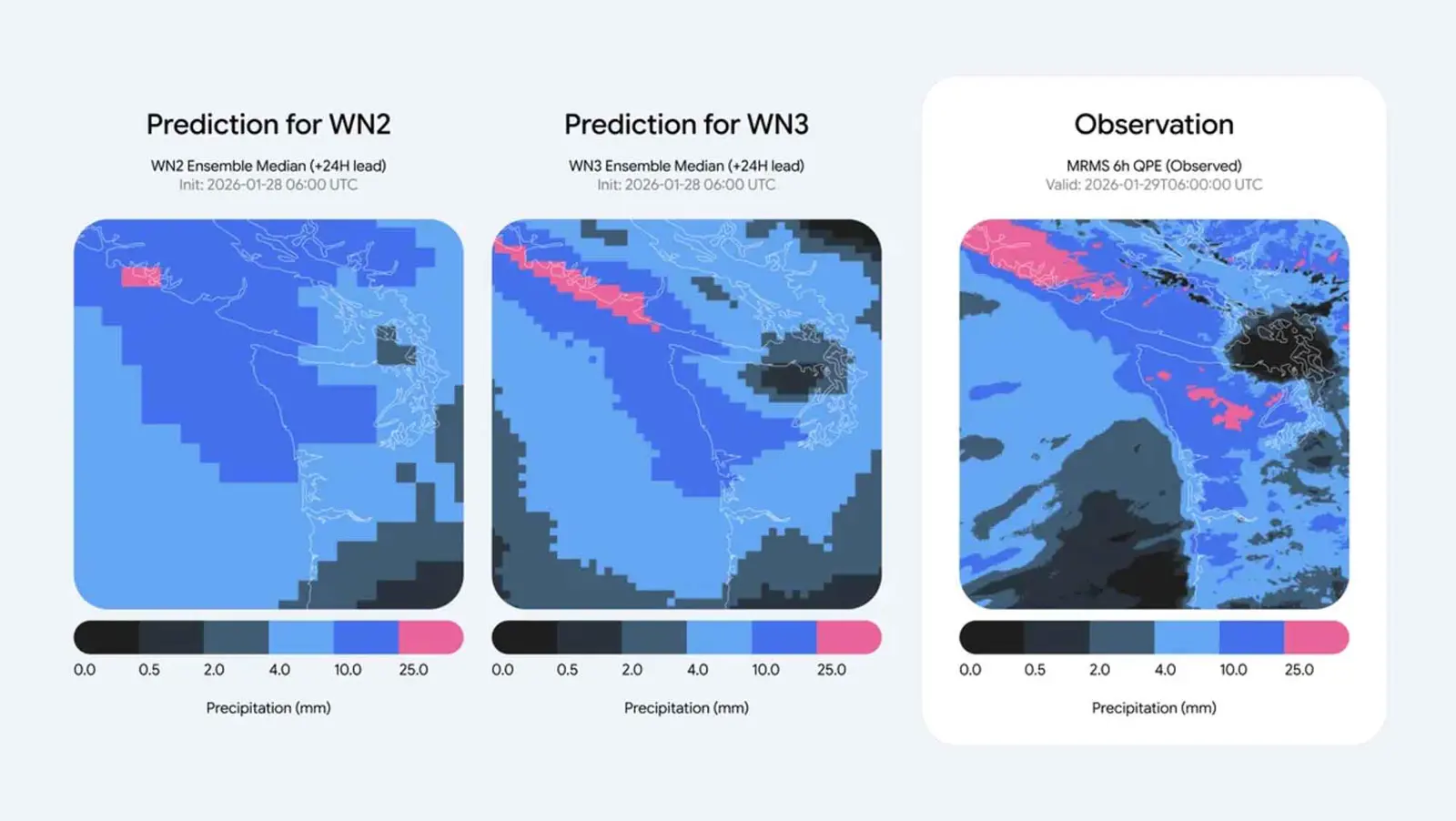
The resolution jump is substantial. WeatherNext 2 ran on a 25-kilometer grid with data refreshed every six hours. WeatherNext 3 runs key surface variables at 5 kilometers and atmospheric variables at 25 kilometers, updated every hour from live satellite feeds rather than reconstructed physics simulations. Training directly on sparse weather station data - not NWP model outputs - lets the model capture local topography effects like coastlines, mountain valleys, and elevation changes that traditional models average away. Precipitation forecasting sees the sharpest gain: the model trained on NASA's IMERG satellite data and a proprietary radar reanalysis dataset, producing storm boundary predictions that match real satellite ground truth instead of the smeared, pixelated estimates WeatherNext 2 produced.
WeatherNext 3 also introduces clean energy variables not present in its predecessor: 100-meter wind speed forecasts at turbine height and high-resolution solar radiation predictions. Grid operators and renewables developers can use these to predict clean energy output and match it against demand, instead of relying on separately built models. On the developer side, the model's output is queryable via BigQuery and Earth Engine, or bulk-downloadable from Google Cloud Storage with no model setup required. Waze added Gemini-powered personalized navigation this year - that same Gemini integration now runs on weather data five times sharper than before.
For most users the change surfaces quietly - more accurate rain timing in Search, better week-ahead forecasts in Maps. Google says day-or-more-ahead precipitation predictions improve by up to 50% globally, with the largest gains in regions that previously had limited access to high-resolution forecasting: Latin America, Africa, and Asia-Pacific. Google Cloud revenue jumped 82% in Q2 2026 as enterprises moved workloads there - WeatherNext 3's BigQuery and Earth Engine access gives developers a direct path to the same model powering consumer products. Traditional numerical weather prediction took supercomputers days to run. WeatherNext 3 runs in an hour on live satellite data.