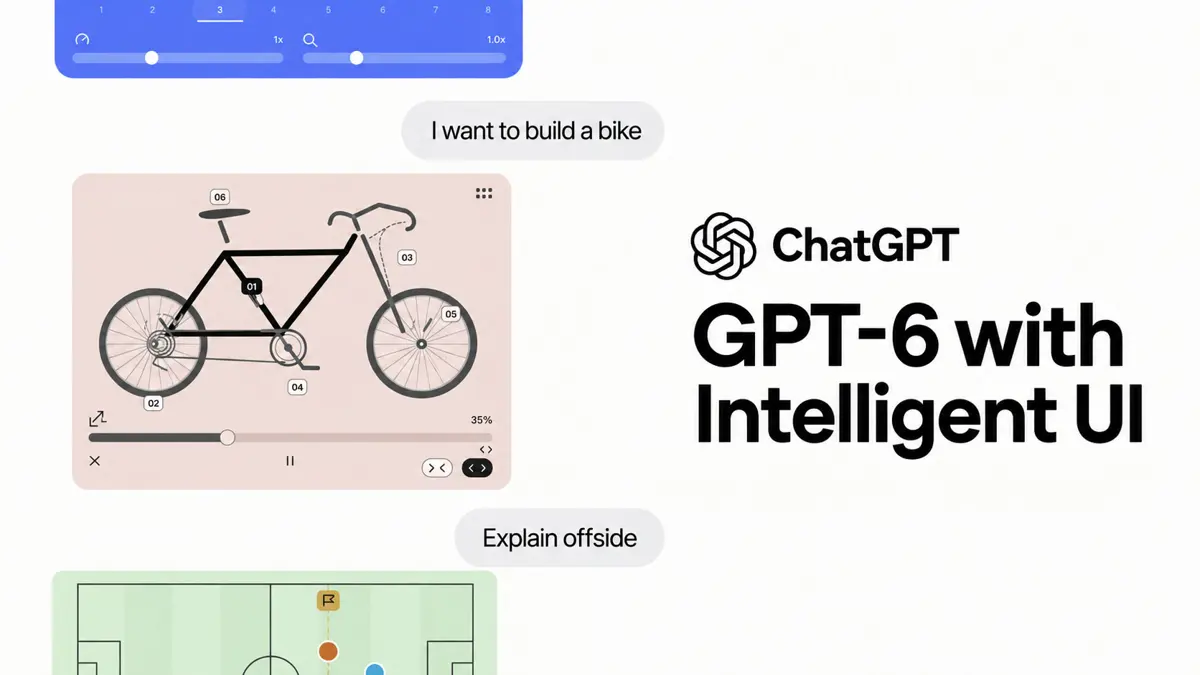
When I first looked at GPT-6, I expected the usual model upgrade: better answers, stronger reasoning, and fewer mistakes. What stood out to me was something else. GPT-6 can change the shape of the answer itself.
Instead of giving me a paragraph and leaving me to figure out what software I need next, ChatGPT can build an interface around the task. A question can become a calculator, a visual explanation can become interactive, and a plan can be presented in a form that is easier to explore.
That is why GPT-6 feels different to me. The interesting part is not simply that the model is smarter. It is that the answer can start behaving like software.
I Stopped Thinking About the Answer as Just Text
OpenAI calls the capability Intelligent UI. GPT-6 can combine text, visuals, buttons, forms, charts, and other interactive elements based on what the question needs. OpenAI's examples include a bill splitter, a retirement savings calculator, interactive lessons, a road-trip map, and a small game.
The important detail is that these interfaces are not presented as a separate product I have to find first. The interface can be part of the response. OpenAI says GPT-6 uses a library of native, streamable components and a compiler that progressively renders the interface while the model generates it. OpenAI's GPT-6 announcement describes this as a shift toward shaping the interface around what people are trying to do.
For me, that changes the question I ask before starting a task. Instead of thinking, "Which app should I open?" I can start by describing the outcome I want and see whether ChatGPT can build the right interaction around it.
The Calculator Is Not the Story
A generated calculator is not impressive because calculators are new. They are useful because the calculator can appear at the exact moment the calculation becomes relevant.
That distinction matters. A traditional app gives me a fixed set of controls designed in advance. GPT-6 can choose from different interface elements depending on the request. An explanation might benefit from an interactive diagram. A comparison might work better as a visual layout. A calculation might need sliders or fields. A small task might be better served by a simple tool.
The interface follows the question instead of forcing the question into a predefined interface.
This Connects to Where ChatGPT Was Already Going
I see the same direction in OpenAI's Data Agent that turns questions into Power BI and Tableau dashboards. That work moves beyond producing prose and toward producing something useful from the request itself. GPT-6 pushes that idea directly into the ChatGPT conversation.
It also feels different from OpenAI Dots and ChatGPT Work. Dots are about agents working continuously on tasks. Intelligent UI is about making the result itself interactive. One is focused on ongoing work; the other changes the interface through which the work is understood and completed.
That distinction is easy to miss if GPT-6 is described only as another AI model. The model is part of the story, but the more interesting product change is what the model can produce around the answer.
There Is Still a Trust Problem
This does not mean I would blindly trust a generated interface just because it looks polished. A calculator can contain a wrong assumption. A chart can be based on incorrect information. An interactive explanation can make a mistake feel more convincing because it is easier to explore.
That is why the habit of checking ChatGPT answers for accuracy becomes even more important when the answer looks like a finished tool. A polished interface can improve usability, but it does not automatically improve the underlying facts.
There is also a difference between a useful generated tool and dependable production software. I would use an interactive GPT-6 response to explore an idea, calculate something, understand a concept, or build a quick utility. I would still want proper validation before relying on it for something consequential.
What Actually Changed for Me
The biggest change is that I no longer have to think about ChatGPT as a place where I receive an answer and then move somewhere else to act on it.
The response can become part of the action. I can ask for an explanation and get something I can explore. I can ask for a calculation and get something I can manipulate. I can ask for a small tool and get an interface designed around that specific problem.
That makes GPT-6 feel less like a better chatbot and more like a layer between me and software.
I do not think this makes traditional apps disappear. A specialized application will still offer deeper controls, reliability, and workflows. But GPT-6 makes the boundary between an answer and an application much thinner.
That is the part I find most interesting. The future version of ChatGPT may not just tell me how to do something. It may build the small piece of software I need to do it right there.