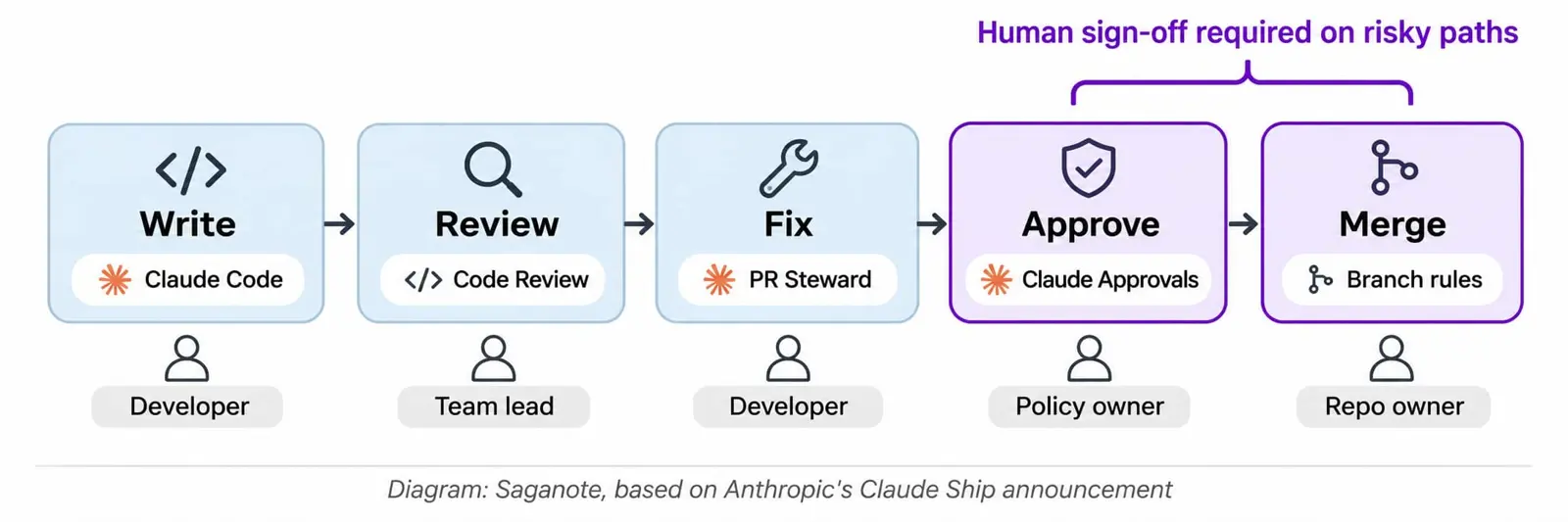
AI code accountability asks a simple question that tooling now makes urgent: when one family of models writes a change, reviews it and approves it, which person answers for the result? Anthropic's Claude Ship, announced Nov. 23, 2026, puts all three steps in one product. Responsibility has no model name.
The Chain of Custody: Who Does What in Claude Ship
| Step | Claude Ship component | Who answers |
|---|---|---|
| Write the change | Claude Code, with /ship to push and open a PR | The developer who ran it |
| Review the change | Code Review, generally available, with Quick, Standard and Deep levels | The team that set the review level |
| Fix feedback | PR Steward, in beta, comments after each push with undo steps | The developer, who can steer with @claude or stop it with @claude stop |
| Approve the change | Claude Approvals, in beta, applying a policy file stored in the repo | The admin who wrote the policy |
| Merge the change | Depends on the developer's permissions and branch rules | The repository owner |
Anthropic spells out the limits. Its announcement warns that Claude Ship "uses AI and may miss bugs, security vulnerabilities, or other issues," and notes that what can merge depends on the developer's permissions and the repository's branch rules. Responsibility therefore lands on whoever configures those rules.
Policy files are decisions. Claude Approvals applies an approval policy stored in the repository, works like a smarter CODEOWNERS file and can require human sign-off for certain changes. Whoever writes that file, usually an admin, makes the first accountable call about which changes need a person.
Separation of Duties: Why One Model Family Checking Itself Is a Weak Safeguard
Many teams already bar authors from approving their own pull requests. Authors miss their own mistakes. A model reviewing code from its own family may share more of those blind spots, though none of the sources reviewed for this piece tests that, so it stays a risk argument rather than a finding.
Vercel's chief executive Guillermo Rauch argues that "the model and the agent should not come from the same company," a position covered in the Vercel Eve and Sandbox analysis. Applied to review, the same logic asks whether the writer and the checker should share a supplier. Independent checks are harder to fool by accident.
Self-assessment is the weak link in any loop. A line in the loop engineering guide states the problem directly: "a model asked to 'write good code' will always believe it has." Verifiers that test concrete conditions, such as passing tests or schema conformance, give accountability something firmer than a model's own opinion of its work.
Humans misjudge their own results too. METR's randomized trial found developers who took 19% longer with AI still believed it had sped them up by 20%, so approvers who skim cannot be the only backstop either. Both kinds of reviewer need measurement.
Anthropic recommends observe-only mode first. Comparing the policy's verdicts with human reviewers' decisions for several weeks shows how often they disagree before the policy gets real authority, and a policy that uses Claude's review triggers a billed Code Review even in observe mode.
The Trust Gap: Developers Doubt AI Code and Often Skip the Check
Sonar's 2026 survey of more than 1,100 developers found 96% do not believe AI-generated code is functionally correct, yet only 48% always check it before committing. Sonar sells review software, a conflict The Register flagged, but other surveys point the same way, and Stack Overflow's 2025 survey found 46% of developers distrust AI accuracy, up from 31% a year earlier. Doubt without checking is an accountability gap.
Background agents raise the stakes. Agents keep working until a task is done or a person must decide, says the AI coding tools guide, which adds that review stays the human step. GitHub branch protection rules can stop Copilot from changing pull requests, as the Claude Code, Codex, Cursor and Copilot comparison notes, which makes repository settings an accountability tool and not only a safety feature.
Sensitive actions need a gate. An agent harness limits which tools an agent can use, can require human approval for actions such as sending messages or deleting data, and can record what ran, which the guide calls "the application's safety boundary." Slack Code adds a similar gate in chat, where higher-risk actions can require human approval and teams can archive finished channels as a record.
Code without an owner is the extreme case. Project Akrites would act as maintainer of last resort for critical open source packages with no active maintainer, a role 19 founding organizations, Anthropic among them, backed after AI tools surfaced flaws faster than maintainers could patch them.
Disclosure offers a second model. Substack lets creators add an "AI author's note" explaining how they used AI, and the same habit fits pull requests: a line in the description or commit message saying which tool wrote, reviewed or fixed the change. Substack launched the feature on July 22, 2026, as the Substack detection report explains.
A Working Rule for AI Code Accountability: AI Reviews Freely, Humans Own Risky Approvals
One rule covers most cases. AI may review every change and fix routine feedback, and a named human approves anything that is hard to undo. Customers describe a similar posture publicly: TELUS said Code Review caught real issues before human reviewers reached pull requests and that it will "keep a human in the loop."
| Change risk | AI role | Human role |
|---|---|---|
| Docs, comments, formatting | Review, routine fixes, policy approval | Weekly spot-check of a sample |
| Standard feature work in tested code | Standard review, findings resolved before merge | One human approval |
| Authentication, payments, data migrations, infrastructure | Deep review as a second opinion | Named owner approves; two people for irreversible changes |
| Dependency and security patches | Deep review plus verifier tests | Human approval, with AI involvement recorded in the PR |
- Name an owner for every path, so each approval has a person behind it.
- Require human sign-off on authentication, payments, data migrations and infrastructure.
- Run observe mode first and log every disagreement with human reviewers.
- Record AI involvement in the pull request description or commit message.
- Set spend limits, which admins can apply to Code Review and PR Steward, so cost never drives review depth.
- Revisit the policy each quarter against real incidents.
Critics of human gates have a fair point. Reviewers under load already skim, as the AI code review bottleneck analysis shows, so a consistent policy engine may beat a tired approver on low-risk changes. Tiers above grant that point where mistakes are cheap, and withhold it where they are not.
Regulated teams face extra limits. Claude Ship is unavailable to organizations using Zero Data Retention, the HIPAA configuration or customer-managed encryption keys, so those teams will need another route to the same discipline.
Frequently Asked Questions
What is AI code accountability?
Can Claude Ship approve pull requests on its own?
Who is responsible if AI-approved code breaks production?
Should AI review its own code?
What does observe-only mode do?
Policies face tests soon. Both Claude Approvals and PR Steward are in beta as of Nov. 23, 2026, so approval policies teams write now will meet real merges before either feature reaches general availability.