An AI code review bottleneck forms when AI tools generate pull requests faster than people can read, test and approve them. Anthropic's Claude Ship announcement, dated Nov. 23, 2026, states its goal plainly: to "ship code as fast as teams write it." Writing code is no longer the slow part.
Where the Time Went: Faros AI Measured 98% More Pull Requests and 91% Longer Reviews
Faros AI's 2025 telemetry study covered more than 10,000 developers across 1,255 teams. Teams with high AI adoption completed 21% more tasks and merged 98% more pull requests, while review time rose 91%, average pull request size grew 154% and bug counts rose 9%, as a 2026 arXiv paper summarizes the data. Organizational delivery metrics stayed flat.
| Source | What it found | Caveat |
|---|---|---|
| Faros AI, 2025 | 21% more tasks, 98% more PRs, 91% longer review | Vendor telemetry, and Faros sells engineering analytics |
| Google DORA, 2025 | 90% AI adoption, up from 76%; 2024 data showed 1.5% lower throughput and 7.2% lower stability per 25% adoption increase | Survey of about 5,000 people; 2025 found a positive throughput link but lingering stability costs |
| METR, 2025 | Experienced developers took 19% longer with AI but believed they were 20% faster | 16 developers, 246 tasks, early-2025 tools |
| Sonar, 2026 | 96% doubt AI code is functionally correct; 48% always check it | Sonar sells review software |
| Stack Overflow, 2025 | 84% use AI; 46% distrust its accuracy, up from 31% | Self-reported survey |
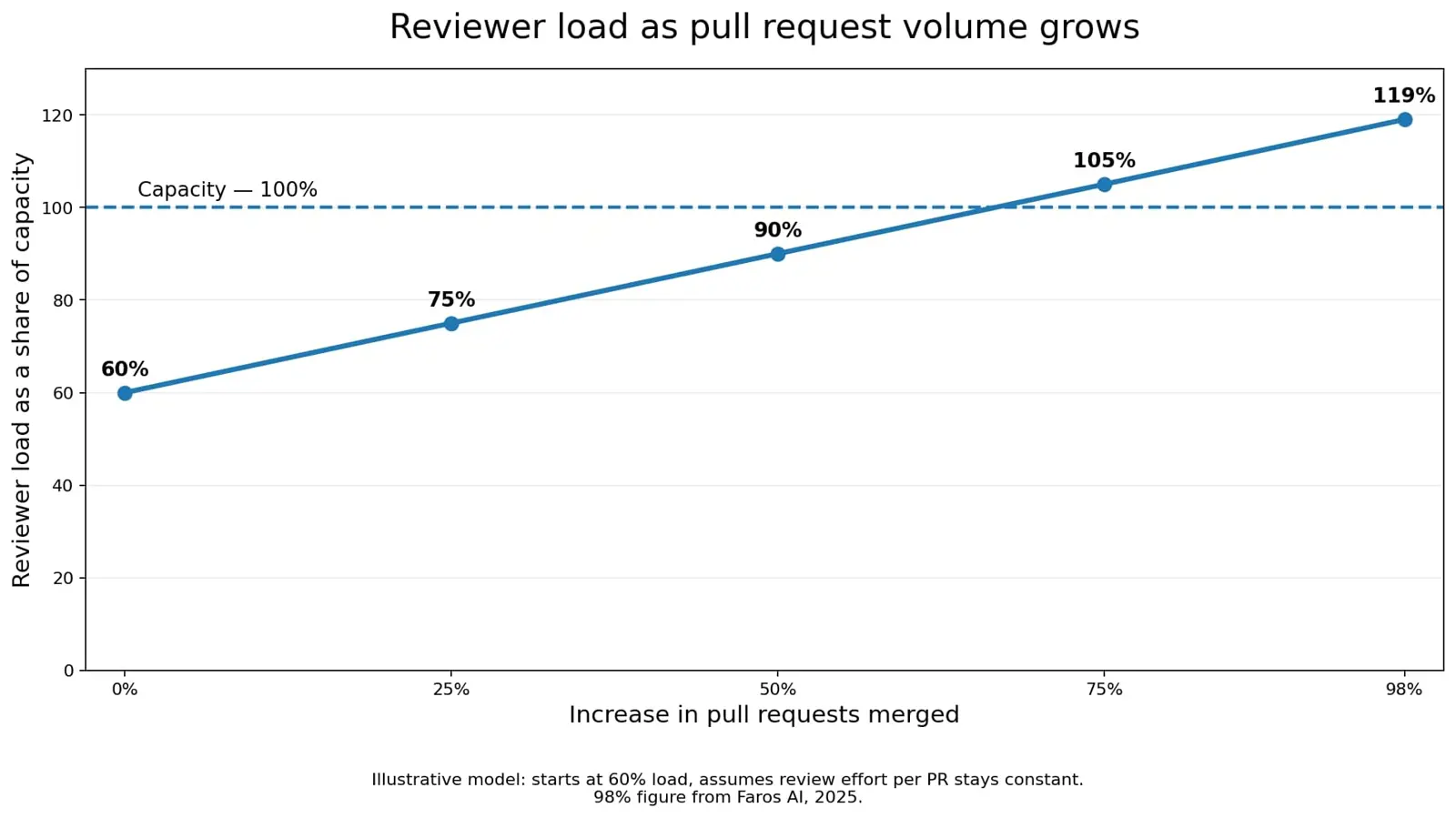
Queues explain the pattern better than speed does. Take a review team running at 60% of capacity and push 98% more pull requests through the same reviewers: demand lands near 119% of capacity, so the backlog grows every week instead of settling. Treat that as illustration, not measurement, because Faros also found larger pull requests, which would push the real load higher.
Why Reviewing AI Code Costs More Per Pull Request
Stack Overflow's 2025 survey found 66% of developers naming "AI solutions that are almost right, but not quite" as their top frustration. Cost sits in reading time. Almost-right code is the expensive kind to review, since each pull request demands a full read before it earns trust. Treating any generated app as unreviewed code is the advice in the vibe coding explainer, which also cites CodeRabbit's finding of about 1.7 times more major issues in AI co-authored code, a vendor figure it labels as directional.
Perception adds a second problem. METR's trial found developers expected a 24% speedup and still believed AI had sped them up by 20% after finishing tasks that took 19% longer, so a team's own sense of pace cannot stand in for measurement. Background tasks follow the same rule in the AI coding tools guide, which cites the study and states, "Review stays the human step."
Faros, Sonar and CodeRabbit all sell products that measure or fix review problems, and The Register called Sonar's own statistic "conveniently self-validating." The direction across surveys, telemetry and a randomized trial matches, but exact percentages should be read as estimates.
Skipped checks make the queue worse. Sonar found 95% of developers spend at least some effort reviewing, testing or correcting AI output, yet only 48% always check generated code before committing it. Half the pipeline relies on hope.
AI Reviewers Add Reading Too: A 41.2% Actionable Rate Means Most Comments Need Triage
Automated review shifts the bottleneck rather than removing it. In CodeRabbit's early test of Claude Sonnet 5.5, covered in the Sonnet 5.5 code review test, the model caught six of 13 known issues against four for Sonnet 5, with actionable precision of 41.2%. About six in 10 comments were not actionable by that measure, and each still needs a human glance.
Alert fatigue is the known failure. One interviewee in a 2025 study of LLM-assisted review said that when checks are not good enough, "you stop reading them." Speed and cost improved in the same test, with mean review time dropping to 5:27 from 9:55 and estimated model cost falling to about $0.47 from $1.16 per review.
Claude Ship packages the response in three parts. Code Review is generally available with Quick, Standard and Deep levels, PR Steward in beta handles failing CI checks, merge conflicts and review feedback, and Claude Approvals in beta applies a policy file stored in the repository. PR Steward comments after each push describing its changes and how to undo them, and by design it does not approve or merge pull requests.
How to Shrink the AI Code Review Bottleneck by Adding Capacity, Not Speed
- Measure reviewer capacity, not seat usage. The New Stack's April 2026 analysis argued that adoption counts track inputs, and that segmenting cycle time by reviewer shows where work waits.
- Cap pull request size. Faros found sizes up 154%, so smaller changes restore the read-through time reviewers need.
- Match review depth to risk. Quick passes suit low-risk edits, and Deep reviews belong on authentication, payments and data migrations.
- Hand verifiable checks to loops. The loop engineering guide says good verifiers test concrete conditions such as passing tests, while weak ones let agents declare success.
- Budget by cost per completed task. The Claude Haiku 5.5 analysis argues teams should count retries and human intervention, since cheaper tokens do not guarantee a cheaper workflow.
- Keep people at irreversible steps. An agent harness can require human approval for sensitive actions and record what ran.
Defaults differ by tool. Copilot's cloud agent opens pull requests for human review, and branch protection rules can stop it from creating or updating them, according to the Claude Code, Codex, Cursor and Copilot comparison. Teams weighing cheaper rivals can start with the Kimi Code versus Claude Code comparison.
Chat-based agents change where review happens. Slack Code puts coding agents in project channels where teammates can watch diffs, pause agents and review results before they ship, and higher-risk actions can require human approval. Visibility helps, though a channel full of diffs still needs readers.
Overload is not unique to company codebases. Project Akrites describes AI tools surfacing flaws in minutes while fewer than 5% of validated AI-found open source vulnerabilities received patches, with maintainers swamped by duplicate reports. Finding problems got cheap, and fixing them did not.
Frequently Asked Questions
Is the AI code review bottleneck real?
Why does AI-generated code take longer to review?
Can AI code review fix the bottleneck?
What does Claude Ship change?
What should a team measure first?
Evidence is still thin. Whether tools like Claude Ship shorten the queue is unproven, since Code Review is generally available and PR Steward and Claude Approvals are in beta. Independent measurements of review time and merge delays on these tools will settle the question over the coming quarters.