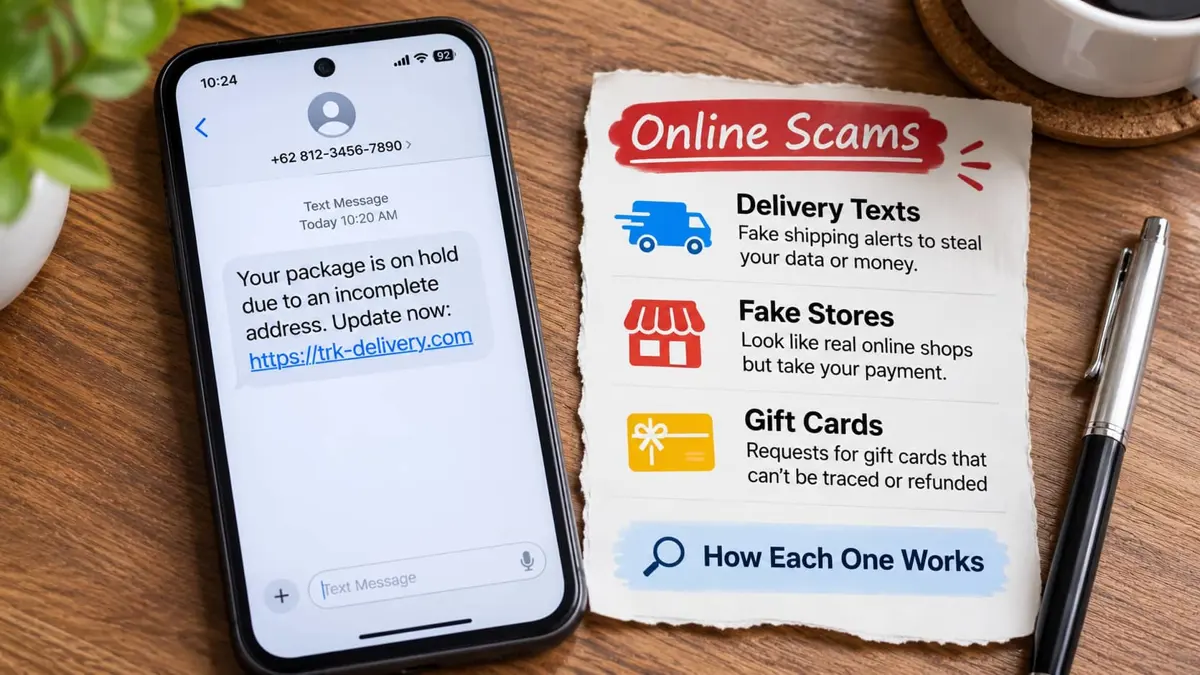
Online scams in 2026 follow a short list of patterns: a fake delivery text, a fake store, a gift card demand, or a call that rushes someone into paying. Saganote's series covers each pattern in its own guide, and this page maps them in one place. Figures below come from the FTC and the FBI.
How Big the Problem Is
Congress heard on March 25, 2026 that reported fraud losses reached $15.9 billion in 2025 from roughly 3 million reports, according to Crowdfund Insider's account of the testimony. Prior-year reports totaled 2.6 million, with more than $12 billion in losses. Quartz calls the 2025 total the largest ever recorded, roughly a quarter above 2024. Totals keep climbing.
Imposter scams were the most-reported category for a fifth straight year, at about $3.5 billion and roughly 1 million complaints, per Quartz, and about four in five of those complainants reported no loss. Median loss for victims was $700. Investment scams cost more, at $7.9 billion, per Crowdfund Insider.
Social media was the costliest contact method, with more than $2.1 billion in losses and about a third of victims who lost money, per Quartz. Saganote could not read the FTC's own release, so every figure here comes from press coverage. Treat them as secondhand.
FBI's 2025 Internet Crime Report counts 1,008,597 complaints and $20.877 billion in losses, up 26% from 2024. Phishing and spoofing drew 191,561 complaints and $215.8 million in losses, and non-payment or non-delivery drew 56,478 complaints and $503.4 million. Investment fraud was the costliest category at $8.65 billion. Separate systems produce separate totals.
Counts and dollars diverge. Phishing and spoofing produced the most complaints among the categories Saganote read but a small share of losses, while investment fraud produced fewer complaints and far larger losses. People 60 and older reported the most complaints, 201,266, and the largest losses, $7.7 billion.
Several categories matter to shoppers. FBI counted tech or customer support fraud at 47,794 complaints and $2.13 billion, government impersonation at 32,424 complaints and $797.9 million, and confidence or romance fraud at 23,159 complaints and $929.3 million. Business email compromise, a scheme that targets companies, reached $3.05 billion across 24,768 complaints. Personal data breaches drew 67,456 complaints and $1.31 billion.
FTC numbers come from press coverage of 2025 testimony, because the agency's own release did not load. FBI numbers come from the 2025 Internet Crime Report, whose text carried no release date. Neither agency's totals cover every victim.
Text and Delivery Scams
Delivery text scams use a fake missed-package notice to push a tap on a link. Saganote's delivery text guide reports that the Postal Inspection Service says USPS does not text consumers unless the customer started the request, and that FedEx says it never asks for payment or personal information to release a package. Lookalike domains such as fedx.com or fed-ex.com appear in fake FedEx texts, per FedEx. Urgency is the tell.
| Sign | Common in fake texts | What real contact looks like |
|---|---|---|
| Who started it | A package nobody ordered or expected | USPIS says USPS would not text a consumer unless the customer initiated the request |
| The link | Lookalike domains such as fedx.com or fed-ex.com, or a .shop domain, per FedEx | FedEx names fedex.com and its Import Tool as legitimate |
| Payment | A redelivery fee, an updated card, or personal data, which the FTC says legitimate companies do not ask for by text | FedEx says it may text a secure link to pay duties and taxes on international shipments |
| Pressure | A threat that an account freezes in 30 minutes, as ABC15 quoted | Carriers direct customers to their own tracking pages |
FTC's test is simple: ask whether the sender is a company the recipient has an account with, since a no means the message is suspect. Missing context is a warning. Real alerts normally relate to something the recipient bought or requested.
Forwarding a fake text to 7726 and reporting it at ReportFraud.ftc.gov are the FTC's two steps, and phones can filter some texts as well. Google Messages Enhanced Protection is an opt-in spam and scam mode, and Gemini scam protection in Google Messages targets sophisticated text scams. Truecaller's Scam Checker follows shortened links and redirects and labels results Safe or Potential Fraud, though its Android launch began in India. Filters help but miss some.
Holiday shipping gives these texts cover. McAfee, a security vendor, reported in December 2023 that 36% of Americans in its survey said they had fallen victim to an online shopping scam during the holidays, and 56% had seen fake missed-delivery notices. Those figures are vendor data, not a government count.
Fake Stores and Fake Deals
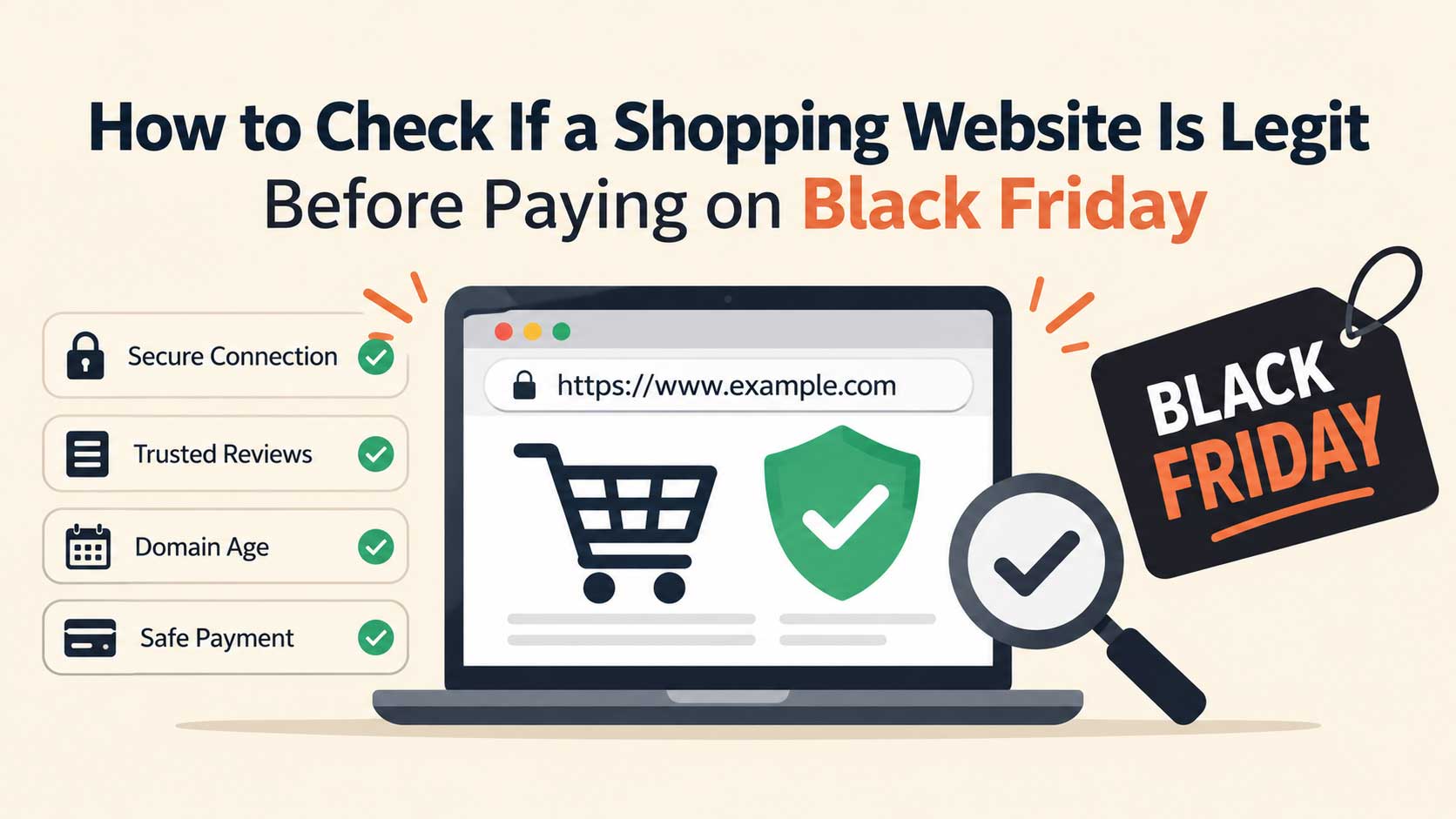
Saganote's guide to checking a shopping website lists seven checks, from reading the full web address to testing the contact details, and says no single tool or badge proves a site is real. ConsumerAffairs reported on November 20, 2025, citing NordVPN data, that fake Amazon sites rose 232% in October from September, and NordVPN is a vendor whose method the article did not describe. Treat the numbers as direction, not measurement.
- Read the full web address. ConsumerAffairs gives lookalikes such as amazn-deals.shop and amazon-black-friday.online, and on a phone, tapping the address bar shows the whole address.
- Question the price. A popular item 40% to 70% cheaper than everywhere else, and only on one site, is a warning.
- Look at how the site wants payment. Wire transfers, Zelle, Venmo, Cash App, or crypto, or a discount for a special payment link, are red flags.
- Test the contact details: a physical address, a working email or phone number, and return and privacy policies.
- Read reviews off the site, sorted worst to best, because generic all-five-star reviews may be copied or AI-generated.
- Notice the pressure. Countdown timers and limited-time prompts push people to pay before thinking.
- Look up the domain. Registration records show when it was created and who the registrar is.
ConsumerAffairs says credit cards offer the best fraud protections, but Saganote did not verify any dispute period, and pages from the FTC and CFPB that would spell out windows did not load. A card issuer's own policy decides deadlines. Two failed checks mean stop.
Real stores run fake deals too. Which?, the UK consumer group, checked 175 Black Friday 2024 deals against six months of prices on either side, and every one had been the same price or cheaper at some other point. Saganote's price history guide compares the trackers that settle the question in minutes.
Two kinds of tools exist. History trackers keep a record of past prices, and page monitors start recording only after an item is added, so a monitor cannot look backward. CamelCamelCamel covers Amazon only, per Which? and How-To Geek, and Keepa offers history charts and alerts for Amazon listings.
- Find the lowest price over the past 90 days and compare it with the sale price.
- Look for a spike shortly before the sale, which How-To Geek, DealStacker, and AlarmBot all describe as a common trick.
- Compare the advertised was price with the chart. Which? found an LG OLED shown at £2,499 that had sold at seven lower prices since.
- Widen the window beyond 30 days, as AlarmBot advises, so a short-lived bump does not hide the true floor.
- Check what happens after the sale ends, because Which? found about 35% of deals cheaper afterward.
Vendor studies point the same way, though they carry commercial interests. Visualping tracked 2,620 products from nine retailers between October 1 and December 1, 2025, and labeled 33% of the price changes it saw fake deals, priced on average 37% above the lowest observed price. Samples differ by retailer and year.
Adobe Analytics counted $257.8 billion in U.S. online holiday sales from November 1 to December 31, 2025, up 6.8% from 2024, with traffic from generative AI tools to retail sites up 693.4%, according to Talk Business & Politics. Black Friday alone reached $11.8 billion online. Adobe measures clicks, not savings.
AI shopping assistants add a new place for errors. Which? found in October 2026 that ChatGPT gave the correct lowest price and retailer for only 8 of 25 products, per Saganote's guide to AI shopping assistants. Every price needs a check at the retailer.
Marketplace sellers bring their own risks. Saganote's used iPhone guide says no single test proves a used iPhone is clean, and Apple says a buyer who reaches an iPhone Locked to Owner screen should not take ownership. Activation Lock, the IMEI, a second-SIM test, and Parts and Service History work best together. A clean IMEI result proves less than most sellers imply, since carriers can take days to months to add a stolen IMEI to shared databases, per ecoATM.
Apple's Activation Lock page, dated April 29, 2026, says the feature turns on automatically when Find My is set up and that the Apple Account password is needed to turn off Find My, erase the phone, or reactivate it. A real check happens on the phone. If setup asks for the previous owner's Apple Account after an erase, the seller must enter the password, or the previous owner can remove the device in a browser, per Apple.
Gift Card and Payment Demands
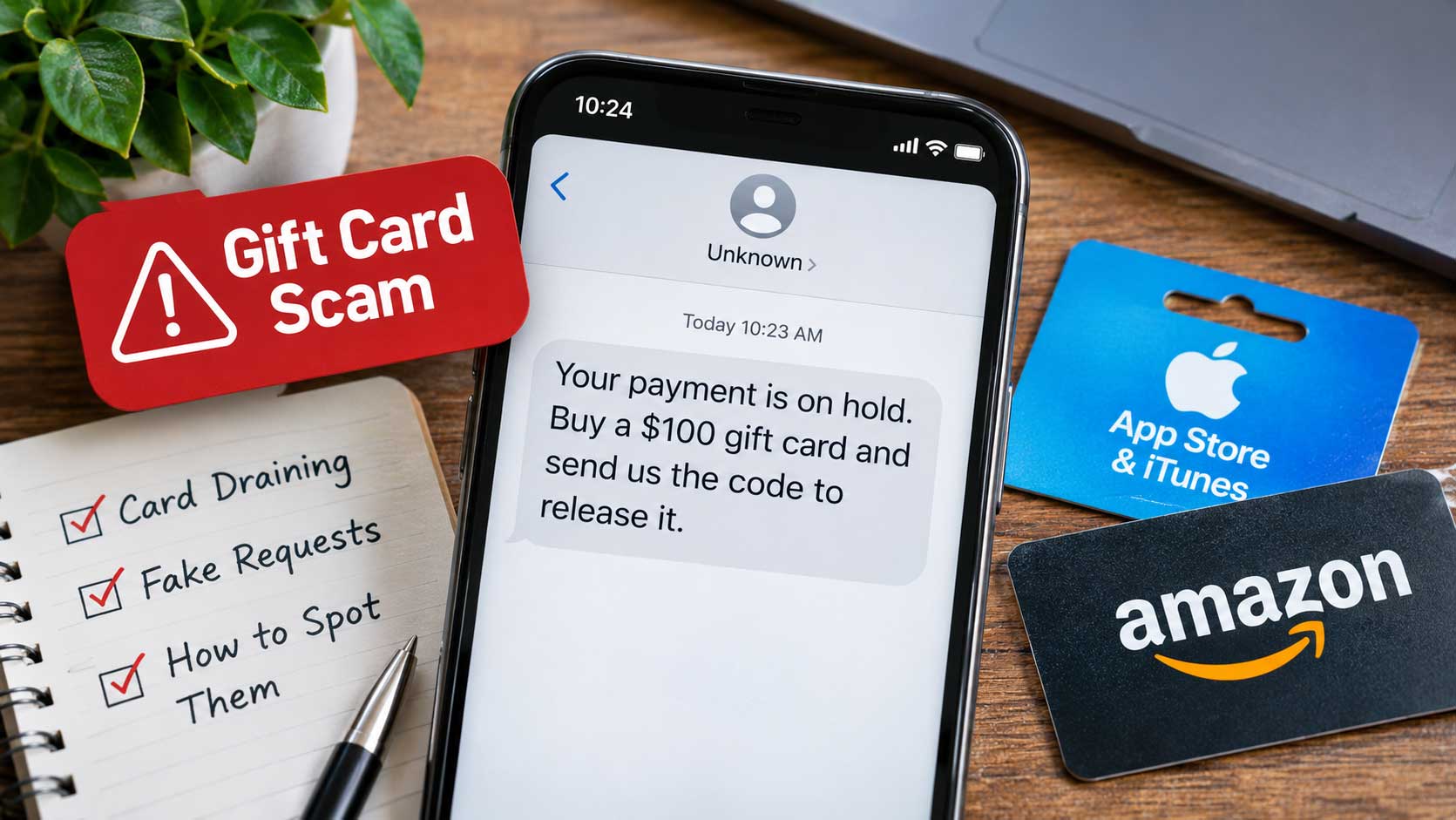
FTC's article, as covered in Saganote's gift card guide, boils the rule down to one line: no real business or government agency will tell anyone to buy a gift card to pay them. Card draining is the other half. National Cybersecurity Alliance guidance says scammers copy numbers and PINs from cards on the rack, put the cards back, and drain funds once a balance appears.
Checks at the rack come from the Retail Industry Leaders Association and the National Cybersecurity Alliance: look at the packaging and the PIN cover, prefer cards behind the counter, and keep the receipt. Speed matters. A drained card goes to the issuer first, then police, the state attorney general, and the FTC, per RILA.
Stories vary, from fake government agencies to tech support to family emergencies. Demands stay the same. FTC says the sender picks the card and the store, often Walmart, Target, CVS, or Walgreens, and may stay on the phone while the victim shops. Saganote's guide lists FTC-published issuer numbers with a note to confirm them against the card.
- Inspect the packaging. NCA says to look for peeling stickers, scratched-off PINs, resealed packaging, tears in the zigzag cuts around a secure pack's edge, or paper fibers at the border.
- Check the PIN cover. RILA says it should be smooth, intact, and not tampered with.
- Prefer cards kept behind the counter, which NCA says are less likely to be tampered with.
- Buy from reputable retailers and avoid discounted or secondhand cards on third-party sites, per RILA.
- Keep the receipt and the original packaging.
- Check the balance only through the website or phone number on the back of the card.
If a Link Was Already Tapped
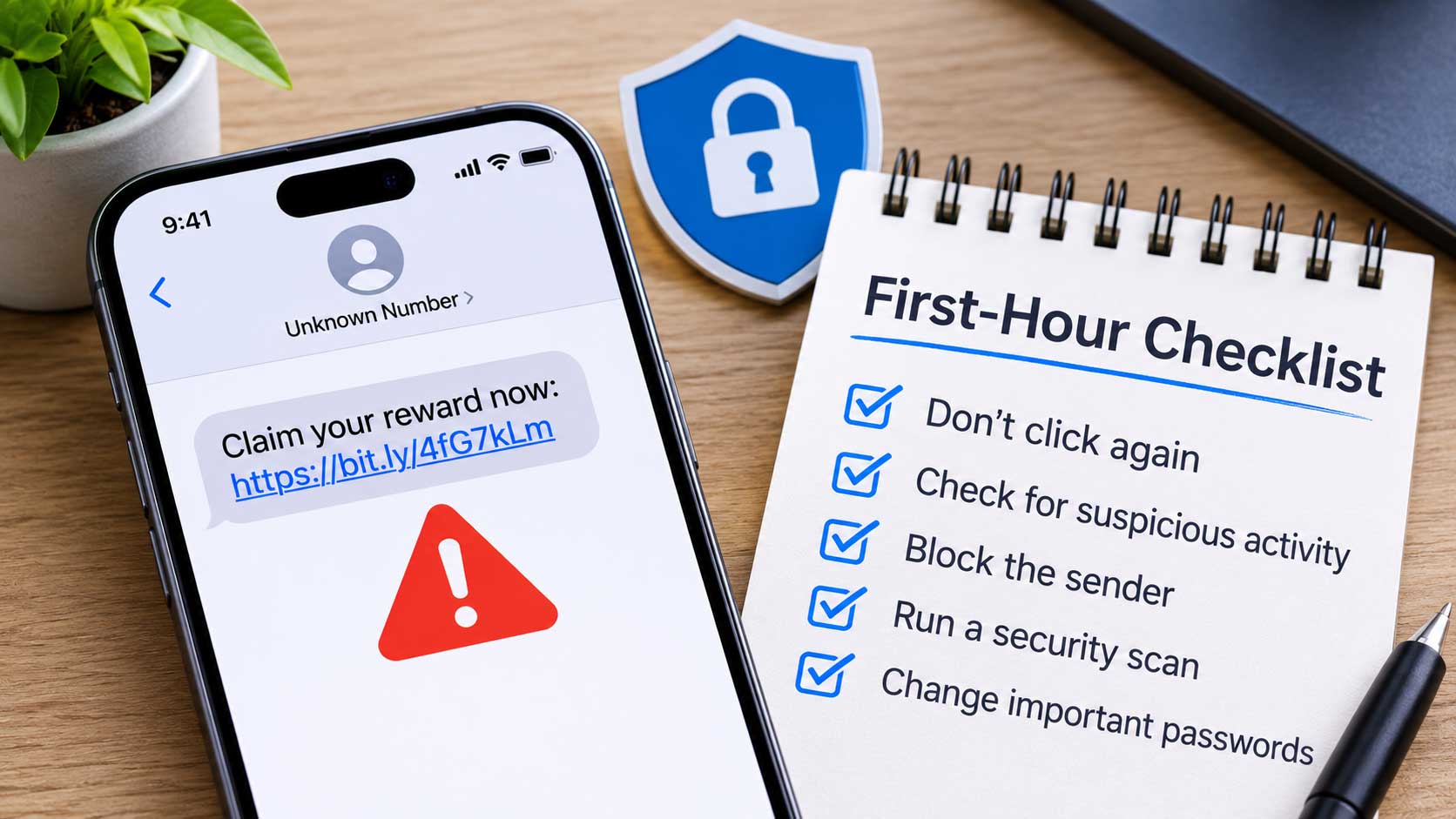
Saganote's first-hour checklist says to close the page, enter nothing more, delete the text, and match the next steps to what was shared. Card and payment problems go to the issuer or app, logins get a new password and two-factor authentication, and the text gets reported to 7726 and ReportFraud.ftc.gov. FTC's guidance organizes the steps the same way.
| What happened | What to do |
|---|---|
| Only tapped the link | Close the page, delete and block the text, and report it |
| Card details entered | Contact the card issuer using the number on the back of the card and ask for a refund |
| Paid by bank transfer | Report to the bank or credit union immediately and ask to reverse the payment |
| Paid by payment app | Report to the app immediately and ask for a reversal |
| Login details entered | Set a new strong password, change reused ones, and turn on two-factor authentication |
| Social Security number shared | Report at IdentityTheft.gov to get a recovery plan |
| Access to the phone or computer given | Update security software, run a scan, delete what it flags, then change passwords and turn on two-factor authentication |
Account Protections That Limit the Damage
A stolen login does less harm when a passkey or a second step guards the account. Saganote's passkey guide covers how passkeys work and which apps support them, and its Google passkey guide walks through a Google Account setup. Both are worth reading first.
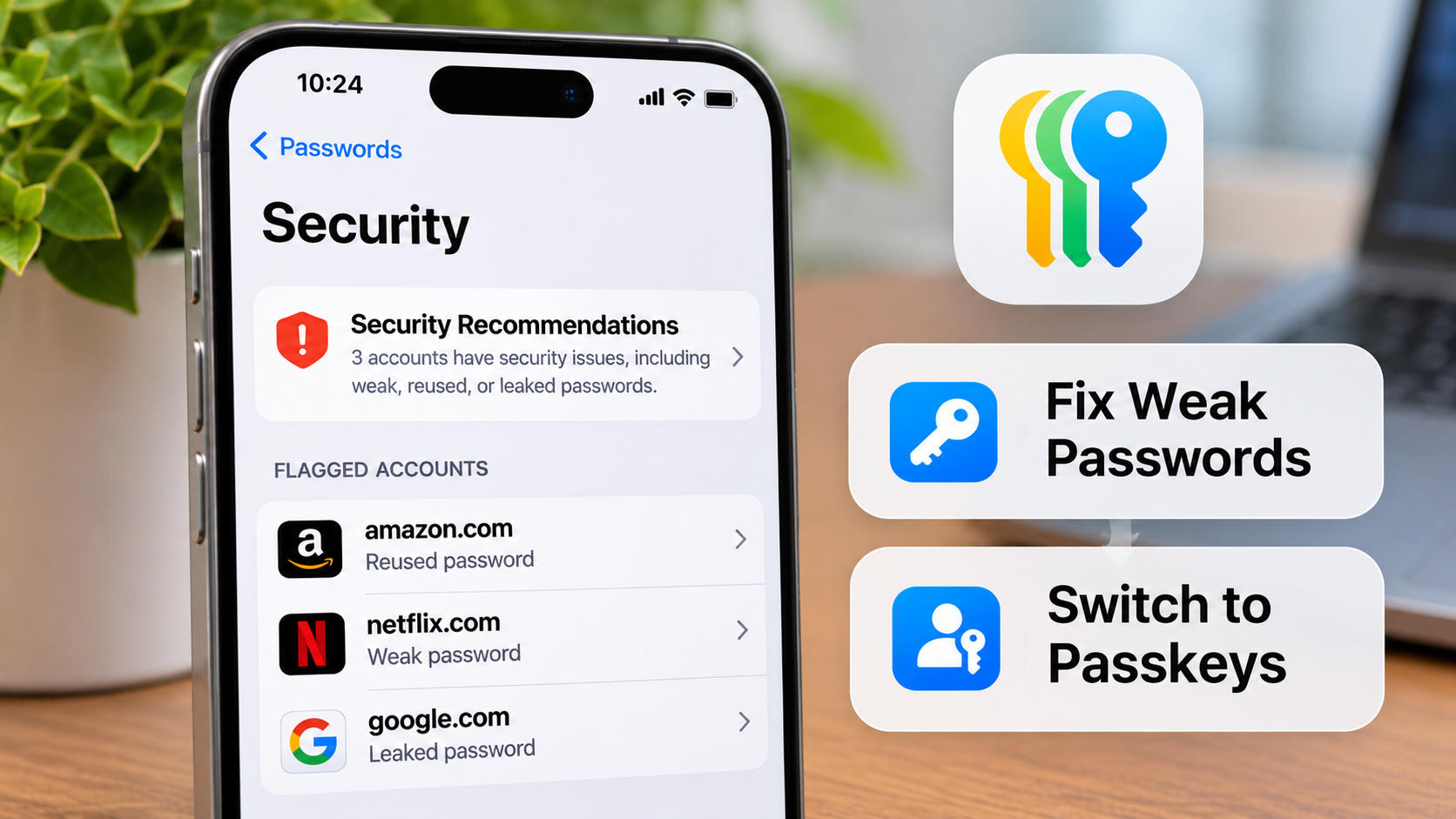
Saganote's iOS 27 Passwords app guide reports that Apple's automatic password fix had no release date as of November 2. Apple gave no date. Saganote's Authenticator guide covers moving codes to a new phone without a lockout, and its password manager comparison weighs prices, passkeys, audits, and platform fit.
Saganote's WhatsApp account security guide lists seven settings for chat accounts, and its Gmail access guide covers reviewing devices, connected apps, and recovery settings. Both are quick reviews.
Where to Report Each Scam
Reporting goes to different places depending on the scam. FTC takes reports at ReportFraud.ftc.gov for every scam in this series, while carriers, card issuers, banks, and payment apps run their own channels for losses that need a reversal.
| Situation | Where to report |
|---|---|
| Fake text | Forward to 7726, then report at ReportFraud.ftc.gov |
| Fake USPS text | spam@uspis.gov, per the Postal Inspection Service as covered in Saganote's delivery guide |
| Fake FedEx message | abuse@fedex.com, per the same guide |
| Drained or tampered gift card | The card issuer, the retailer, local police, the state attorney general, and the FTC, per RILA |
| Gift card paid to a scammer | The gift card company, then ReportFraud.ftc.gov, per FTC |
| Card details entered | The card issuer, using the number on the back of the card |
| Social Security number shared | IdentityTheft.gov |
Scam-by-Scam Reference
Use this table as a quick reference for online scams during the holiday rush: each row names a scam, a common sign, a first protection, and the guide that goes deeper. Scan it first.
| Scam | Common sign | First protection | Guide |
|---|---|---|---|
| Fake delivery text | A package nobody ordered, a lookalike link | Skip the link, use the carrier's own tracking, forward to 7726 | Delivery text guide |
| Fake store | A price far below everywhere else, odd payment methods | Run the seven checks and read the full web address | Shopping website guide |
| Doctored deal | A price spike before the sale | Check the price history | Price history guide |
| AI price error | A wrong lowest price or retailer | Confirm at the retailer | AI shopping assistant guide |
| Used iPhone | An iPhone Locked to Owner screen | Erase on arrival, match the IMEI | Used iPhone guide |
| Gift card demand | Insistence on gift cards as payment | End the contact, report to the FTC | Gift card guide |
| Card draining | Tampered packaging or PIN cover | Buy behind the counter, keep the receipt | Gift card guide |
| Tapped link | Details entered on a lookalike page | Match steps to what was shared | First-hour checklist |
Every Guide in This Series
Each guide below covers one scam in depth. Spokes run from price checks before Black Friday to the first hour after a tapped link, so the order below follows a shopper's path from deal to payment to recovery.
- How to Tell If a Black Friday Tech Deal Is Real: Price History Tools and Red Flags: Which? findings, six tools compared, and how to read a chart.
- Package Delivery Text Scams: How to Spot Fake USPS, UPS, and FedEx Messages: carrier rules, a real-versus-fake table, and phone filters.
- How to Use ChatGPT, Gemini, and Perplexity to Find Real Black Friday Deals: what each assistant reported and where prices went wrong.
- How to Check If a Shopping Website Is Legit Before Paying on Black Friday: seven checks and free domain tools.
- How to Check If a Used iPhone Is Stolen or Activation Locked Before Buying: Activation Lock, IMEI, and repair history checks.
- What to Do After Clicking a Scam Text Link: A First-Hour Checklist for iPhone and Android: steps matched to what was entered.
- Gift Card Scams in 2026: Card Draining, Fake Payment Requests, and How to Spot Them: rack checks and who to call after a loss.
- Google Messages Enhanced Protection: How to Turn It On and What It Does: an opt-in spam and scam mode.
- Truecaller Scam Checker Brings Scam Detection to Links, Numbers and Messages: link and message checks.
- How to Improve WhatsApp Account Security: 7 Settings: settings for chat accounts.
- Google Passkeys: How to Set One Up and Sign In Without a Password: a setup walkthrough for Google Accounts.
Anyone shopping this December can use the series as a checklist against online scams, and the three habits that recur across every guide are to check the sender, check the price, and check how the money moves. Saganote adds guides to this page as they publish. FTC asked for imposter ad reports in a November 2 alert, per its alerts page.
Frequently Asked Questions
What is the most reported kind of fraud?
Where should a fake text be reported?
Do real companies ask for payment in gift cards?
Does one check prove a store is real?
What comes first after tapping a suspicious link?