AI layoffs top the list of reasons US employers gave for cutting jobs in 2026, yet the evidence behind that label is thinner than the headlines suggest. Challenger, Gray & Christmas, the firm that tracks announced job cuts, tied 116,175 of them to AI through August, about 22% of its total. Researchers who check payrolls instead of press releases find almost no matching effect. That gap is the story.
Wednesday brought another case. Canva said it will cut 1,271 jobs, 22% of its staff, after growth slowed for the first time in a decade, according to a memo from co-founder and CEO Melanie Perkins that TechCrunch reported. TechCrunch's account does not describe AI replacing those workers.
Instead, Canva's explanation holds two AI threads. Rising AI costs led Canva to cut its revenue growth forecast from 30% to 20%, TechCrunch reported, even as it builds its own models to cut costs and reduce reliance on outside providers. Meanwhile, ChatGPT and Gemini now generate posters and presentations, the kind of output Canva sells. Early investors cut its valuation to about $35 billion earlier this year.
AI Took 22% of Announced US Cuts Through August, Then Its Share Dropped to 7%
Challenger counts stated reasons, not proven causes. AI rose from about 7% of announced cuts in January to almost 40% in May, then fell to fourth place in August, when it accounted for 3,462 of 52,881 cuts, roughly 7%. Technology employers kept cutting regardless, with 155,126 tech cuts logged through August.
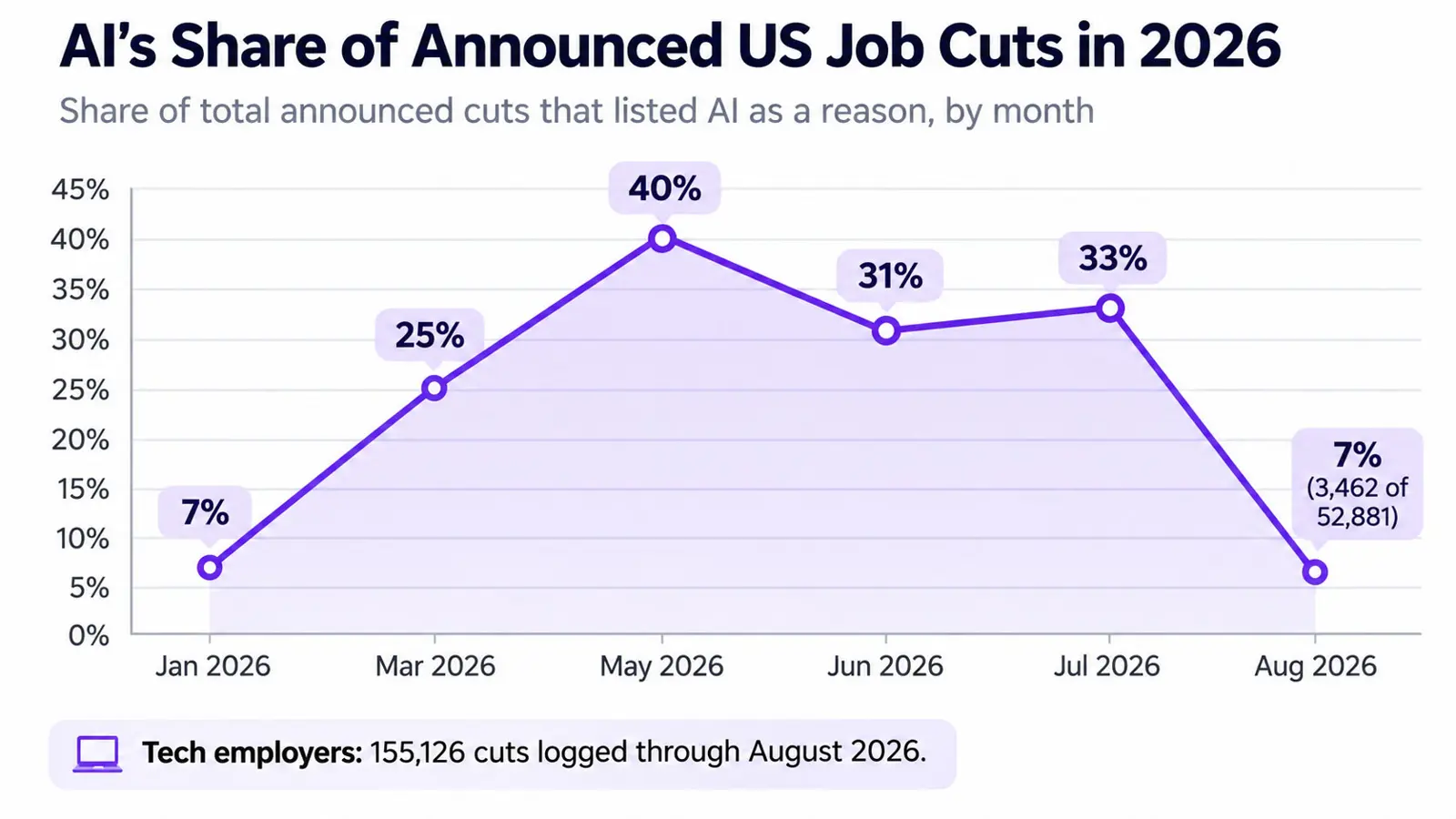
June's Challenger report showed the same tension: AI accounted for 31% of that month's cuts, while tech employers had cut 83% more people through June than a year earlier. Both numbers can be true. A label that swings from almost 40% of cuts to about 7% within three months probably reflects how employers describe layoffs more than any change in the work itself.
Nine Companies Across Four Continents Gave Different Reasons for Their Cuts
TechCrunch's running list of 2026 layoffs where employers cited AI names about 20 companies, and the stated reasons differ more than the headlines imply. By the Financial Times' estimate, US tech companies cut nearly 140,000 jobs by late July, with Amazon, Oracle, Meta and Microsoft behind almost 50,000 of them. Banks and insurers abroad followed.
| Company | Where | Cuts | Reason the company gave |
|---|---|---|---|
| Amazon | US | 16,000 corporate roles in January, after 14,000 in October 2025 | Fewer management layers, pandemic-era excess capacity, wider AI use |
| Oracle | US | 21,000 over 12 months (13%) | Annual filing says AI adoption may keep reducing headcount |
| Meta | US | About 8,000 (10%) in May | Faster AI development; about 7,000 staff moved into AI units |
| Microsoft | US | About 4,800 (2.1%) in July | Xbox margins and a shift to customer-facing engineers; says roles are not directly replaced by AI |
| Cognizant | Global, India largest share | Up to 15,000 | "Project Leap" restructuring toward leaner, AI-supported delivery |
| Mizuho | Japan | Up to 5,000 over 10 years | Long-term AI-driven streamlining plan |
| Wisetech | Australia | 2,000 (one-third of staff) | AI integration |
| Allianz | Germany | Up to 1,800 (announced November 2025) | AI replacing manual work in travel insurance |
| Canva | Australia | 1,271 (22%) | Slower growth, rising AI costs, chatbot competition |
Across the rows, AI layoffs carry three meanings. Oracle's filing and Mizuho's decade-long plan treat AI as a reason to hold fewer staff for years. Meta and Cognizant treat it as a reason to move people and money into new teams, while Amazon and Canva tie their cuts to management layers and slower growth, with AI as a cost or a competitor.
Microsoft Cut Xbox and Sales Roles While Funding 6,000 Embedded Engineers
Microsoft cut about 4,800 jobs in July, roughly 2.1% of its 220,000 employees, and Xbox is on track to lose about 20% of its staff this fiscal year. Xbox CEO Asha Sharma told employees that gaming margins run three to 10 times below comparable platform businesses. Cost pressure was explicit. Shares had already fallen 30% in nine months, erasing about $1.2 trillion in market value.
Chief people officer Amy Coleman said AI is changing how work gets done but that the eliminated roles do not directly give way to AI. Sales and consulting headcount is shrinking, while a $2.5 billion program called Frontier places 6,000 engineers inside customer organizations. Payroll is moving, not just falling. Microsoft president Brad Smith put it plainly: "Some things like coding require less time of software developers."
Over-Hiring, Tariffs and AI Bills Explain More Than Automation Does
Economists quoted by The Guardian in February said many AI-attributed layoffs trace to tariffs, pandemic-era over-hiring and profit targets. Martha Gimbel, executive director of the Yale Budget Lab, noted that ChatGPT arrived only three years ago, too recently for workforces to have adjusted to it. Critics have a name for it. OpenAI CEO Sam Altman has said some companies engage in "AI washing," blaming AI for cuts they would have made anyway.
Spending is the other half. Meta committed up to $145 billion to AI infrastructure for 2026, and Amazon, Microsoft, Alphabet and Meta together guided to about $700 billion in capital spending, nearly double their 2025 total. Payroll is among the few lines a finance chief can trim fast enough to offset those bills, which may explain why cuts and AI spending rise together. Canva layoffs fit the same arithmetic on a smaller scale: rising AI costs, a lower growth forecast, fewer people.
Surveys Show Almost No Net Employment Effect From AI, Yet CFOs Plan Deeper Cuts
Yale Budget Lab researchers found in May that AI exposure had an effect on employment statistically indistinguishable from zero. A National Bureau of Economic Research survey of thousands of executives in the US, UK, Germany and Australia found nearly 90% saw no difference to employment at their firms over three years. Gartner found only 20% of 321 customer service leaders had cut agent staffing because of AI. Those findings look backward.
Plans point the other way. A Duke University survey of CFOs at 750 US firms, published by NBER in March, found 44% planned AI-related job cuts in 2026. Researchers projected about 502,000 such cuts across the economy, roughly nine times the 55,000 AI-attributed layoffs recorded in 2025. Its authors also suggest CFOs credit AI with more productivity than the data supports.
JP Gownder, vice president and principal analyst at Forrester, warned that some CEOs are cutting 20% to 30% of staff while planning to backfill with AI. Replacement could take 18 to 24 months, he estimated, "if it even works." Cuts arrive first. Proof arrives later.
Klarna, Ford and Meta Show What Happens When the Replacement Does Not Arrive
Klarna replaced about 700 customer service roles with an OpenAI-built assistant and shrank from roughly 5,500 employees toward 3,400. Customers rated complex dispute handling lower, savings came in below projections, and the CEO said Klarna had leaned too hard on cost. Klarna began rehiring.
Ford reversed course in June. Its AI-driven quality control missed defects that experienced staff used to catch, J.D. Power scores fell, and Ford rehired 350 engineers.
Regret is common. Forrester found 55% of employers regret AI-attributed layoffs, and Gartner predicts that by 2027 half of the companies that blame headcount cuts on AI will rehire for similar functions under new titles.
Meta CEO Mark Zuckerberg told employees on July 3 that agent development "hasn't really accelerated in the way that we expected," about six weeks after Meta cut roughly 8,000 jobs and moved about 7,000 people into three AI divisions. Executives had misjudged the timing, he added. He gave the AI investments three to six months to deliver bigger returns.
Work Moves From Specialists and Support Roles Toward Generalists and AI Teams
Headcount tells half the story. Where the work goes tells the other half, and company disclosures point to the same few shifts.
| Work that shrinks | Where it moves | Evidence |
|---|---|---|
| Specialist roles | Broader generalist roles | Canva is merging its product, growth and platform teams and cutting "subspecialisation" (TechCrunch) |
| Sales and consulting | Engineers placed with customers | Microsoft's Frontier program |
| Customer support | AI agents plus smaller human teams | Salesforce cut customer staff from 9,000 to 5,000, per HR Director |
| Middle management, finance, legal, auditing | Flatter teams | Cloudflare's CEO said most of its roughly 1,100 May cuts came from these areas (TechCrunch) |
| HR administration | AI agents | IBM replaced about 200 HR roles with AI agents (TechCrunch) |
| Product and engineering roles | AI divisions | Meta moved about 7,000 staff into three AI units |
Patreon cut 93 jobs, 20% of its workforce, and CEO Jack Conte wrote that the company was not acting "because we believe AI replaces humans." He added that AI lets smaller teams do more, a shift that echoes Canva's plan for broader roles. Smaller teams, broader jobs.
One role keeps getting funded. Anthropic put $100 million into Claude Frontier Academy, which aims to train 10,000 deployment engineers by the end of 2027, and Microsoft's Frontier program embeds 6,000 engineers with customers. Both programs rest on the same premise: moving AI from pilot to production takes people.
Microsoft Warns of More Changes While Meta's Three-to-Six-Month Clock Runs Out
Coleman warned employees that Microsoft is "still early on this journey." More changes lie ahead. Microsoft is weighing annual voluntary exit programs, after about 30% of eligible US employees, roughly 2,600 people, accepted packages, and CFO Amy Hood said in April that headcount would decline year over year.
Meta set its own deadline. Mark Zuckerberg's three-to-six-month window, counted from July 3, closes between early October and early January, and Challenger's next monthly reports will show whether AI layoffs recover from their August drop. Canva has not said when its cuts take effect, which roles go or what severance workers will receive.
Frequently Asked Questions
Why did Canva lay off 1,271 employees?
How many US job cuts have employers blamed on AI in 2026?
What is AI washing?
Are companies rehiring after AI-driven cuts?