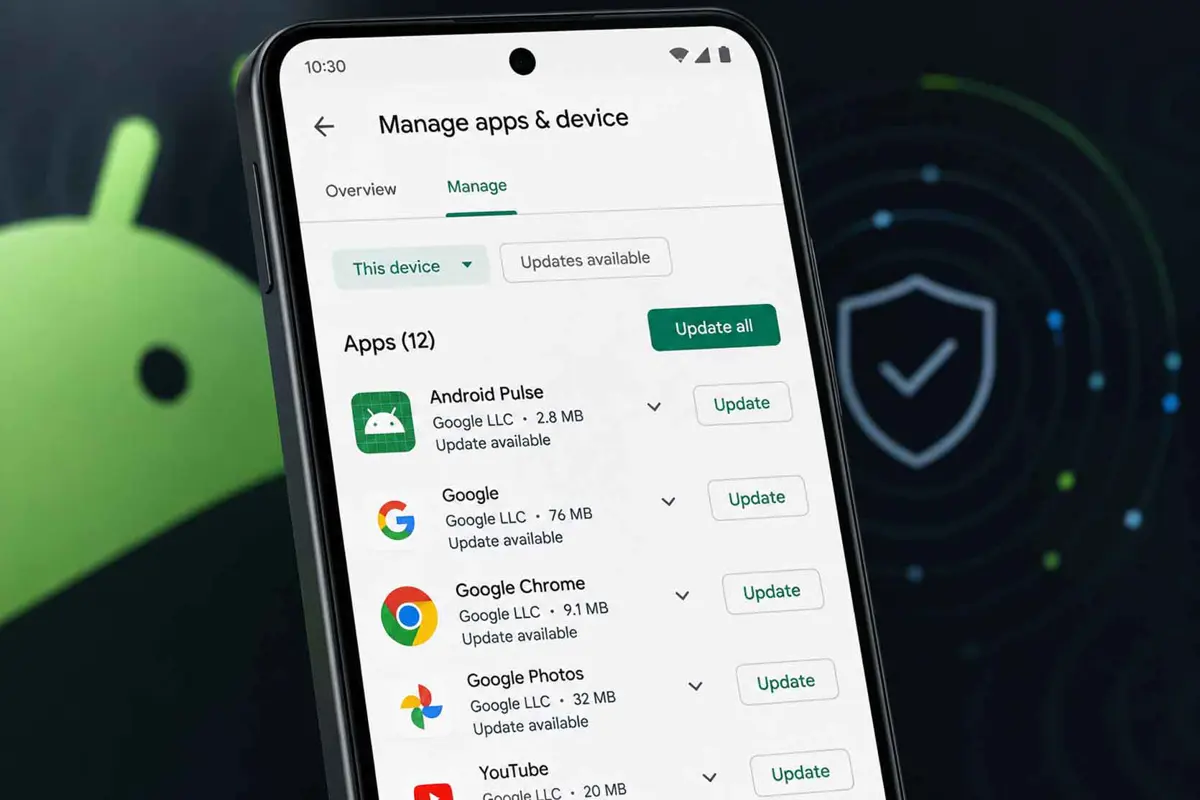
Android users are starting to see a strange new name in their Google Play update lists: Android Pulse. It looks like a regular app at first, but there is no normal app experience behind it. Google has been shipping the component for months, and its sudden appearance in Play Store updates is what is new.
The Android Pulse listing identifies Google as the publisher and uses the package name com.google.android.apps.pulse. Google's description says the app facilitates rule distribution for anomaly detection in critical system resource consumption by Android and installed applications. Android Authority's report notes that the listing has now become visible to some users as an available update.
What Android Pulse Actually Does
The wording from Google is unusually technical, but the basic idea is straightforward: Android Pulse appears to deliver rules that help the operating system detect unusual resource behavior. That can involve an Android system process or an installed app behaving differently from expected.
It is important not to overstate what the service does. Google's public description does not say that Android Pulse is a user-facing battery monitor, nor does it provide a detailed list of the resources or detection rules it uses. Reports have connected it with unusual battery, memory, and processing use, but those details are interpretations rather than a full specification from Google.
The component works in the background, which explains why many users are only noticing its name now.
Android Pulse Is Not a Brand-New App
Despite the timing, Android Pulse did not launch this week. APK version histories show builds going back to March, followed by additional releases through July and August. The current Play Store listing also shows more than 10 million downloads.
That makes the recent visibility more interesting than the app itself. Google appears to be treating the component as an independently updateable package, allowing it to receive changes without waiting for a full Android system update.
Saganote recently covered Android 17 QPR2 Beta 3, another example of Google changing Android outside the main annual release cycle.
Why You Are Seeing It in the Play Store
If Android Pulse appears under available updates, there is no indication that it is a suspicious third-party app. The listing is published by Google, and the package is part of Android's system software ecosystem.
Its appearance does not mean Google has suddenly installed a new consumer app on your phone. Instead, users are getting a clearer view of a background component that has already been present on supported devices.
Saganote has also covered Google's Android local documents backup, another recent example of Google adding or updating system-level Android capabilities.
For now, Android Pulse is best understood as a quiet system component that has become unusually visible. Unless Google publishes more technical documentation, the safest description is the one it gives itself: a service for distributing anomaly-detection rules for Android and installed apps.