Google is bringing AI agents deeper into everyday business software with a new Gemini agent designed to plan tasks, use company tools, and return completed work from a single prompt. Announced at Google Cloud’s Gemini at Work event on October 8, 2026, the agent can support knowledge work, answer questions, create content and media, and write and run code. Google says it can work with business context and connect to systems employees already use.
The launch moves Google’s workplace AI pitch beyond asking a chatbot for answers. Instead, a user can describe an outcome and let Gemini plan the steps, use relevant tools, and produce work inside familiar business environments. The agent is part of Google Cloud’s broader push to make AI useful across an organization’s workflows.
Gemini can work across Workspace and business systems
Google says Gemini can work directly inside Gmail, Drive, Docs, Slides, Sheets, Chat, and Calendar while retaining the same memory, skills, and controls across those apps. The company also says it can connect to third-party workplace tools, including Microsoft Office, Teams, Slack, Confluence, Git, Jira, Salesforce, and ServiceNow, as well as supported databases and Model Context Protocol (MCP) servers.
These connections matter because business tasks rarely stay inside one app. Preparing a project update, for example, can involve gathering information from documents, checking messages, analyzing data, and producing a summary. Google’s stated goal is to let the agent coordinate those steps rather than require employees to move between separate AI chats and software tools themselves.
The agent can support individual and team tasks
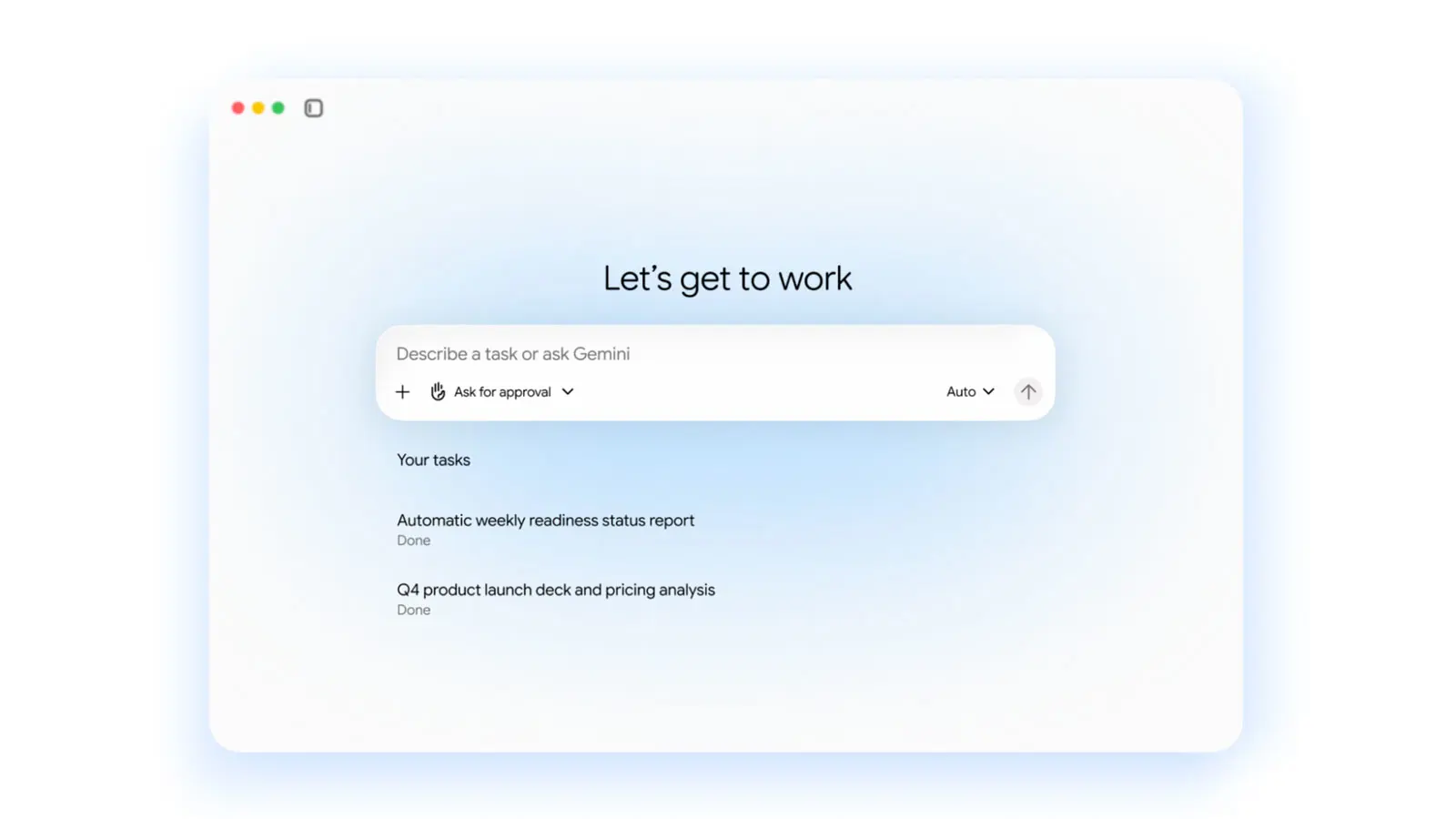
Google describes Gemini as both a personal assistant and a potential team member. Organizations could assign it work for a group, such as coordinating project tasks, or for a specific role, such as helping a finance analyst. Google also says users can assign objectives, schedule tasks, or configure the agent to respond to events.
For data teams, Google is introducing capabilities that can generate PySpark code, help create and test notebooks, train models, and troubleshoot data pipeline issues. For business users, the company says operational reports can be generated by asking questions in plain language, with Gemini using BigQuery and Knowledge Catalog to construct and save queries.
Google highlights governance and cost controls
Giving an AI agent access to company systems creates practical questions about permissions, data access, and oversight. Google says its approach includes identity and policy management, authorization controls, secure sandboxing, network gateways, and administrative governance. The company also describes multi-model orchestration, model routing, and real-time spending caps as ways to manage costs.
Those safeguards will be important for companies deciding how much work to delegate. The announcement describes the capabilities and controls Google is building into the product, but it does not establish that every task can be completed without errors or human review. Businesses will still need to evaluate the agent against their own security requirements and workflows.
Gemini’s move toward task execution builds on its other agents
Google has been expanding Gemini beyond a conventional chat interface. Saganote previously covered Gemini Spark coming to Chrome for AI-powered browser tasks and Gemini Spark on Mac with file access and custom MCP, both examples of agents working closer to the tools and files people use.
The company has also explored background work in Gemini 3.8 Live and agent-like capabilities behind Gemini Live Avatar. For readers comparing assistants, Saganote’s guide to ChatGPT vs Gemini vs Claude provides broader context on the competing AI products.
Google’s new Gemini agent is aimed at businesses that want one entry point for work spanning documents, communication, data, and code. Its practical value will depend on how reliably it completes multi-step tasks, how well it works with each company’s systems, and how much control administrators can retain over what it does.