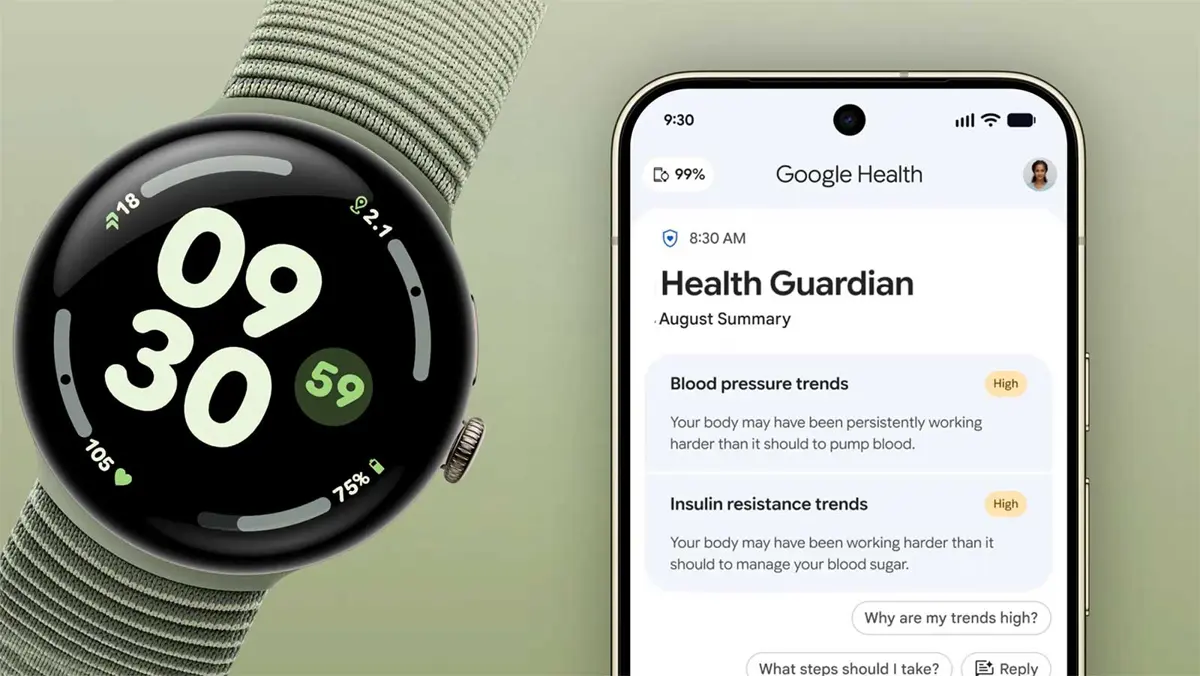
Google Health Guardian Explained: How Pixel Watch Tracks Hidden Health Trends
Google's new wearable health system is built around long-term patterns, not one-off readings.

Google Health Guardian is now rolling out through the Google Health app, but the interesting part is not simply that a Pixel Watch has gained more health features. Google is trying to turn the watch into a system that notices changes in a person's usual physiological patterns and surfaces those changes over time.
That distinction matters. A traditional health measurement answers a question such as "What is the reading right now?" Health Guardian is designed to answer a different question: "Has the pattern changed enough over time to be worth paying attention to?" Google says the features are for general wellness and information, not for diagnosing conditions or replacing medical care. Read Google's live Health Guardian announcement for the current rollout details.
Google Health Guardian Is Built Around Trends, Not One-Off Readings
The first three trend features focus on blood pressure, insulin resistance and sleep breathing quality. They use signals collected over time instead of treating a single noisy sensor reading as the answer.
- Blood pressure trends estimate longer-term changes from pulse and motion patterns.
- Insulin resistance trends analyze multi-week physiological data to estimate how metabolic health is shifting.
- Sleep breathing quality looks at breathing changes during sleep and summarizes the pattern over time.
- Reports are designed around longer windows, with Google describing monthly summaries rather than a stream of clinical readings.
Google says the features work in the background and can produce a monthly summary. For the current rollout, blood pressure trend reports require at least five consecutive days in a week, while insulin resistance trend reports require at least seven days of data in a month. The exact availability depends on the device and region.
How Can a Pixel Watch Estimate Insulin Resistance?
Insulin resistance is normally evaluated with clinical testing rather than a smartwatch. Google Health Guardian takes a different route: it looks for patterns in wearable data that correlate with changes in metabolic health.
Google says its insulin resistance feature analyzes physiological data collected across multiple weeks. The company describes the underlying model as a sensor foundation model trained on more than one trillion minutes of data from five million opted-in users. Google says the research behind the feature was validated against standard clinical blood tests and published in Nature.
The important limitation is that the watch is not measuring blood glucose directly. Google explicitly says the feature is not a diabetes prescreener, does not provide real-time glucose readings and should not be used to change medication or insulin levels.
Google describes this as a wellness trend, not a diagnostic test. A change in the trend does not establish diabetes or another medical condition, and it should not be used to change treatment.
Blood Pressure Trends Use a Different Kind of Signal
Blood pressure trends rely on another approach. Google says the Pixel Watch passively observes pulse and motion patterns over time and uses those signals to estimate changes in blood pressure without requiring a cuff or manual calibration.
That makes the feature useful for a different purpose than a conventional blood pressure monitor. Instead of giving a clinical systolic and diastolic reading on demand, the system is intended to identify a persistent shift in the underlying trend. Google recommends confirming a pattern with a home blood pressure monitor or discussing it with a healthcare professional.
The model behind this feature is called WavesFM. Google says it was trained on billions of minutes of raw heart and movement data and validated across a diverse population and through Fitbit Hypertension Labs research. Google's research-backed Health Guardian overview explains how the model fits into the wider system.
Why Google Reports Some Health Information Monthly
Monthly reporting can seem unusual when a smartwatch is capable of showing heart rate and other metrics every few seconds. Health Guardian is designed around a different problem: separating a meaningful change from normal daily variation.
Sleep, exercise, caffeine, stress, illness and ordinary changes in routine can all affect physiological signals. Looking at a longer period gives the system more context than a single reading. It also changes how the result should be interpreted. A trend is a prompt to look closer, not a diagnosis delivered by the watch.
| Feature | What it looks for | What it does not replace |
|---|---|---|
| Blood pressure trends | Longer-term changes estimated from pulse and motion | A blood pressure monitor or clinical measurement |
| Insulin resistance trends | Patterns associated with changes in metabolic health | Blood tests, diabetes evaluation or treatment decisions |
| Sleep breathing quality | Changes in breathing patterns during sleep | A clinical sleep study or diagnosis of sleep apnea |
Sleep Breathing Quality Is About Patterns During Sleep
Sleep breathing quality adds a respiratory dimension to the same trend-based idea. Google says the feature tracks breathing changes during sleep and gives a view of how much sleep was spent in a more optimal breathing pattern, along with longer-term context.
The feature is not presented as a sleep apnea test. Google says the breathing quality metric is for general wellness and is not a prescreener for sleep apnea. That distinction is important because sleep-related breathing problems can require clinical evaluation rather than a wearable trend alone.
The Bigger Story Is the AI Model Behind the Watch
The hardware is only one part of Health Guardian. Google's larger bet is on models that can learn useful representations from huge amounts of continuous wearable data.
Google has been researching wearable foundation models that learn from physiological and behavioral signals rather than relying only on hand-labeled examples. Its research describes models trained on large collections of Fitbit and Pixel Watch data, with missing sections of sensor data intentionally hidden during training so the model learns to reconstruct patterns. Google Research's wearable foundation model work provides more technical background on that approach.
Health Guardian applies that research to consumer features. Instead of asking the wearer to interpret raw heart or movement signals, the model turns those signals into a higher-level estimate such as a blood pressure trend or metabolic trend.
That is a meaningful shift in wearable computing. The watch is moving from being a sensor dashboard toward being a pattern-recognition layer that tries to understand what the sensor data means over time.
Health Guardian Is Part of Google's Larger Health App Strategy
The timing also makes more sense when viewed alongside the broader Google Health app. Google has been consolidating health information and adding AI-assisted interpretation, so Health Guardian is not an isolated Pixel Watch feature.
For example, Saganote previously covered Google Health's setting for hiding the AI Coach from the Today tab. That feature is about how the app presents AI assistance, while Health Guardian focuses on generating new interpretations from wearable signals.
The hardware side connects directly to Made by Google 2026 and the Pixel Watch 5, where Google introduced the latest Pixel Watch alongside its wider device and Gemini strategy. Health Guardian gives that watch a role beyond notifications and fitness tracking.
The broader health-data competition is also visible outside Google. Apple's latest health changes, including Health Age, Readiness Score and new insights, show how major platform companies are increasingly turning raw health data into summaries and interpretations. The approaches are different, but the direction is similar: health apps are becoming interpretation layers rather than simple data stores.
OpenAI is taking another route by putting medical records and connected health data into ChatGPT through OpenAI Health. That makes the contrast useful: Google is leaning heavily on continuous wearable sensing, while OpenAI's health product centers on information and conversation. Neither approach removes the need for clinical care.
What Google Health Guardian Does Not Tell You
The easiest mistake is to read a trend label as though it were a medical result. Google's own product disclosures draw a firm line between the two.
- Health Guardian features are intended for general wellness and informational purposes.
- Blood pressure trends are not real-time clinical blood pressure readings.
- Insulin resistance trends are not a diabetes prescreener and do not measure glucose in real time.
- Sleep breathing quality is not a prescreener for sleep apnea.
- The features should not be used to adjust medication or treatment plans.
- Availability varies by country, device and subscription requirements.
There is also a separate safety feature in the Health Guardian suite. Breathing Emergency Detection on Pixel Watch 4 and 5 is designed to detect severe drops in blood oxygen and, in supported European markets, can prompt an emergency call if the wearer becomes unresponsive. Google says this feature has not been cleared or evaluated by the FDA and is CE marked in the EU.
The Practical Way to Think About Health Guardian
The simplest mental model is to treat Health Guardian as an early-warning layer for patterns, not a pocket laboratory. It can watch continuously, combine many signals and surface a change that might otherwise be easy to miss.
That can be useful because people rarely notice gradual changes in their own physiological data. A monthly trend can put a pattern in front of someone who would never manually compare weeks of heart, sleep and movement data.
But the same system has a hard boundary. A wearable can estimate a pattern without proving its medical cause. If a trend looks unusual or concerning, the appropriate next step is confirmation through established measurement or professional evaluation, not changing treatment based on the watch.
Frequently Asked Questions
What is Google Health Guardian?
Does Health Guardian measure blood pressure directly?
Can a Pixel Watch detect insulin resistance without a blood test?
Is Health Guardian a medical diagnostic tool?
Which Pixel Watches support Health Guardian?
Google Health Guardian Is Really About Long-Term Pattern Recognition
The most useful way to understand Google Health Guardian is not as a collection of new medical readings. It is a system for turning continuous wearable data into longer-term patterns that are easier for a person to understand.
That makes the underlying AI research as important as the watch sensors themselves. Google is using large-scale wearable models to interpret signals that are individually noisy but more informative when viewed together over time. The result is a new category of wearable insight, with clear limits that Google itself says should remain in view.