Meta Model API opened in public preview today, giving developers direct access to Muse Spark 1.1 - marking the first time Meta has opened a frontier model to external builders via a formal API. Muse Spark 1.1 is not Meta's image tool. Meta Superintelligence Labs built it as a multimodal reasoning model for agents, computer use, and large-codebase coding - a direct competitor to Claude Fable 5 and GPT-5.6 Sol in the enterprise automation market.
Agents, 1 Million Tokens of Context, and Computer Use That Writes Its Own Scripts
Muse Spark 1.1 runs in two modes. As main agent, it gathers context, plans, and delegates execution to parallel subagents to cut end-to-end latency. As subagent, it handles a specific job and escalates back to the orchestrator when requirements change. A 1-million-token active context window keeps the full session history in play - the model compacts earlier steps rather than losing them to truncation, so long workflows do not drift.
Computer use adds an interesting design choice. Rather than clicking through every desktop action one step at a time, Muse Spark 1.1 decides when to write a script versus when to click directly based on which path is faster. Repetitive tasks get automated. Unfamiliar interfaces get direct navigation, batched into several actions per step to reduce latency. Meta says the model can maintain context across extended multi-app sessions with changing requirements without needing human re-prompting.
Meta Model API Ships OpenAI-Compatible From Day One
Early partner access ran for several weeks before today's public preview. Replit CEO Amjad Masad described the Meta Model API as "a clean OpenAI-compatible package" bundling 1M-token context, multimodal support for images, video, and PDFs, built-in search with citations, structured output, and parallel tool calling. For teams already building on OpenAI's API format, switching to test Muse Spark 1.1 requires changing an endpoint URL - not rewriting client code. Cline CEO Saoud Rizwan flagged the combination of "strong tool use at a price point that makes it viable to run real coding workloads at scale."
No public pricing has been announced for the Meta Model API. The lack of a public rate card on day one suggests Meta is still calibrating usage patterns with early partners before committing to a price structure - the same approach OpenAI used when GPT-4 first opened to API access.
Coding Improvements and Enterprise Benchmark Results
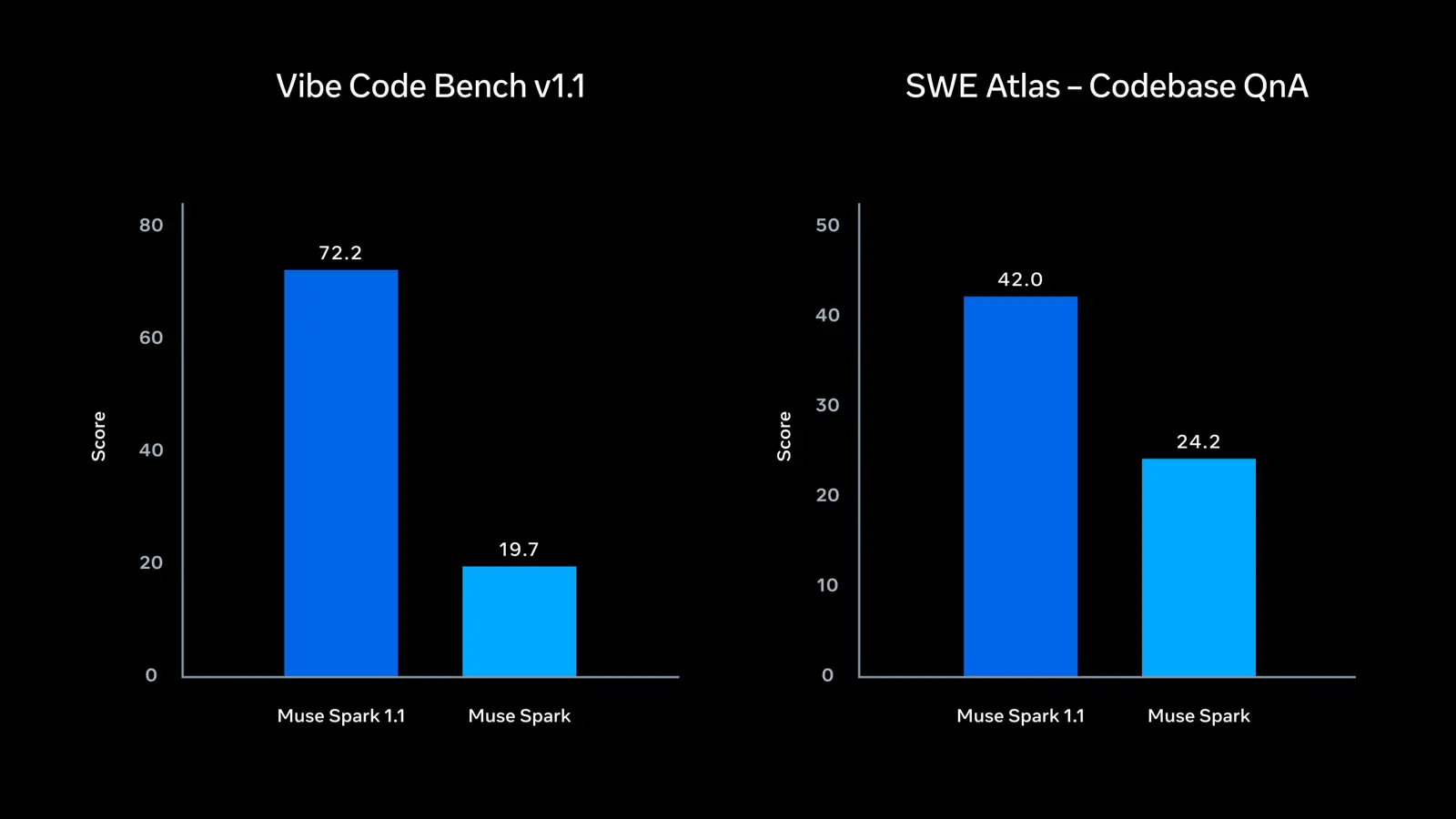
Large-codebase debugging is the headline coding upgrade. Muse Spark 1.1 improved substantially on Meta Internal Coding Bench over the original Muse Spark - diagnosing and fixing complex bugs in enterprise systems, implementing features in large codebases, and running large-scale code migrations. Meta researchers are also using the model on meta-level tasks: the launch post shows Muse Spark 1.1 evaluating itself on a subset of DeepSWE tasks and generating an analysis dashboard from the results.
Box VP of AI Products Yashodha Bhavnani said Muse Spark 1.1 tested as "competitive with today's leading frontier models" on Box's enterprise evaluation set, with particular strength in structured, procedural workflows across professional services and public sector workloads. GPT-5.6 Sol also launched publicly today after a 12-day White House gate, giving developers two new frontier API options on the same afternoon. Muse Spark 1.1 is a separate product from Meta's Muse image generator, which handles ad creative and Instagram content; this model is the reasoning and agentic layer.
Meta's Advanced AI Scaling Framework evaluation found Muse Spark 1.1 within safe margins across chemical and biological, cybersecurity, and loss-of-control risk categories. Access opens at developer.meta.com; the model also runs in "Thinking" mode in the Meta AI app and on meta.ai. Meta says more capable models are already in training.