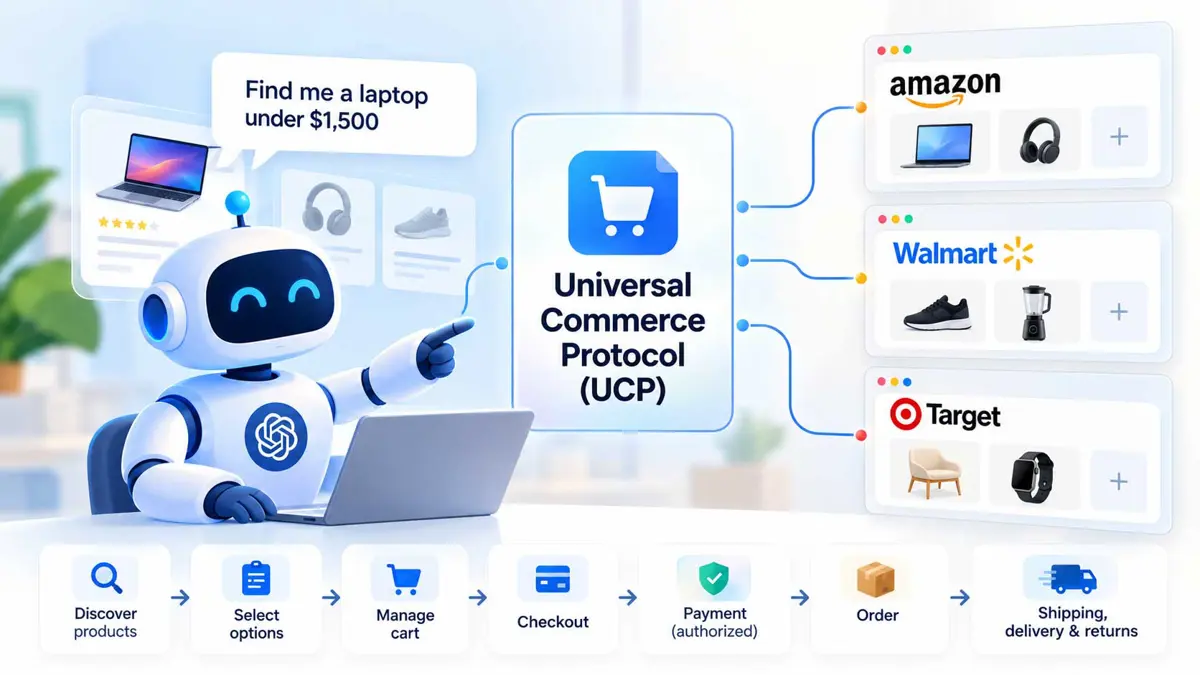
Universal Commerce Protocol Explained: How AI Agents Shop
UCP gives AI agents and commerce systems a common way to discover products, manage checkout, and follow orders.

Universal Commerce Protocol, or UCP, is an open standard designed to let AI agents and commerce systems communicate using a common set of capabilities. Instead of every AI platform building a separate integration for every retailer, UCP provides standardized ways to discover supported commerce capabilities, manage carts and checkout, handle identity, process supported payment flows, and receive order updates.
The idea is simple: an AI agent should be able to understand what a merchant supports without needing a custom integration for every store. UCP does not replace ecommerce websites, payment providers, or existing APIs. It provides a standardized layer that can connect those systems to AI agents and other consumer-facing platforms.
What Is Universal Commerce Protocol?
Universal Commerce Protocol, usually shortened to UCP, is an open standard for connecting commerce businesses with platforms such as AI agents and applications.
The protocol defines common capabilities that systems can discover and negotiate instead of requiring each platform and merchant to design a separate integration. The current UCP specification includes capabilities covering areas such as catalog discovery, carts, checkout, identity linking, orders, fulfillment, discounts, and payment-related extensions.
The important idea is interoperability.
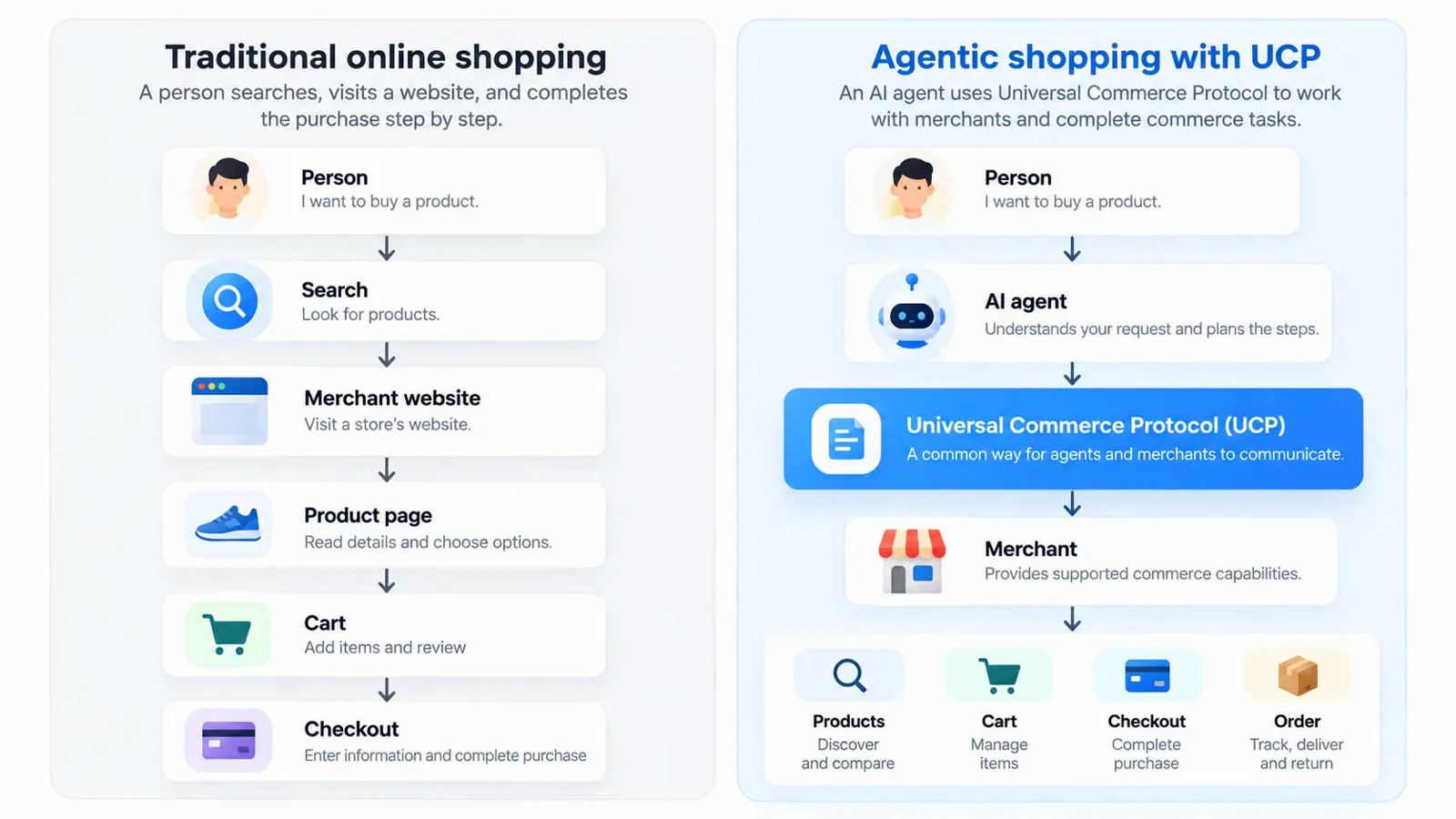
The AI agent still needs permission, payment authorization, and access to supported merchant capabilities. UCP provides a standardized way for those systems to communicate.
Why Do AI Agents Need UCP?
AI agents can already understand natural-language requests such as: “Find me a pair of running shoes under $150.” Understanding the request is only the first step.
To actually help with the purchase, an agent may need to search products, check availability, compare product information, create or update a cart, calculate the checkout total, handle shipping information, obtain an authorized payment instrument, complete the transaction, and track the resulting order.
- Search products.
- Check availability.
- Compare product information.
- Create or update a cart.
- Calculate the checkout total.
- Handle shipping information.
- Obtain an authorized payment instrument.
- Complete the transaction.
- Track the resulting order.
The problem is that merchants do not all expose these capabilities in the same way. One store might use one API structure. Another might use a completely different checkout system. A third might expose some information but not support automated checkout.
UCP is designed to provide a common language for those interactions. That makes it different from simply giving an AI agent access to a website.
How UCP Works
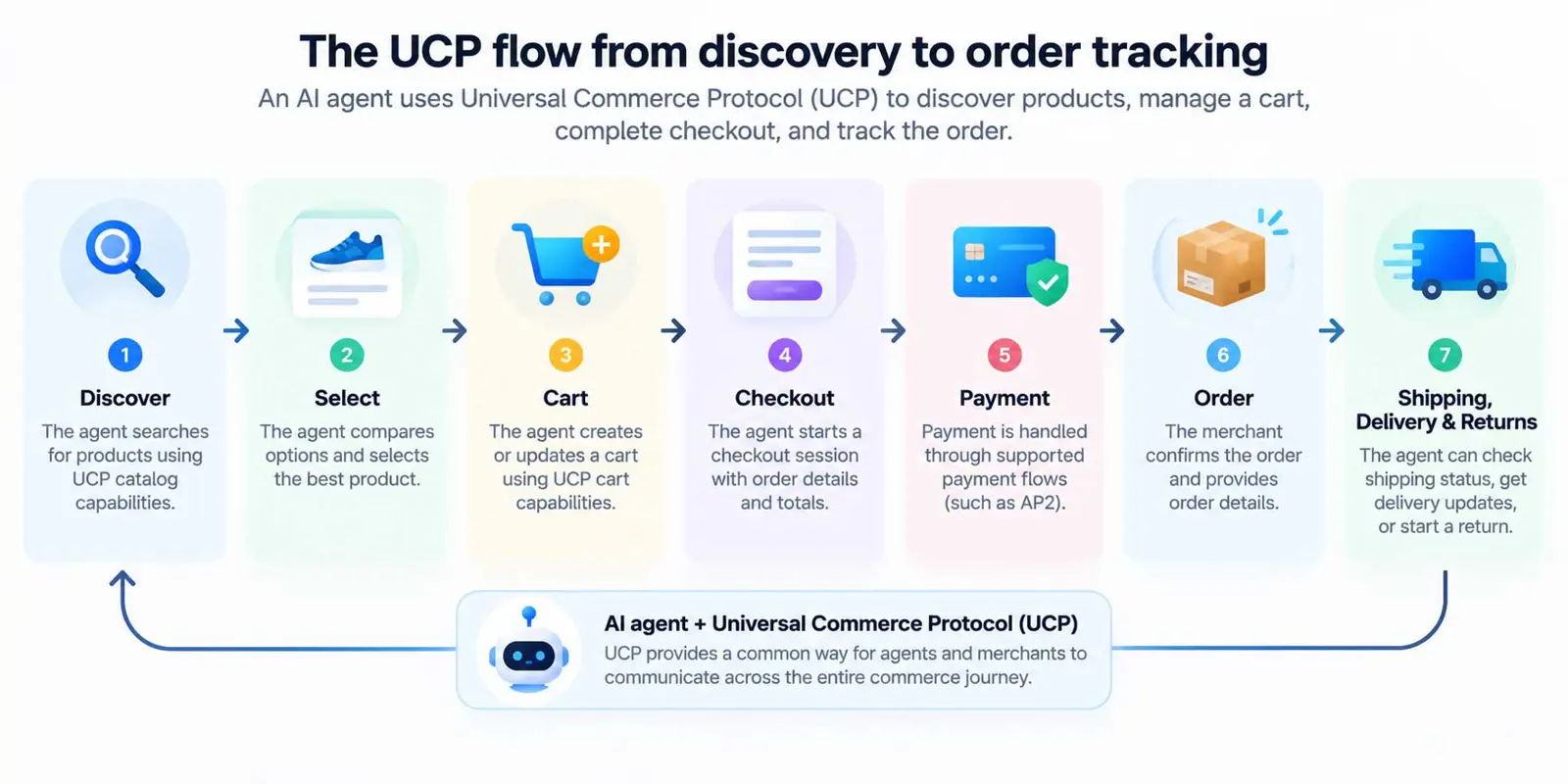
The easiest way to understand UCP is to follow a shopping request from discovery to order.
1. The agent starts with a user's request
Imagine someone tells an AI agent: “Find a 15-inch laptop with 32GB of RAM under $1,500.” The agent needs access to commerce information before it can make a useful recommendation.
UCP includes catalog capabilities for searching and looking up products through standardized interfaces.
2. The agent discovers what a merchant supports
UCP uses a business profile available at /.well-known/ucp. That profile can describe the services, capabilities, versions, and supported transports a business exposes.
This matters because the agent does not have to assume that every merchant supports exactly the same operations. It can discover what is available first.
3. The systems negotiate capabilities
A merchant might support checkout, orders, discounts, and fulfillment. An AI platform might support only some of those capabilities.
UCP allows the two sides to determine their compatible capability set before proceeding. The current specification describes this as capability negotiation, where the active capabilities are derived from what both sides support.
That creates a more structured interaction than simply asking an AI model to figure out how a website works.
4. The agent can create a cart or checkout session
Once the products are selected, the commerce system can create a cart or checkout session.
The UCP checkout capability supports checkout sessions, including cart information and totals. The protocol also supports extensions for things such as discounts and fulfillment.
The merchant remains responsible for the actual commerce transaction.
5. Payment is handled through supported payment flows
Payment is one of the most sensitive parts of agentic commerce.
UCP separates the commerce interaction from the underlying payment credentials. Its current specification describes payment negotiation, credential acquisition, and completion as separate stages.
That distinction matters because an AI agent should not simply receive unrestricted access to someone's raw card information.
UCP can work with payment handlers and related payment protocols, including AP2-related extensions, to support authorized agentic payment flows.
For some UCP checkout flows, a trusted user interface is still required for finalization unless an appropriate AP2 mandate extension is supported.
6. The order can continue after checkout
Agentic commerce does not necessarily end when payment succeeds. A customer might later ask: “Has my laptop shipped?”
UCP includes an Order capability for order lifecycle information and updates such as shipping, delivery, and returns.
UCP vs MCP vs AP2
These protocols are easy to confuse because they can appear together in discussions about AI agents and commerce. They solve different problems.
| Protocol | Main role |
|---|---|
| UCP | Standardizes commerce interactions between platforms, agents, businesses, and related systems |
| MCP | Provides a standard way for AI applications to connect with tools and external data |
| AP2 | Provides infrastructure for authorized agentic payment flows |
UCP can actually use MCP as one of its transport options. The current UCP specification includes MCP bindings for capabilities such as catalog, cart, and order operations.
So UCP and MCP are not simply competing alternatives. For readers who want the deeper explanation, see Saganote's guide to Model Context Protocol.
AP2 is also related rather than identical. UCP's specification describes an integration between UCP and AP2 for agent-mediated payment commitments and mandates.
What Can an AI Agent Do With UCP?
UCP is designed around specific commerce capabilities rather than one giant “AI shopping” function.
Product discovery
An agent can search or look up products through standardized catalog capabilities. For example: “Find noise-canceling headphones under $300.”
Cart management
The agent can work with a supported cart capability to create, retrieve, update, or cancel a cart.
Checkout
The checkout capability provides a standardized way to create and manage checkout sessions.
Payment
Supported payment handlers can be discovered as part of the commerce interaction, while payment credentials can be handled through the appropriate payment flow.
Order tracking
After a purchase, order capabilities can provide information about the order lifecycle, including fulfillment updates.
The important distinction is that UCP defines the interaction, while the merchant and its underlying systems still determine what products, prices, inventory, payment methods, shipping options, and policies are actually available.
What UCP Changes for Online Shopping
Traditional online shopping assumes that a person is the primary interface. The person searches, clicks, reads product pages, selects options, enters information, and completes checkout.
Agentic commerce changes the interface.
The person can instead express an intent: “Find me the best option for this requirement.” The agent can then interact with supported commerce systems to perform parts of the process.
That does not mean the person disappears from the transaction. Depending on the implementation, the user may still need to approve a purchase, provide information, authenticate, or interact with a trusted payment interface.
The bigger change is where the interaction happens. Instead of forcing every AI platform to understand every merchant's proprietary commerce interface, standardized protocols can give agents a structured way to communicate with participating businesses.
This shift is already showing up in platform-level questions around AI shopping. Saganote's coverage of Amazon blocking Meta Muse from shopping on Amazon.com provides a useful real-world example of how access by AI shopping agents can become a platform issue. Amazon Blocks Meta Muse From Shopping on Amazon.com.
What UCP Means for Merchants
For merchants, the potential benefit is not simply “AI can shop.” The bigger technical problem is integration.
Without a common protocol, a merchant that wants to support multiple AI platforms may need multiple custom integrations.
UCP is designed to reduce that fragmentation by defining common capabilities and discovery mechanisms. Google described UCP as a common language for commerce interactions between consumer surfaces, businesses, and payment providers when it introduced the protocol in January 2026.
UCP was developed with a group of industry participants including Google, Shopify, Etsy, Wayfair, Target, and Walmart, alongside payment and technology companies.
The protocol is also continuing to evolve. UCP released version 2026-08-25 on August 25, 2026, adding changes including payment-security improvements, independent capability versioning, and support aimed at additional commerce scenarios.
That is one reason an evergreen explanation should focus on the architecture rather than one particular implementation.
Does UCP Replace Ecommerce APIs?
No. UCP is better understood as a standardized layer for commerce interactions.
A merchant can expose UCP capabilities through different transports, including REST and MCP. The current specification also defines how capabilities and schemas are discovered and negotiated.
The underlying ecommerce platform, inventory system, order management system, payment provider, and other backend services can remain in place.
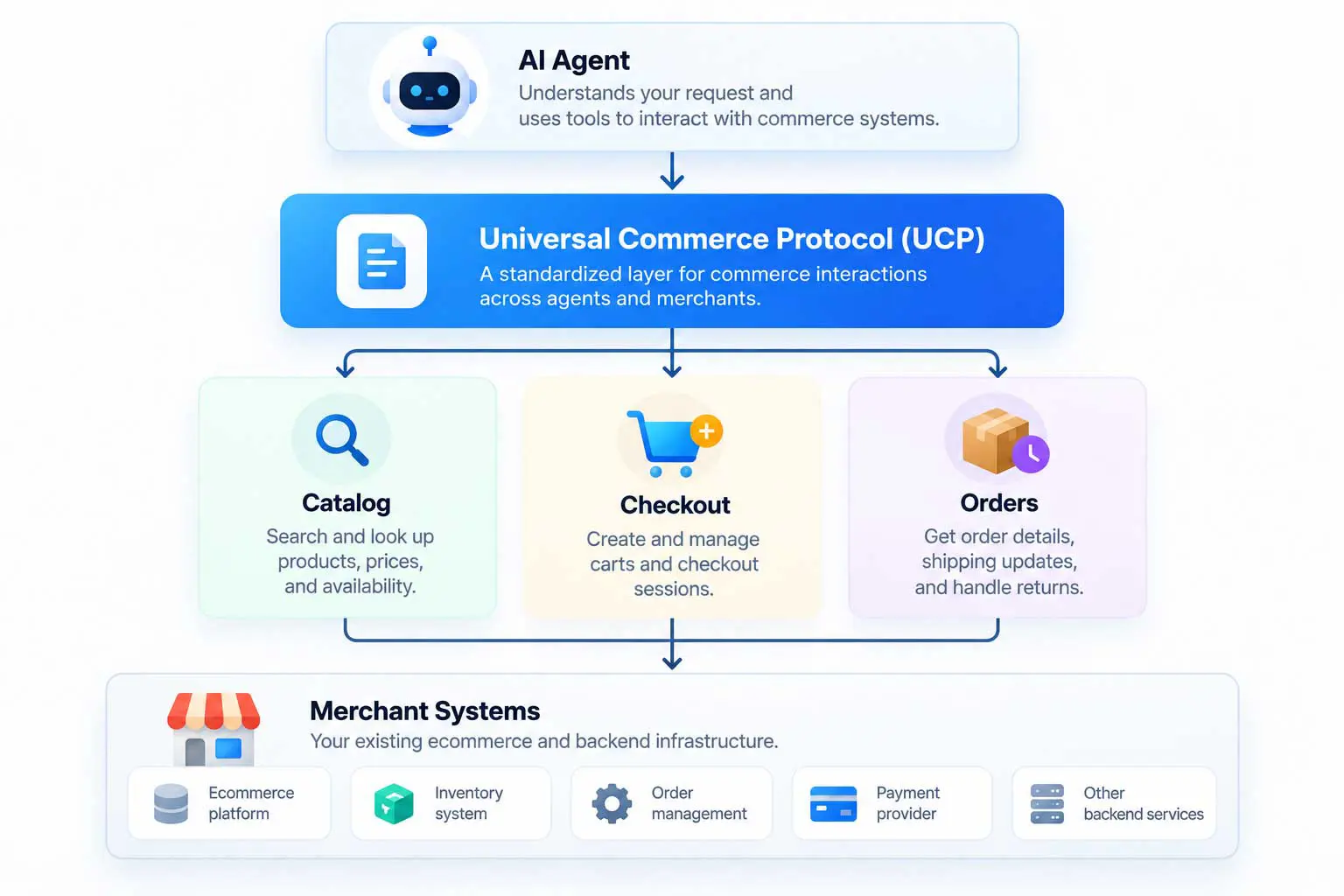
UCP standardizes the interaction at the protocol layer. It does not require every merchant to rebuild its entire ecommerce stack.
Does UCP Mean AI Agents Can Buy Anything?
No. UCP provides standardized commerce capabilities, but a transaction still depends on what a merchant supports, what the platform supports, the available payment method, authorization requirements, and the specific implementation.
The current UCP checkout specification, for example, says checkout must be finalized manually by the user through a trusted interface unless the appropriate AP2 Mandates extension is supported.
“AI agent shopping” should not be interpreted as “AI can freely spend your money.” Actual transactions remain subject to authentication, authorization, payment controls, merchant policies, and the implementation of participating systems.
What Happens Next for AI Shopping?
UCP is part of a broader shift from AI that only provides information toward AI systems that can interact with external services.
The protocol itself is still evolving. Its August 2026 release added structural changes intended to support expansion beyond its initial scope, while the project continues to publish new specifications and updates.
The important long-term idea is not that every shopping website will disappear. It is that the interface between a person and a merchant may increasingly include software acting on the person's behalf.
For that model to work at scale, those systems need shared rules for discovering capabilities, exchanging structured information, managing transactions, handling authorization, and reporting order status.
UCP is one standard being built around that problem.
Frequently Asked Questions
What is Universal Commerce Protocol?
What does UCP stand for in AI?
How does Universal Commerce Protocol work?
Is UCP the same as MCP?
What is the difference between UCP and AP2?
Can AI agents buy products using UCP?
Does UCP replace ecommerce websites?
Conclusion
Universal Commerce Protocol is an attempt to solve a practical problem created by agentic AI: how can software representing a customer communicate with different commerce systems without requiring a custom integration for every merchant?
UCP addresses that problem through standardized discovery and commerce capabilities covering areas such as products, carts, checkout, payments, identity, and orders.
The technology is still evolving, but the underlying idea is straightforward: if AI agents are going to shop on behalf of people, they need a common way to communicate with the businesses they shop from.
The official UCP specification documents the current checkout model, capability discovery, and related payment behavior. UCP checkout specification is the primary reference for the protocol's current checkout rules.
UCP is also published as an open specification, with the official UCP repository providing the protocol source and implementation material.
Google's technical overview of UCP explains how the protocol is intended to connect consumer surfaces, businesses, and payment providers.