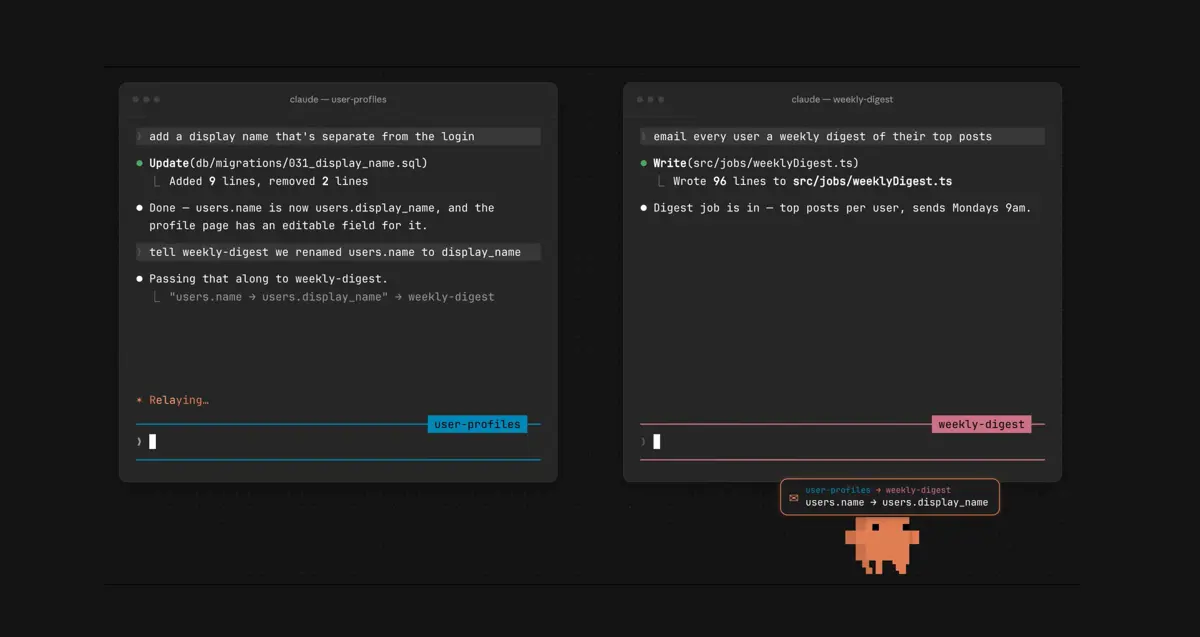
Claude Code Sessions Can Now Message Each Other - No Re-Explaining Context Between Terminals
Anthropic shipped v2.1.224 on August 7 with cross-session messaging for macOS and Linux - Claude finds the target session by name and writes the message itself.

Claude Code cross-session messaging shipped August 7 in version 2.1.224, letting independent sessions send plain-text summaries to each other on macOS and Linux - no copy-pasting between terminals, no re-explaining the same context twice. Anthropic announced the feature via the @ClaudeDevs account on X and published full documentation at code.claude.com.
Sessions Pass Text - Not History or Files
Plain text is all that travels. A session cannot send conversation history or files to another session - moving full context still requires resuming the session instead. Developers give Claude a target and an intent; Claude uses ListAgents to discover sessions by name, composes the message itself, and delivers it with SendMessage. Delivery happens between tool calls in an active turn, or opens a new turn when the receiving session sits idle.
Four Scenarios - Worktrees, Findings, Long Tasks, and Cross-Machine Replies
Same-machine messages stay local. Anthropic documents four primary use cases for Claude Code cross-session messaging: handing a finding to the session working on the affected area; coordinating sessions running the same repo in separate worktrees; polling a long-running migration or test for status without switching terminals; and replying to a message from a session on another machine via Remote Control. Cross-machine messages route through Anthropic's servers; same-machine delivery runs over a per-session Unix socket on disk, scoped to the operating-system user, never touching Anthropic's infrastructure.
Permission Boundaries Stay Per-Session - Messages Cannot Approve or Configure
Another Claude cannot consent on your behalf. Claude Code marks each message as a peer request - not a user prompt - so an incoming message cannot answer pending permission prompts, change configuration files, or execute slash commands; /compact in a message body shows as plain text and never runs. Claude Code has added platform support quickly this year, with iOS Simulator support landing recently and Claude Code cross-session messaging arriving now; both treat permission boundaries as inviolable regardless of where the instruction came from. Cross-machine messaging requires explicit approval before any message leaves the machine when isolatePeerMachines is set to true in settings.
Availability is narrower than expected. macOS and Linux qualify; native Windows does not. Amazon Bedrock, Google Cloud's Agent Platform, and Microsoft Foundry all fall outside the list - developers using agentic workflows on those providers cannot use cross-session messaging regardless of version. For developers running multiple sessions on a single machine, the most practical upside is probably the one the @ClaudeDevs post leads with: instead of re-explaining work in a new terminal, Claude writes the summary and sends it to the other session directly.