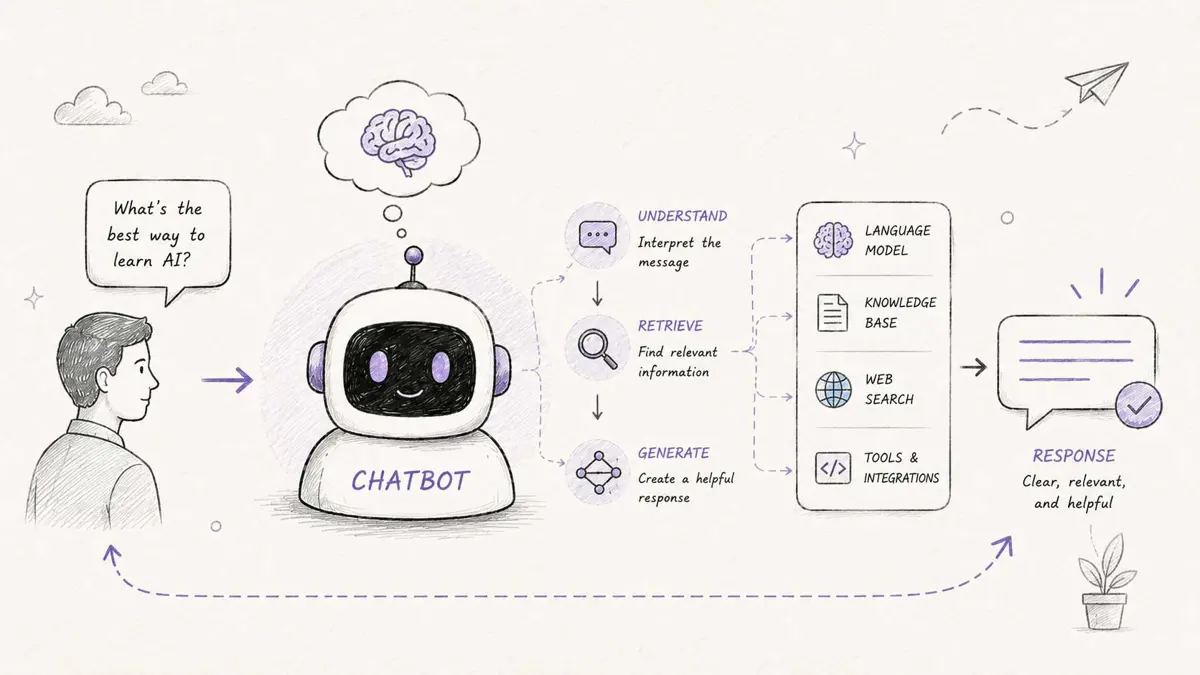
What is a chatbot? A chatbot is software that communicates with people through text or voice and returns a response based on the conversation. Simple bots follow predefined rules, while modern AI chatbots can use language models, retrieved information, and application-specific instructions to handle much broader requests.
The label covers many systems. A customer-service menu, a retrieval-powered support bot, and an LLM assistant can all look like a chat window while using very different logic, data sources, and response methods behind the interface.
What Is a Chatbot? How Does It Work?
Input comes first. Next, the system interprets the message, uses available context or information, and produces a response that fits the conversation and the task the application expects to handle.
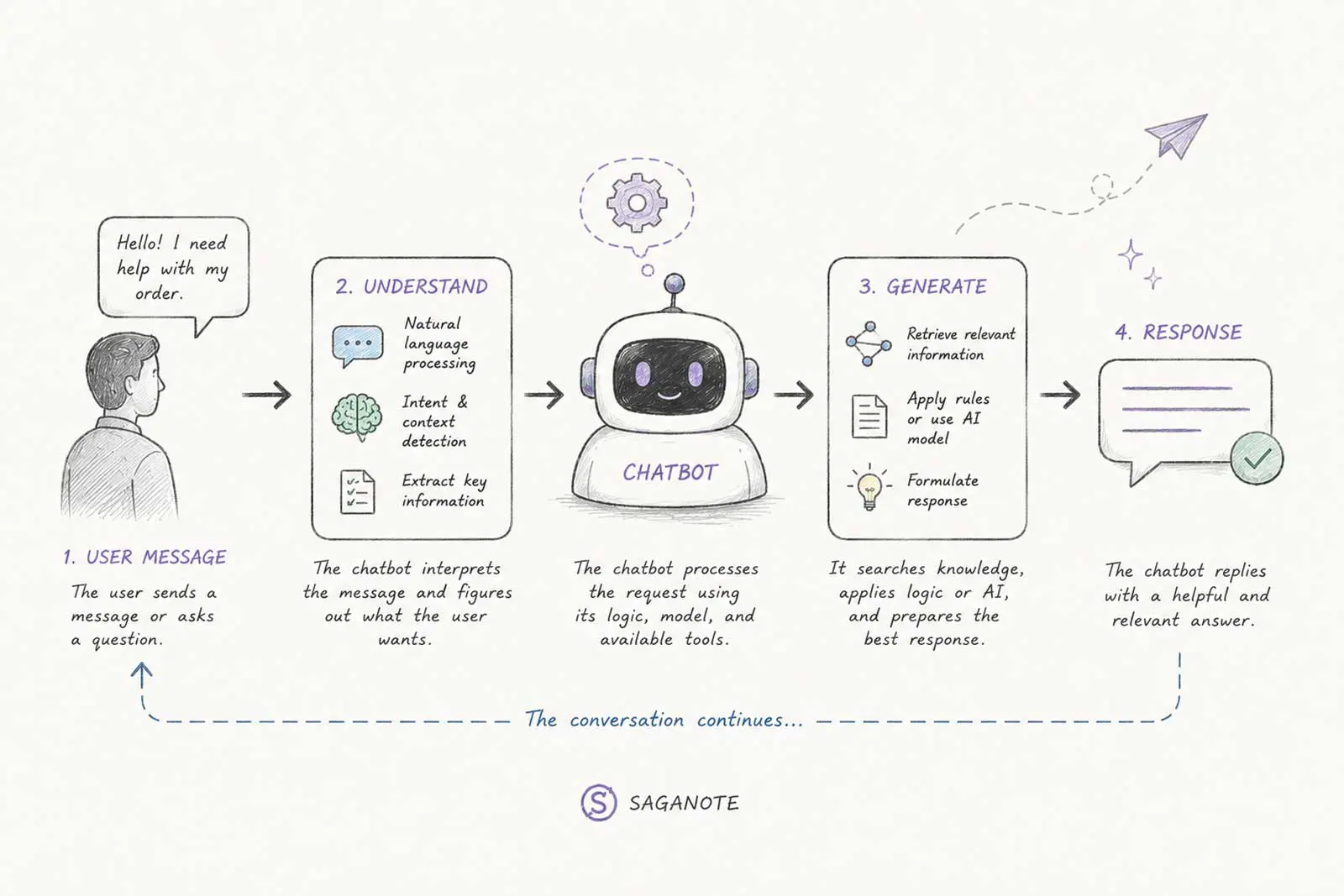
Rules come first in older systems. Modern AI chatbots can send the conversation to a language model that generates an answer from available context, making the interaction more flexible while also introducing the possibility of incorrect output.
Context plays a major role in multi-turn conversations. A capable chatbot can use earlier messages to understand what a short follow-up such as "what about the cheaper option?" refers to, rather than treating every message as a completely separate question.
Google Cloud defines AI chatbots clearly. Its overview of AI chatbots describes applications that use natural-language processing and machine learning, including retrieval-augmented systems that search external knowledge bases before generating an answer.
What are the main types of chatbots?
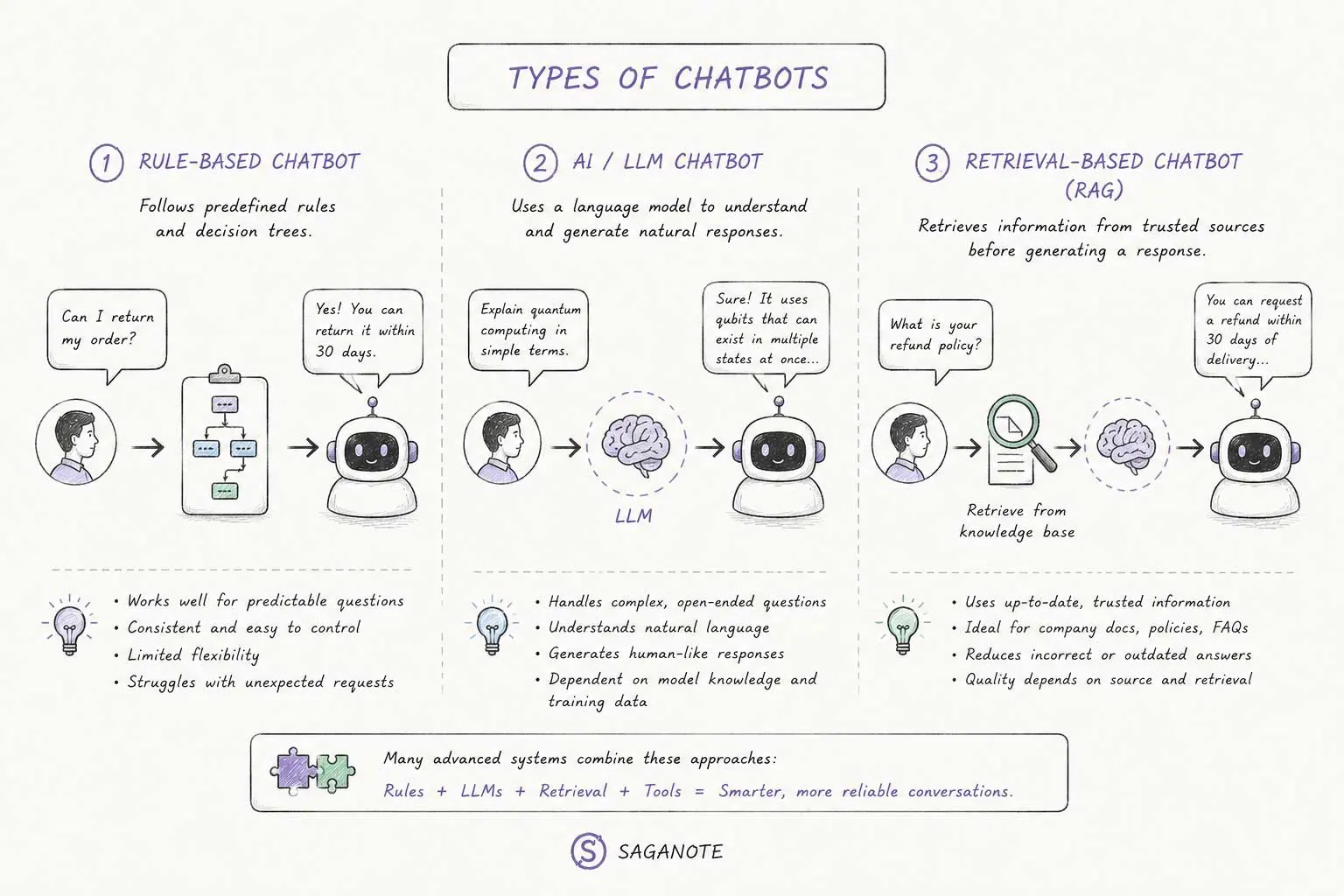
Four categories help explain the shift. Real products can combine rule-based flows, intent detection, language models, and retrieval, so the boundaries matter less than the mechanisms a particular bot actually uses.
Rule-based chatbots
Rule-based chatbots follow instructions written in advance. A user might choose "Track an order," "Start a return," or "Talk to support," and each selection sends the conversation down a known path.
- Predictable questions can receive predictable answers.
- Responses stay within a defined set of rules.
- Businesses can tightly control what the bot says.
- Unexpected questions can push the conversation outside its supported paths.
- Major changes usually require someone to update the rules or content.
These bots still have a job. A simple support flow can benefit more from predictable behavior than from a model that generates open-ended responses, especially when the business needs tight control over every answer.
AI and LLM chatbots
AI chatbots generate language. Large language models can handle a wider range of wording because they do not need a separate scripted response for every possible sentence, which lets one system respond to requests that a fixed menu could never anticipate.
An LLM does more than select a line. Language models use the prompt, conversation context, instructions, and other available information to generate an answer, which lets modern chatbots explain a topic, rewrite text, summarize a document, or help with code.
Flexibility has a cost. A generated response can sound convincing even when the underlying claim is wrong, incomplete, or based on outdated information, so fluent wording cannot serve as proof of accuracy.
Retrieval-based chatbots
Retrieval adds another step. A system can search a product manual, internal wiki, support database, or other source, then give relevant material to the model as context before it generates the final response.
RAG is one common pattern. Retrieved information can anchor the generated answer to a specific knowledge source instead of leaving the model to rely entirely on training data, which can help when the source material changes faster than the model itself.
RAG does not automatically make an answer correct. Poor retrieval can provide the wrong document, incomplete context can leave out an important detail, and the model can still misinterpret the information it receives.
What can chatbots do?
Modern chatbots cover more tasks. Capabilities vary with the model, connected data, available tools, and permissions around the chatbot, so two products with similar chat interfaces can behave very differently.
- Answer common customer questions
- Explain products, services, or documentation
- Help users troubleshoot routine problems
- Search a company knowledge base
- Summarize documents and conversations
- Draft and rewrite emails or other text
- Translate or transform text
- Analyze uploaded files
- Help with software development and code
- Collect information before handing a case to a human
- Provide conversational access to other software features
Customer support remains one of the clearest examples. A chatbot can answer routine questions at any hour, while a more advanced system can retrieve account or product information and pass complicated cases to a human when the conversation reaches a boundary.
What can a chatbot not do reliably?
Fluent answers can still be wrong. That limitation matters when a response involves current facts, precise figures, legal requirements, medical information, financial decisions, or other high-stakes subjects where a plausible sentence can hide a bad premise.
- A model may generate a factual error.
- A rule-based bot may fail outside its predefined paths.
- Retrieved information may be incomplete or irrelevant.
- Current information may be unavailable without connected search or updated data.
- A chatbot may misunderstand an ambiguous request.
- A tool-connected chatbot may have permissions that need careful control.
Verification remains part of responsible use. Good chatbot design can reduce errors with trusted sources, retrieval, clear instructions, constrained tools, and human escalation, but none of those mechanisms guarantees a correct answer in every conversation.
AI-generated answers can contain errors even when the response sounds confident. Important claims should be checked against appropriate sources.
Chatbot vs. AI agent
The distinction is practical. A chatbot centers on conversation, while an agent can pursue a goal across multiple steps by deciding which permitted actions to take and checking what happens after each step.
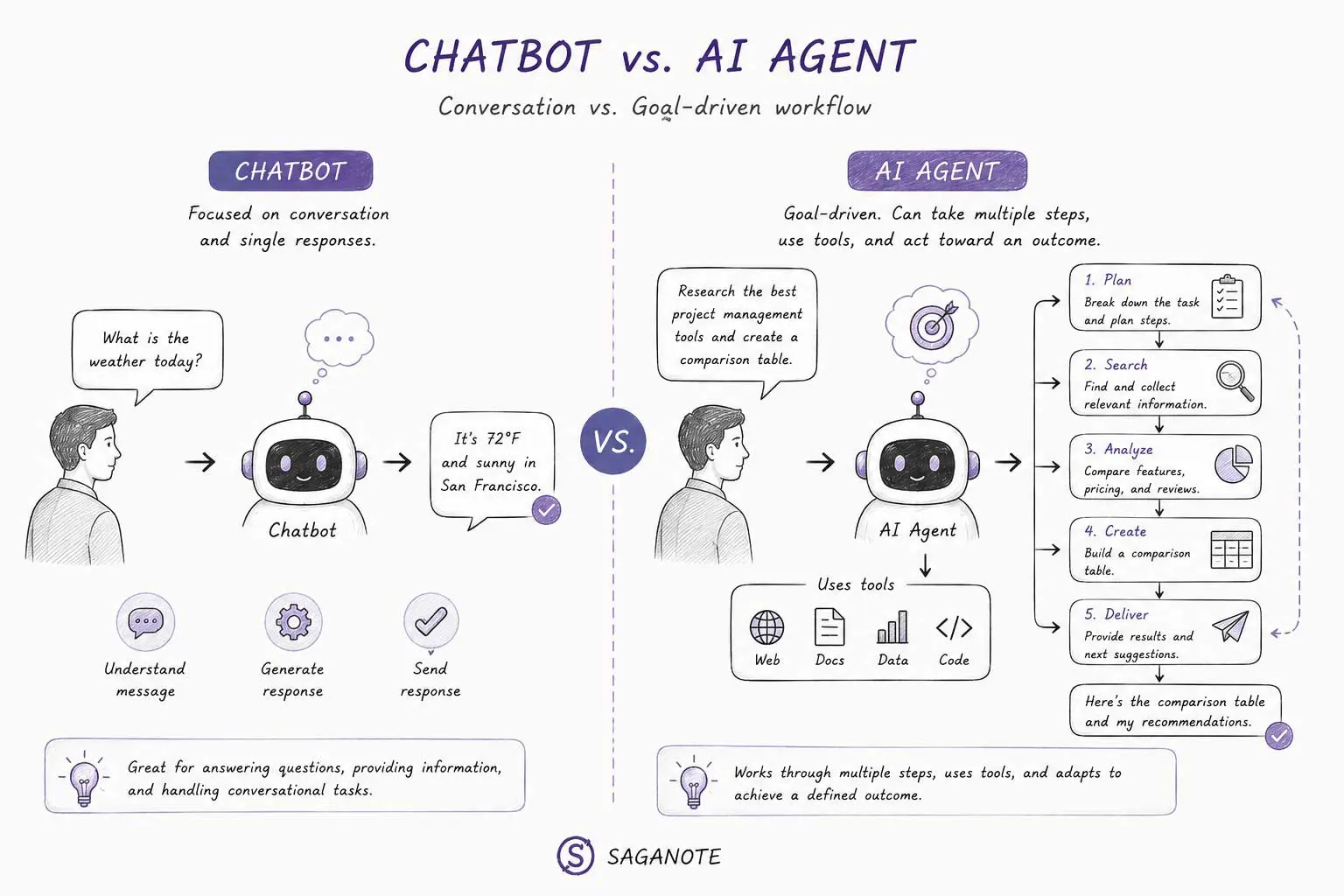
A chatbot might answer a competitor question. An agent could gather approved sources, search for new information, organize the findings, draft the report, inspect the result, and pause for human review before returning the work.
Tools change the equation. A system may look like a normal chat window while software behind it retrieves documents, calls APIs, operates a browser, or runs a longer workflow without requiring a new user prompt for every step.
Browser action is one example. Claude in Chrome shows how a conversational AI system can move into browser-based action, giving the chat interface access to a more task-oriented workflow.
When does a chatbot become more agent-like?
No single switch creates an agent. A transition toward agent behavior usually starts when a system gains enough planning, tool use, memory, and permission to keep working toward an outcome instead of stopping after one generated response.
Ask what happens next. If the system waits for another prompt before every action, it behaves more like a chatbot or assistant; if it can select the next permitted step, inspect the result, and continue toward a goal, it has more agent-like behavior.
Loop design changes the developer problem. Saganote's explainer on loop engineering examines how developers build systems that keep working through a task rather than treating every model response as the end of the workflow.
Frequently Asked Questions
Frequently Asked Questions
How does a chatbot work?
Are all chatbots powered by AI?
Is ChatGPT a chatbot?
What is the difference between a chatbot and an AI agent?
Can a chatbot use company documents?
Conclusion
A chatbot is software for conversation. Some bots follow fixed rules, while others use language models, retrieval, and connected tools to handle broader conversations across support, research, and productivity tasks.
The practical difference between a chatbot and an agent comes down to what happens after the conversation begins. Chatbots can be effective interfaces for questions and guided tasks, while agents add the ability to continue through multiple permitted actions toward a goal.