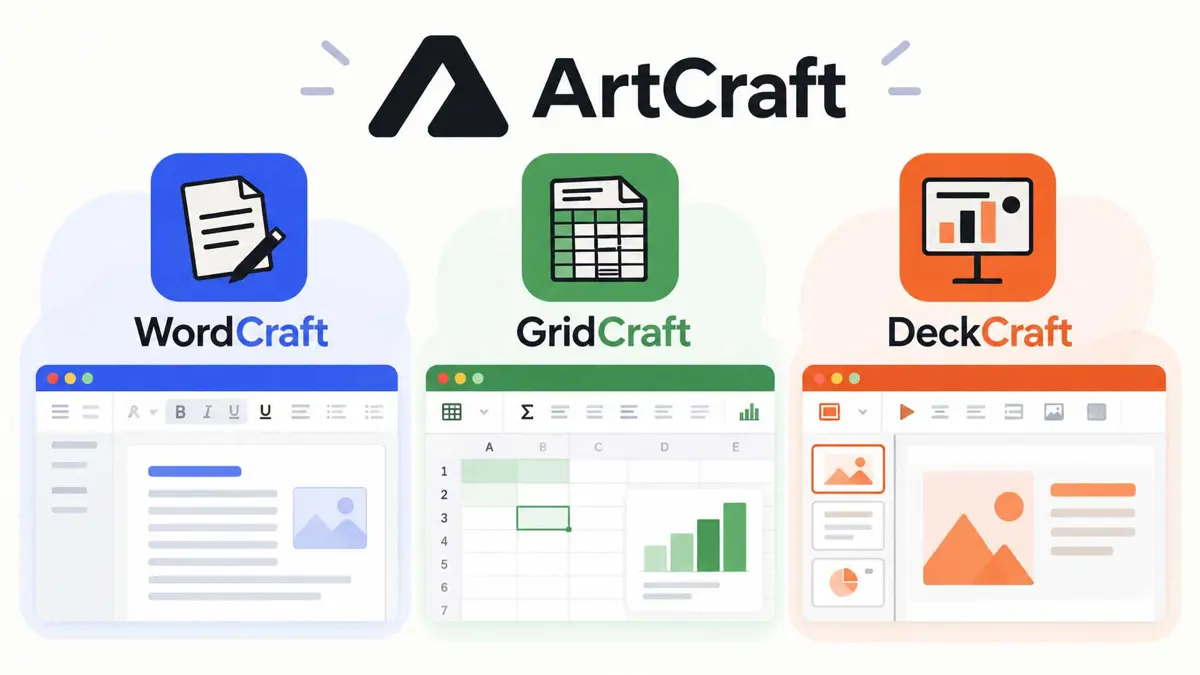
ArtCraft has expanded its open-source software lineup with three apps aimed at Microsoft Office workflows. WordCraft targets Microsoft Word, GridCraft targets Excel, and DeckCraft targets PowerPoint. The apps are written in Rust and are offered free for desktop platforms, with browser versions also listed by the project. These open-source Office alternatives aim to reproduce familiar productivity workflows without a Microsoft 365 subscription, but they are not yet drop-in replacements for every Office user.
What the three apps offer
WordCraft is a word processor that can open and save DOCX files. Its official page lists familiar editing tools such as styles, tables, track changes, citations, and document references. GridCraft is a spreadsheet app with XLSX support and features including formulas, charts, and PivotTables. DeckCraft focuses on presentations, with slide layouts, themes, vector shapes, transitions, animations, and support for PowerPoint files. The project’s official Crafting Apps page lists all three among its Rust-based applications.
The distinction is between having a feature and matching the behavior of mature software. Complex documents may rely on precise layout, embedded objects, comments, or custom fonts. Workbooks can include advanced formulas and data connections, while presentations may depend on animations and carefully positioned elements. Being able to open and save a file does not guarantee that every detail will remain intact after editing it in another app.
Development status is the key caveat
ArtCraft’s public app directory lists WordCraft, GridCraft, and DeckCraft as in development. That makes them projects to evaluate rather than universal replacements for Microsoft Office. Anyone testing them should start with copies of ordinary files, compare the results after saving, and avoid relying on them for critical work until the required features have been checked.
The projects also reflect two different ways AI is entering productivity software: building alternatives from scratch and adding assistants to existing tools. Microsoft is incorporating models into its own suite, including the move covered in Saganote’s report on GPT-5.6 becoming the preferred model in Microsoft 365 Copilot. Other integrations add AI inside familiar apps, such as Grok for Excel and ChatGPT for Word.
ArtCraft is taking the application-building route. Its earlier creative-software effort included seven open-source alternatives covered in Saganote’s article on ArtCraft’s Adobe alternatives. The company’s broader push sits alongside other AI product efforts, from OpenAI’s presentation startup acquisition to AI agents for ChatGPT work and Microsoft’s Foundry platform for hosted agents and models.
These projects also fit into the wider discussion around AI-assisted software development and automation. Saganote’s guides to what OpenAI does across models, APIs, agents, and Codex and using AI to automate everyday tasks offer broader context. Elsewhere, transparency around AI-generated work is becoming a product issue too, as seen in Substack’s AI-detection labels for newsletters.
What to watch next
The next test is practical reliability: how well the apps preserve Office files, how stable they are during everyday work, and whether they develop the advanced features people depend on. For now, WordCraft, GridCraft, and DeckCraft are worth watching as open-source projects, but users should verify their own workflows before switching from Microsoft Office.