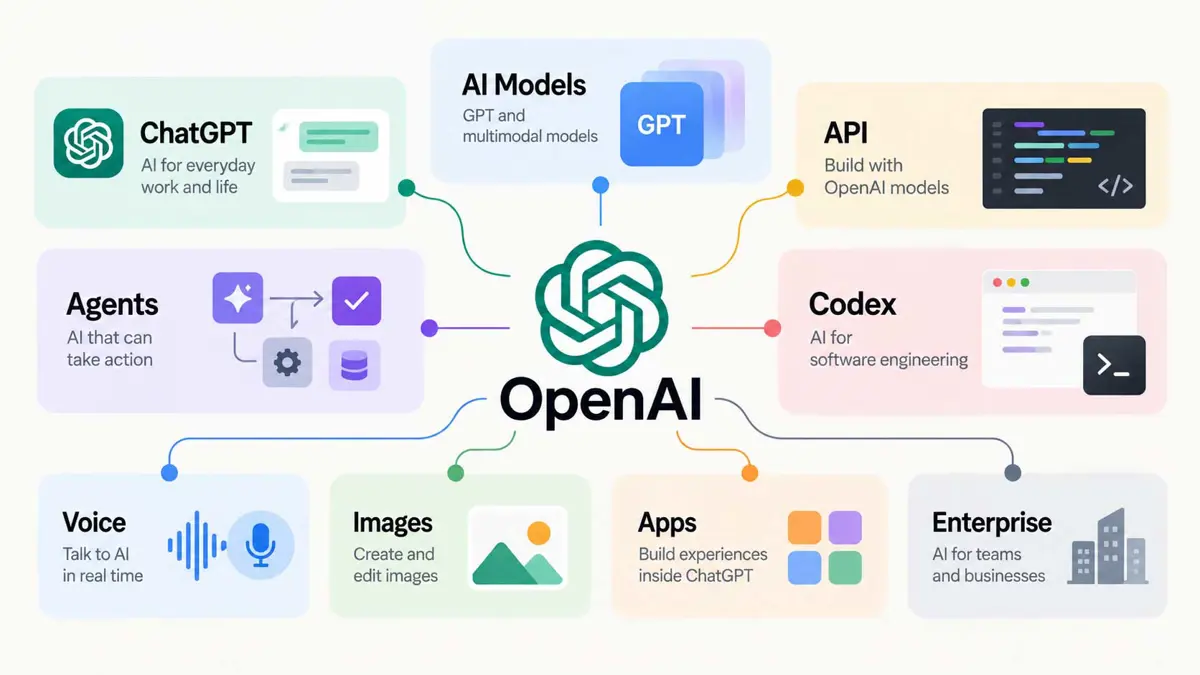
What Does OpenAI Do? The short answer is that OpenAI researches and deploys artificial intelligence, builds foundation models, and turns those models into products and developer services. OpenAI describes itself as an AI research and deployment company, with a mission centered on ensuring that artificial general intelligence benefits humanity. OpenAI's official overview also describes its current structure as the nonprofit OpenAI Foundation and the for-profit OpenAI Group.
The longer answer is more useful because OpenAI can look like a collection of unrelated products. ChatGPT is a consumer and work product. GPT models are the underlying AI systems. The API lets developers put those models into their own software. Agents add the ability to use tools and complete multi-step work. Codex focuses on software engineering. Audio, image generation, and apps extend the same platform into other forms of interaction.
OpenAI is the company. GPT models are the model layer. ChatGPT is a product layer. The API is the developer layer. Tools and agents let models do more than generate a response.
How OpenAI's Pieces Fit Together
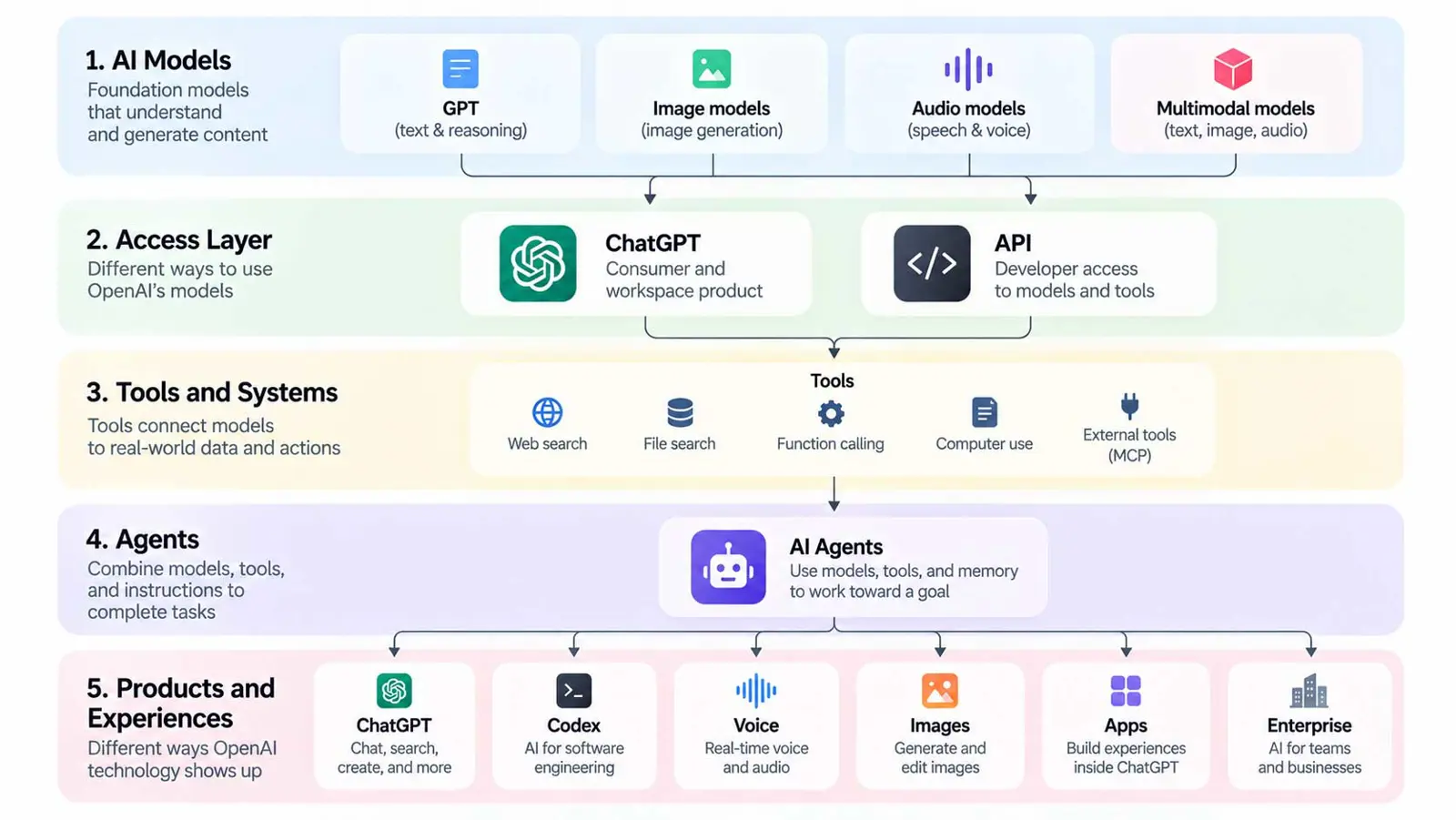
The easiest way to understand OpenAI is to think in layers rather than product names. A model can understand inputs and generate outputs. A product wraps that model in an experience for people. An API gives developers access to model capabilities. Tools connect models to external systems. Agents combine models, tools, instructions, state, and execution environments so they can work through a goal.
| Layer | What it does | Example |
|---|---|---|
| OpenAI | Researches and deploys AI | Research, products, developer platform |
| Models | Understand inputs and generate outputs | GPT-6 Astra, GPT-6.1 Sol, GPT-6 Luna |
| Products | Put AI into ready-to-use experiences | ChatGPT, Codex |
| API | Lets developers build with OpenAI | Responses API, Realtime API |
| Tools | Give models access to actions and information | Web search, file search, function calling, MCP |
| Agents | Combine models, tools, context, and execution | Agents API, Agents SDK |
| Apps | Bring third-party experiences into ChatGPT | Apps SDK and MCP apps |
That layered view also explains why an announcement about one OpenAI product does not necessarily describe everything OpenAI can do. A new model can appear in several products. A new API capability can power products that look completely different to end users. And an agent can sit on top of a model without being a new model itself.
What Does OpenAI Do as a Company?
At the highest level, OpenAI combines research with deployment. Its research work focuses on areas including frontier models, reasoning, multimodal systems, and safe deployment. The company then makes parts of that work available through products and developer services. OpenAI's research overview describes its work as advancing AI science on the path toward AGI while developing systems that can understand context, generate content, and reason across modalities.
This research-to-product path matters because the same underlying technology can move through several stages. A capability may begin as a research result, become a model, appear in ChatGPT, become an API feature, and later become part of an agent or another application. The products change faster than the basic structure of the platform.
Saganote has covered that broader company story from several angles, including OpenAI vs Anthropic vs Google DeepMind and reporting on OpenAI's acquisition of NextSlide. Those stories are useful examples of how OpenAI's strategy reaches beyond a single chatbot.
What Are OpenAI's AI Models?
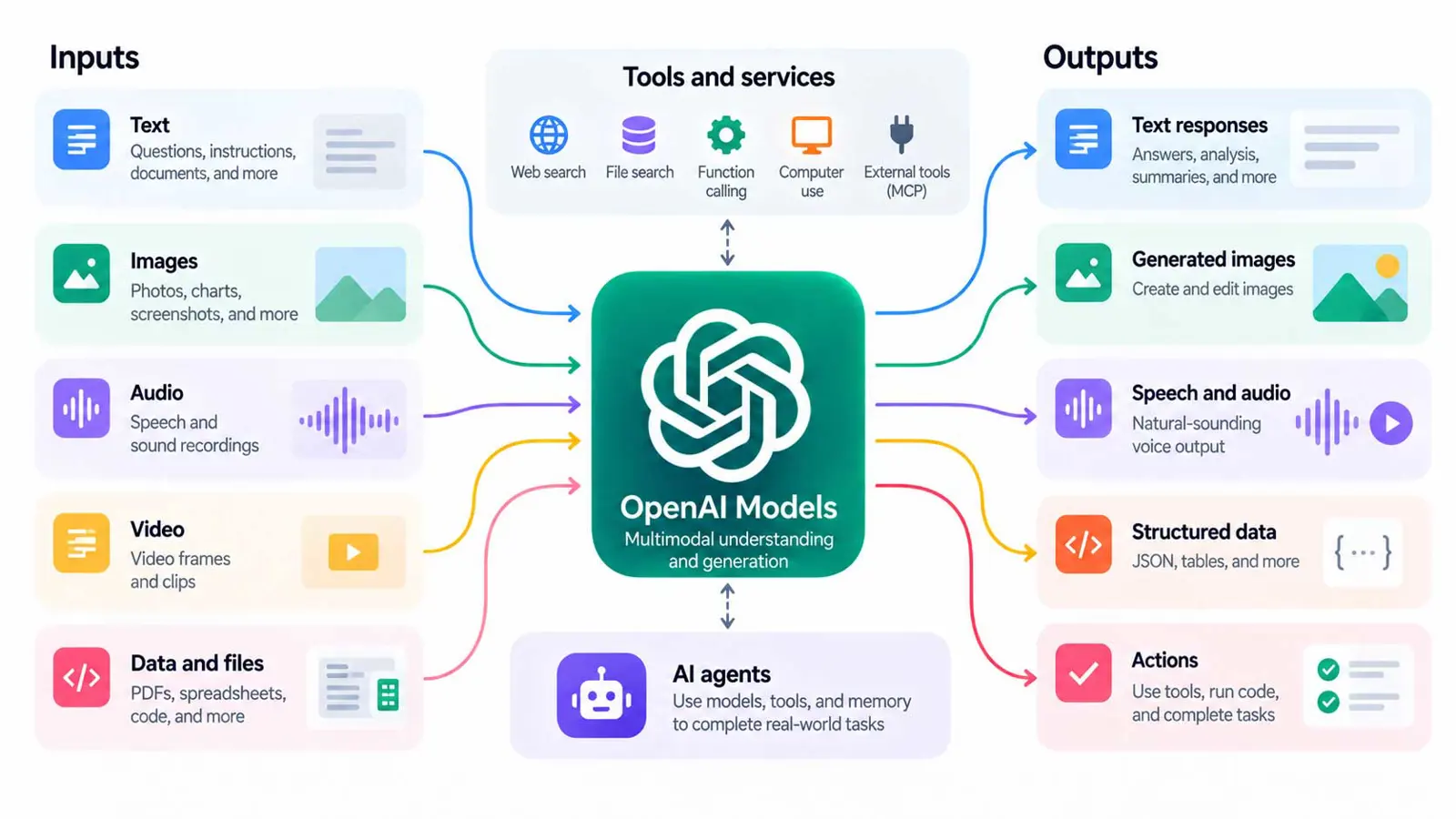
Models are the core computational systems behind many OpenAI capabilities. They process inputs and produce outputs such as text, structured data, images, or audio. Different models can be optimized for different trade-offs, including reasoning ability, speed, cost, coding, audio, or image generation.
The current OpenAI API model catalog separates flagship models from image, realtime and audio, embedding, open-weight, and other specialized model families. The catalog currently lists GPT-6 Astra for demanding work, GPT-6.1 Sol as a lower-cost high-capability option, and GPT-6 Luna for focused, high-volume workloads, alongside separate audio and image model families. The official model catalog is the source to use when model names or availability change.
This is why it is useful to separate a model from a product. A model is a building block. ChatGPT is an application that can use models, tools, memory or state, interfaces, and other services around that building block.
For a deeper explanation of the technology underneath these systems, see Saganote's guide to large language models. Saganote also explains how chatbots work and how to create a first chatbot. It explains the model concept without tying the explanation to one OpenAI release.
What Is ChatGPT?
ChatGPT is OpenAI's most visible user-facing product. Instead of asking people to manage API keys, model endpoints, tool definitions, and application code, ChatGPT packages AI capabilities into a ready-to-use interface.
That interface has expanded far beyond a simple text chatbot. Depending on the product, plan, and availability, ChatGPT can work with files, images, voice, web research, connected services, coding workflows, agents, and collaborative work. The exact feature set changes, so an evergreen article should explain the role of ChatGPT rather than freeze a temporary feature list.
Saganote's ChatGPT pricing guide covers the plan layer, while ChatGPT for teens shows how OpenAI also adapts the product for different user groups. Coverage of the ChatGPT Linux desktop app and ChatGPT iMessage integration shows another part of the same strategy: bringing the assistant into places where people already work.
The key distinction is simple: ChatGPT is a way to use OpenAI technology. It is not the name of the company, and it is not the name of every model OpenAI builds.
What Is the OpenAI API?
The OpenAI API is the developer-facing layer. Instead of using ChatGPT as a finished application, a developer can send input to an OpenAI model and build the surrounding product themselves.
The current platform provides several paths. The Responses API handles direct model requests, structured outputs, multimodal inputs, stateful interactions, and tool use. The Realtime API targets low-latency audio sessions. The Agents API and Agents SDK provide ways to build longer-running or application-managed agents. OpenAI's API platform documentation lays out those paths and the model choices available today.
| Goal | OpenAI layer to consider |
|---|---|
| Add text or image understanding to an app | Responses API |
| Build tool-using workflows | Responses API with tools |
| Build a custom agent loop | Agents SDK |
| Run a managed long-running agent | Agents API |
| Build realtime voice | Realtime API or GPT-Live |
| Generate or edit images | Image generation APIs and tools |
| Add speech capabilities | Audio and realtime APIs |
| Build an app inside ChatGPT | Apps SDK |
For developers, this distinction changes the question from "Which ChatGPT plan should I buy?" to "Which OpenAI platform surface matches the product I am building?" That is one of the most important differences between ChatGPT and the API.
Saganote also maintains AI API Pricing 2026 and a broader AI Pricing comparison. Those pages are better places for current price comparisons because API prices can change while the basic role of the API remains stable.
What Can OpenAI Models Do With Tools?
A model becomes more useful when it can interact with information and systems outside its immediate prompt. OpenAI's current tool layer includes web search, file search, function calling, remote MCP servers, computer use, image generation, shell access, tool search, and programmatic tool calling. OpenAI's tools documentation describes these as ways to extend model capabilities.
Consider a simple workflow. A user asks an AI system to investigate a customer issue. The model can interpret the request, search a knowledge base, call a company function, inspect a file, and then write a response. The model does not magically know the company's private database. Tools give it a controlled way to reach that information.
Function calling is especially important here. OpenAI describes it as a way for models to interface with external systems and access data or functionality outside their training data. The function-calling guide explains the pattern in developer terms.
Saganote's OpenAI data agent coverage is a useful real-world example of this idea. The interesting part is not simply that a model can answer a question. The system can connect the question to data and produce a useful output such as a dashboard.
What Are OpenAI Agents?
An AI agent is a system that can pursue a task through multiple steps instead of producing one isolated answer. OpenAI's current agent tooling gives developers several ways to build these systems. The Agents documentation describes agents as systems that can plan and complete tasks using tools, work with other agents, and maintain context across steps.
The distinction becomes clearer when compared with a normal chatbot. A chatbot might answer, "Here is how to update the report." An agent can be given the goal of updating the report, inspect the relevant files, use tools, make changes, and return the result, subject to the permissions and controls the application gives it.
| System | Main job |
|---|---|
| Chatbot | Respond to a conversation |
| Model with tools | Respond while accessing selected tools or data |
| Agent | Pursue a goal across multiple steps and tool calls |
| Multi-agent workflow | Coordinate several specialized agents or tasks |
OpenAI's Agents API is designed for durable cloud agents using a managed Codex harness. OpenAI manages sessions, orchestration, context compaction, and recovery, while the application supplies tools and chooses the execution environment.
For readers who want the concept without the OpenAI-specific implementation, Saganote's What Is an AI Agent? and What Is Agentic AI? explain the broader category. The AI Agent vs Chatbot distinction is useful when the terms start to blur. Readers who want to build one can continue with How to Create an AI Agent.
Why Codex Matters to OpenAI's Platform
Codex is OpenAI's coding-agent layer. It is designed for software engineering tasks such as writing, reviewing, editing, and debugging code. OpenAI's current developer documentation describes Codex as a coding agent that can work through an IDE, CLI, web and mobile experiences, and CI/CD workflows. The official code-generation guide explains where Codex fits compared with integrating coding models directly.
That makes Codex different from ordinary code completion. A coding agent can work through a larger task, inspect a repository, modify files, run commands or tests, and return results. The exact workflow depends on the environment and permissions, but the underlying idea is the same: the AI operates as a software-engineering worker rather than only a text generator.
Saganote's coverage of GPT-6 Sol and Luna, GPT-6.1 Sol, and the OpenAI admin plugin for ChatGPT Work and Codex shows how quickly this category is expanding. The more durable point is that OpenAI is treating coding as an agent workflow, not just a prompt-and-answer task.
For the current Codex product surface, use OpenAI's Codex documentation when checking interfaces, supported workflows, or setup details because those details can change faster than the underlying concept.
What Does OpenAI Do With Voice and Audio?
OpenAI also treats audio as its own model and API category. Developers can build transcription, text-to-speech, realtime speech, translation, and full voice-agent experiences. The current audio documentation recommends GPT-Live for new conversational voice applications, while the Realtime API provides a stateful session and tool model for speech-to-speech interactions. OpenAI's audio guide explains how the different approaches fit together.
The Realtime API can handle voice-to-voice interaction without requiring a separate speech-to-text and text-to-speech step in the application architecture. It can also maintain session state and use tools. The Realtime conversation guide explains the speech-to-speech model and session behavior.
Saganote's OpenAI GPT-Live coverage and the pillar Voice AI Models Explained provide the broader context. Voice is no longer just a transcription feature. It can be an interface for an agent that listens, reasons, calls tools, and responds aloud.
What Does OpenAI Do With Images and Vision?
OpenAI's platform also works with images in two directions. Models can analyze image inputs, while GPT Image models can generate or edit images. The current images and vision documentation separates understanding images from generating them, while the image-generation tools let applications create or edit visual content.
This matters because multimodal AI changes the input and output surface. A user can give an application a screenshot, photograph, diagram, or other visual input. The system can analyze it and combine that information with text or tools. In the other direction, an application can ask an image model to create or edit a visual result.
Saganote's ChatGPT visual ads coverage is an example of how image generation can become part of a product experience rather than a standalone image tool.
What Are ChatGPT Apps?
OpenAI is also making ChatGPT a place where third-party applications can run. The Apps SDK lets developers design an app's logic and interface for use inside ChatGPT. OpenAI's current help documentation says the SDK is built on Model Context Protocol, or MCP, an open standard for connecting ChatGPT to external tools and data. OpenAI's Apps SDK guide covers the current preview and developer workflow.
This creates an important distinction from the API. With the API, a developer puts OpenAI capabilities into an application. With the Apps SDK, a developer can put an application experience into ChatGPT.
| Approach | Where the experience lives |
|---|---|
| OpenAI API | Inside the developer's application |
| Agents SDK | Inside the developer's agent workflow |
| Agents API | In OpenAI-managed agent infrastructure |
| Apps SDK | Inside ChatGPT |
| MCP | Connects models and apps to external tools and data |
Saganote's ChatGPT iMessage coverage shows the broader direction from another angle. ChatGPT is becoming a surface through which users can reach more software and services, rather than a destination limited to a text conversation.
What Is MCP and Why Does It Matter?
Model Context Protocol, or MCP, is a standard for connecting AI systems to external tools and data. In practical terms, it gives an AI application a common way to discover and call capabilities exposed by a remote server.
That matters for agents because agents need more than a model. They need access to information and actions. A model can decide that it needs a calendar event, a database record, a file, or another service. MCP can provide a standardized connection to those capabilities.
OpenAI's current Apps SDK is built on MCP, and OpenAI's tools documentation also describes remote MCP servers as one way to extend model capabilities. In realtime voice systems, OpenAI documents MCP as another tool type alongside application-owned function tools. This is one reason MCP is becoming relevant to the broader agent architecture rather than only to ChatGPT apps.
OpenAI's Platform Is Bigger Than ChatGPT
It is easy to think of OpenAI as "the company behind ChatGPT." That is true but incomplete. A better map looks like this:
- Research develops new model capabilities and safety techniques.
- Models provide the underlying intelligence for different workloads.
- ChatGPT packages those capabilities for people and teams.
- The API lets developers build their own products with OpenAI models.
- Tools connect models to information, software, and actions.
- Agents combine models, tools, context, and execution into longer workflows.
- Codex applies the agent model to software engineering.
- Voice and realtime systems turn spoken interaction into an application interface.
- Image and vision capabilities add visual inputs and outputs.
- Apps bring third-party experiences into ChatGPT.
DevDay 2026 provides a useful snapshot of this architecture. OpenAI's September 29 recap described more than 20 announcements across ChatGPT, Codex, models, and new ways of working with AI. It also described agents that can take on ongoing responsibilities and ChatGPT as a shared surface where people, agents, and developer-built experiences can interact. That is current evidence of the direction of the platform, not a permanent promise about every future product.
The DevDay 2026 recap is worth reading for the current announcements. This pillar should remain broader because individual model names, plans, and features will change.
What Does OpenAI Do for Developers?
For developers, OpenAI is closer to a platform than a single model provider. A team can start with a direct model request, add structured output, connect tools, introduce state, and eventually build an agent. The platform supports different execution patterns so the developer can decide how much of the agent loop OpenAI should manage.
OpenAI currently presents three main agent paths: the Agents API for long-running work with an OpenAI-managed harness, the Agents SDK for custom agent loops inside an application, and the Responses API for direct model interaction or building an agent from scratch. OpenAI's agent guide lays out those options.
The result is a stack rather than a single product. A developer might use a GPT model for reasoning, function calling for a private business system, file search for internal documents, a sandbox for execution, and an agent runtime to coordinate the steps.
ChatGPT, GPT, API, Agents, and Codex: What's the Difference?
| Term | What it means |
|---|---|
| OpenAI | The company that researches and deploys AI systems |
| GPT | A family of OpenAI AI models |
| ChatGPT | A user-facing OpenAI product built around AI capabilities |
| OpenAI API | Developer interfaces for using OpenAI capabilities in software |
| Tools | Capabilities that let models access information or take actions |
| Agents | Systems that use models and tools to complete multi-step tasks |
| Codex | OpenAI's coding-agent product and workflow |
| Apps SDK | Toolkit for building apps that run inside ChatGPT |
| MCP | Open standard for connecting AI applications to tools and data |
That vocabulary matters because product announcements often use several of these terms in the same sentence. Once the layers are separated, the announcements become much easier to understand.
How OpenAI Makes Money
OpenAI has several commercial surfaces rather than one simple product line. ChatGPT has consumer and business plans. Developers pay for API usage. Organizations can buy business and enterprise offerings. OpenAI also has an expanding developer platform around agents, tools, and applications.
Current pricing is deliberately kept out of this evergreen explanation because prices and plan structures change. For current comparisons, use Saganote's ChatGPT Pricing 2026, AI API Pricing 2026, and AI Pricing Comparison 2026.
Recent Saganote reporting on ChatGPT's advertising business and Anthropic's revenue growth relative to OpenAI are other examples of why this section needs to be treated as a changing part of the company rather than a fixed description. Revenue sources can expand or change while the underlying platform architecture remains recognizable.
Who Uses OpenAI?
- Individuals use ChatGPT for questions, writing, research, coding, voice, images, and other tasks.
- Developers use APIs and SDKs to build AI features into their own software.
- Companies use ChatGPT and APIs for internal workflows, knowledge access, automation, and software development.
- Software teams use agents and tools to automate multi-step work.
- Developers can build applications that run inside ChatGPT through the Apps SDK.
The same model technology can therefore appear in very different experiences. A student might see a chat interface. A developer might see a JSON response from the API. A company might see an agent working in a controlled environment. A programmer might see Codex editing a repository. The underlying OpenAI platform connects those experiences.
OpenAI vs ChatGPT vs GPT
The shortest explanation is this: OpenAI is the company, GPT is a model family, and ChatGPT is a product. The API is how developers access platform capabilities, while agents and tools describe ways those capabilities can perform work.
That distinction is also why comparisons such as ChatGPT vs Gemini vs Claude are product comparisons, not company-to-company comparisons. A model, product, and company operate at different layers.
What OpenAI's Recent Direction Tells Us
OpenAI's current platform shows a move from isolated model responses toward systems that can operate across longer workflows. DevDay 2026 highlighted agents, Codex, models, ChatGPT collaboration, and developer-built experiences. The current API documentation likewise emphasizes tools, agents, multimodal inputs, state, and execution environments.
That does not mean every OpenAI product is an agent or that every future feature will follow the same path. It does mean the current platform is being built around a broader idea: models become more useful when they can access context, use tools, take actions, and remain involved across multiple steps.
Saganote's coverage of OpenAI Dots, the Meta Muse vs Grok Bot vs OpenAI Dots comparison, and its OpenAI admin plugin coverage shows several current expressions of that broader shift toward AI that can participate in ongoing work.
Common Questions About OpenAI
Is OpenAI the same thing as ChatGPT?
What does OpenAI sell to developers?
Is GPT a product or a model?
What is the difference between an OpenAI agent and ChatGPT?
What is Codex used for?
Can developers build an app inside ChatGPT?
The Best Way to Think About OpenAI
OpenAI is easier to understand when the product names stop being the starting point. Start with the layers instead: research creates capabilities, models provide intelligence, products package those capabilities, APIs expose them to developers, tools connect them to outside systems, and agents coordinate them across tasks.
ChatGPT is the most familiar front door, but it is only one part of the system. Codex applies the same broader idea to software engineering. Voice and realtime APIs make conversation an interface. Image models add visual creation and understanding. Apps and MCP connect ChatGPT and agents to other software.
That structure is the durable answer to What Does OpenAI Do? The names of individual models, plans, interfaces, and features will keep changing. The underlying pattern is much easier to follow: OpenAI builds AI capabilities, turns them into products and platform services, and gives people and developers ways to use those capabilities to perform increasingly complex work.