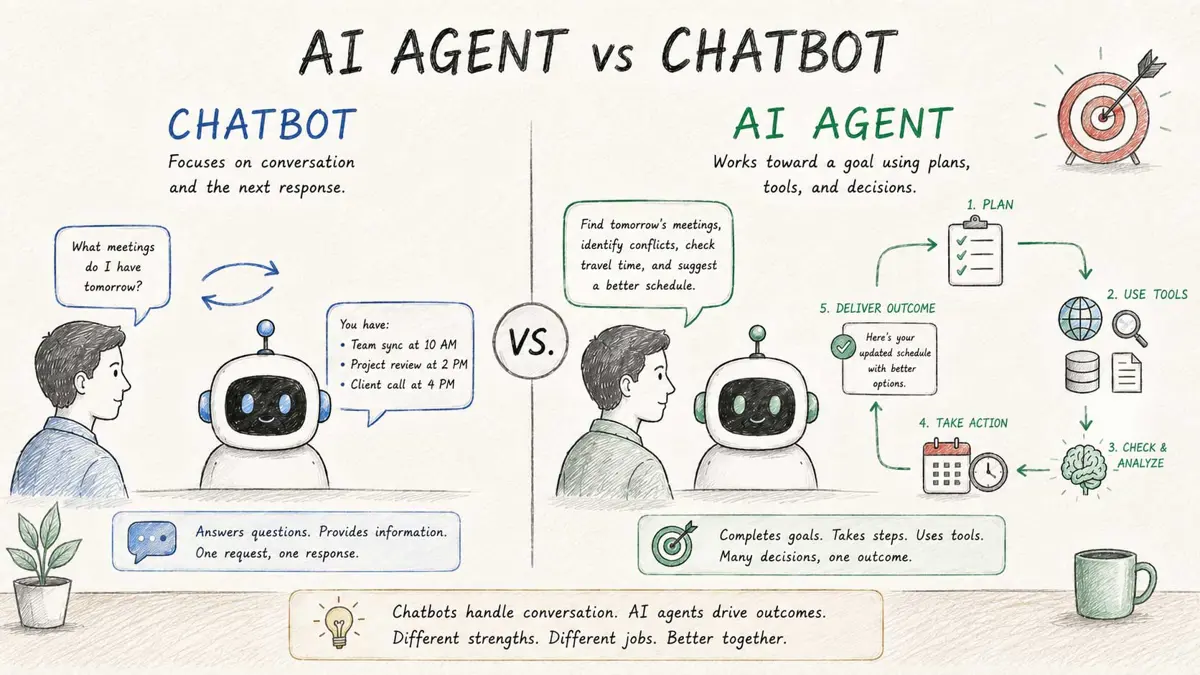
The simplest way to understand the AI agent vs chatbot distinction is to ask one question: what happens after the first answer? A chatbot generally responds to the conversation in front of it. An AI agent can decide what to do next, call tools, inspect what comes back, and continue working toward a defined outcome.
That does not mean every chatbot is simple or every agent is fully autonomous. Modern chatbots can search, retrieve files, call tools, and complete useful tasks. The useful dividing line is the system's ability to manage a multi-step objective rather than merely the number of features attached to the chat interface.
AI Agent vs Chatbot: The core difference
A chatbot is primarily a conversational interface. It receives an input, interprets it using rules, retrieval, or an AI model, and generates a response. The user usually decides what to ask next and when to move from one step to another.
An AI agent adds a decision loop around the model. It can break a goal into steps, choose among available tools, observe the results, and revise the next step when the situation changes. OpenAI describes agents as systems that can plan, decide, and act toward a goal within human-defined guardrails, while Anthropic describes the agent pattern as a self-directed loop of planning, acting, observing, and repeating.
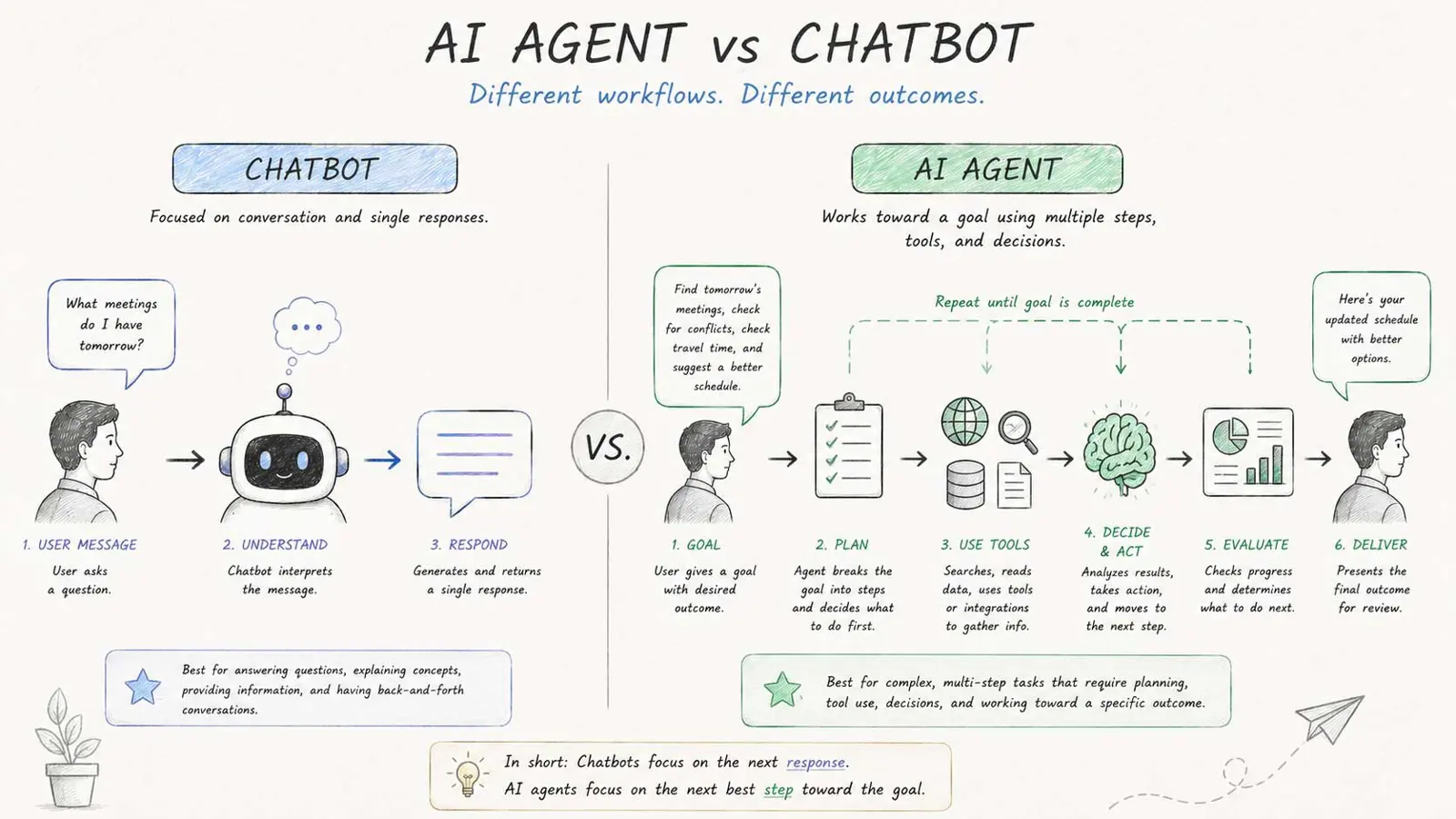
Chatbot vs AI agent: What changes?
The two systems can look almost identical on screen. The difference becomes obvious when the task requires several connected decisions.
| Capability | Chatbot | AI agent |
|---|---|---|
| Conversation | Core interaction | Can use conversation as the interface |
| Planning | Usually limited to the current response | Can plan multiple steps toward a goal |
| Tool use | May call tools when explicitly designed to do so | Can choose among approved tools as part of the task |
| Multi-step work | Often requires repeated user prompts | Can continue across several steps |
| Actions | Usually returns information or a suggested action | Can perform permitted actions through connected systems |
| Human approval | Often happens before the next request | Can pause for approval at defined checkpoints |
| Goal orientation | Primarily response-oriented | Goal-oriented and outcome-focused |
The boundary is not perfectly binary. A chatbot with web search and tool calling can perform actions, while an agent can still spend most of its time talking. What matters is whether the system can manage the work between the user's instructions instead of waiting for a new prompt after every step.
A simple example: checking tomorrow's schedule
Imagine asking, "What meetings do I have tomorrow?" A capable chatbot can read a calendar and return the meetings. That is useful, but the user still owns the next decision.
Now change the request to: "Find tomorrow's meetings, identify conflicts, check travel time between locations, and suggest a revised schedule." The task now contains several dependent steps. An agent could inspect the calendar, identify overlapping events, query a travel service, compare the results, and prepare a recommendation without requiring a fresh prompt after each operation.
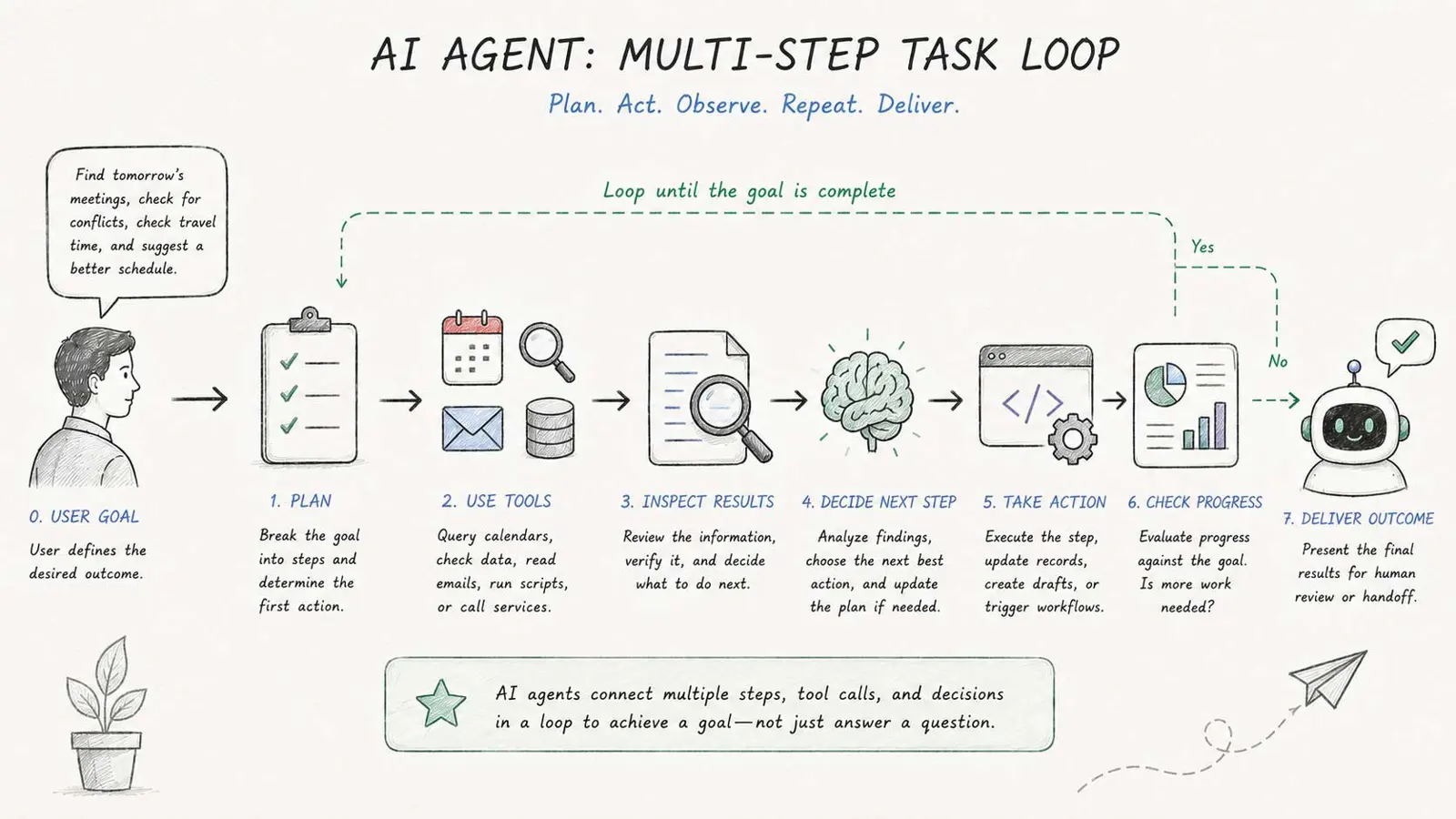
That is the practical difference. The agent does not simply produce a better answer; it manages a larger portion of the path between the request and the outcome.
Conversation vs planning
Chatbots are naturally good at conversational work. They can answer questions, explain concepts, summarize information, draft text, classify requests, and guide a user through a process one turn at a time.
Agents become more useful when the process itself contains uncertainty. Instead of following one fixed sequence, an agent can decide which step makes sense after it sees the previous result. Google Cloud describes this pattern as a reason-act-observe loop in which tool output feeds the next reasoning step.
The distinction matters because planning introduces another layer of responsibility. A system that chooses what to do next needs boundaries around its tools, data, permissions, and stopping conditions.
Tool use is important, but it is not the whole story
It is tempting to define an agent as "a chatbot with tools." That shortcut is too broad. Tool calling alone does not make a system an agent.
A chatbot might call a search tool once, retrieve a document, or send a single API request because the user explicitly asked for it. An agent can use tools as part of a larger decision loop: select a tool, inspect the result, decide whether another tool is needed, and continue until it reaches the intended state or requires human input.
OpenAI's current agent guidance similarly separates the model from the tools and guardrails around it. The model provides reasoning, tools provide access to external systems, and guardrails constrain what the agent can do.
Planning, action, and independence
Planning gives an agent a way to turn a broad goal into smaller operations. Action gives it a way to change something outside the model itself. Independence describes how much of that process the system can handle before it needs another instruction.
These three ideas often appear together, but they are not identical. A system can plan without taking action. It can take actions through a rigid workflow without deciding what to do next. And it can perform several steps while still requiring human approval before important actions.
Human approval still matters
A useful agent does not need unlimited freedom. High-impact actions such as sending a message, changing account data, making a purchase, or deleting information can require explicit approval before execution.
Anthropic highlights this trade-off directly: greater autonomy can make agents more useful, but it also creates more room for misunderstood intent, unintended actions, and prompt-injection risks. Human checkpoints therefore belong in the design, not as an afterthought.
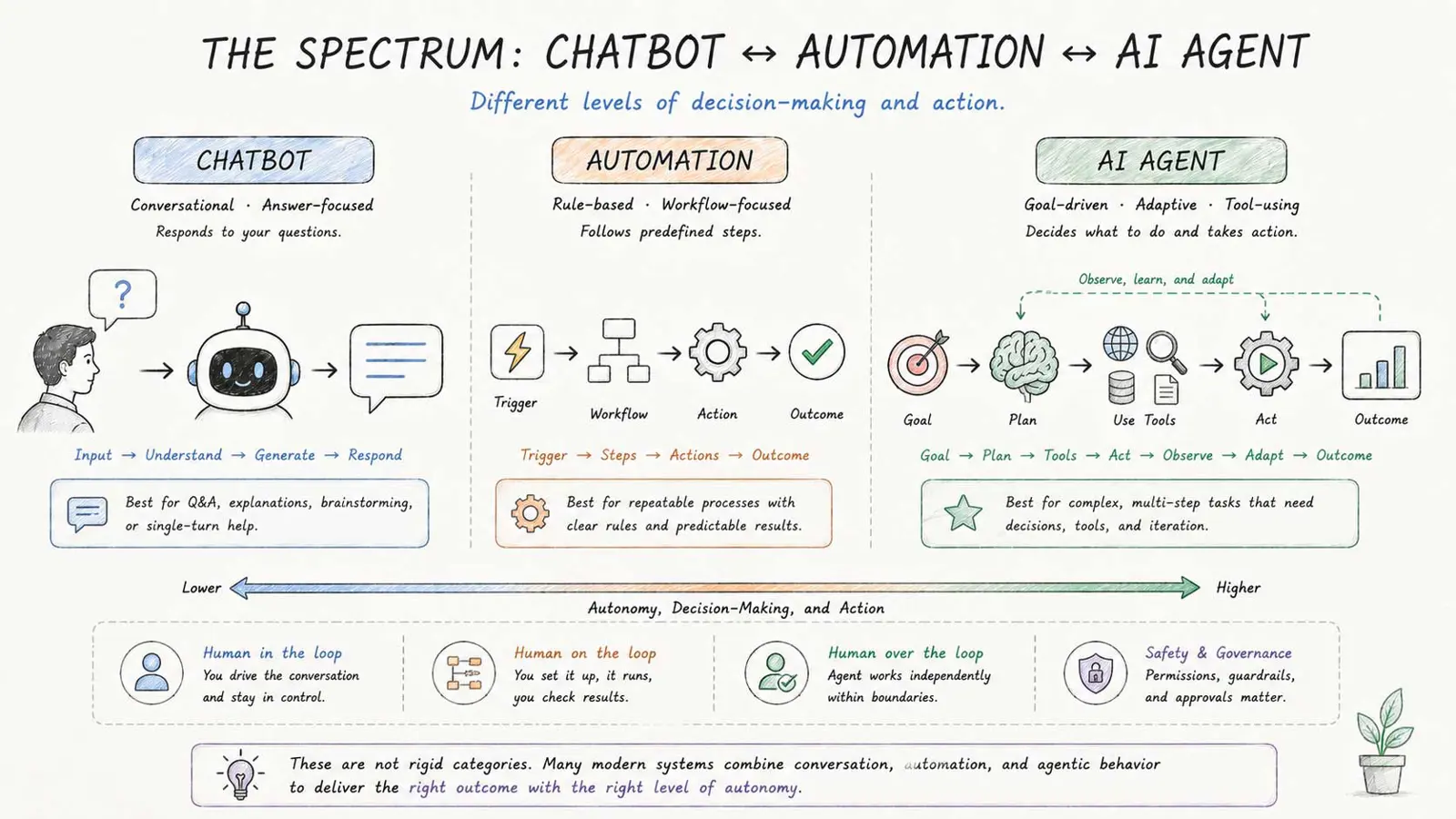
Chatbot vs agent vs automation
There is a third category worth separating from both: traditional automation. An automation normally follows a predefined path. If the trigger is X, the workflow performs A, then B, then C.
An agent can operate inside a workflow while making bounded decisions about the path. It may encounter missing information, choose another approved tool, or revise its next step based on a result. The workflow supplies the boundaries; the agent supplies more flexible decision-making inside them.
Which should you use?
A chatbot is usually the better fit when the main job is conversation, explanation, drafting, or question answering. It keeps the human close to each decision and avoids adding unnecessary autonomy to a simple task. If you want to move from understanding chatbots to building one, see our guide on how to create your first AI chatbot. It walks through the basic pieces of a working chatbot and shows how the conversation, instructions, knowledge, and model fit together.
Choose an automation when the process is predictable and repeatable. If the same inputs should always produce the same sequence of actions, deterministic rules can be easier to test, monitor, and control.
An agent makes more sense when the task is multi-step, requires judgment between steps, uses several tools, and has a clear outcome. The best agent use cases usually have enough structure to measure success but enough variation that a rigid script becomes cumbersome. If you want to build an agent for this kind of work, see our beginner's guide on how to create an AI agent. It takes the concepts covered here and turns them into a practical starting point for building an agent with instructions, tools, a decision loop, and clear boundaries.
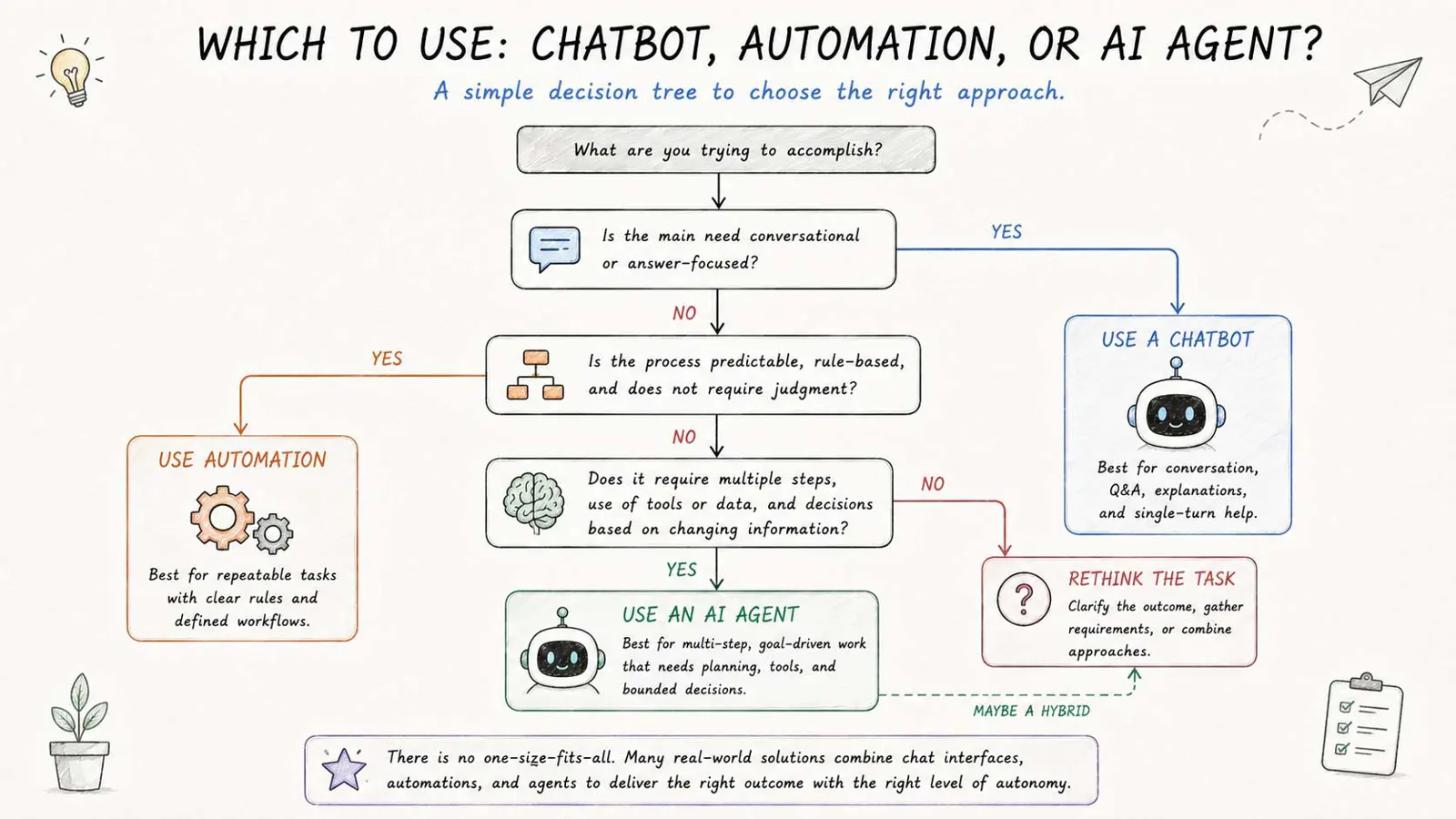
A good rule of thumb is simple: use the least autonomy that solves the problem well. More autonomy can reduce manual work, but it also increases the number of decisions that need testing, monitoring, and permission controls.
When does a chatbot become more agent-like?
There is no single switch that turns a chatbot into an agent. Products can add retrieval, memory, tool calling, planning, computer control, or background execution one capability at a time.
The shift becomes meaningful when the system can take a goal, decide among permitted next steps, act through tools, inspect the outcome, and continue without requiring the user to specify every intermediate instruction. That is the same basic idea covered in the guide to what an AI agent is.
The companion guide on what a chatbot is explains the other side of the comparison: how conversational systems receive a request, interpret it, and generate a response. Reading the two together makes the boundary easier to see.
For a broader look at systems that move from conversation toward goal-driven work, the guide to agentic AI and how it changes work adds the larger context.
The practical difference in one sentence
A chatbot mainly answers the next question. An AI agent can own more of the work between the question and the result.
That does not make agents automatically better. For a simple question, extra planning and tool access can add complexity without adding value. For a task that crosses several systems and requires decisions along the way, that extra layer can be exactly what turns AI from a conversational helper into a working system.
Frequently Asked Questions
Is every AI chatbot an AI agent?
Can an AI agent also be a chatbot?
Are AI agents fully autonomous?
Is automation the same as an AI agent?
When should a business use an AI agent?
Conclusion
The AI agent vs chatbot difference comes down to who manages the work after the initial request. A chatbot centers on conversation and responses; an agent can plan, use approved tools, inspect results, and continue toward a goal.
The most useful distinction is not whether a product calls itself an agent. It is whether the system can make bounded decisions between steps and take responsibility for more of the path to the desired outcome.