Claude Personal Finance, a US beta Anthropic released on Thursday, lets paid subscribers link bank and card accounts through Plaid and ask Claude about their own spending. Access is read-only, so the tool can read balances and transactions but cannot move, manage or invest money, according to Anthropic's announcement post. Plans start at $20 a month. Beyond the headline, three details decide whether it earns a place in a money routine: what data Claude sees, where that data goes, and how often the arithmetic holds up.
Anthropic's post, published Nov. 5 on claude.com, is the primary source for the details below. Access is US-only, for Pro, Max and Ultra subscribers. TechCrunch and Engadget supply the competitive context, including how OpenAI's ChatGPT Finances compares with Anthropic's version on plans, training and disconnect rules.
Anthropic's Beta Reads Balances and Two Years of Transactions, Not Bank Passwords
For each account a user links, Claude sees the bank's name, the account's name, type and last four digits, balances, credit limits and up to two years of transactions. Plaid handles the bank sign-in, so Claude never receives the password. Two years is a long window. That span covers every annual renewal and recurring fee in the period, which is what lets the tool compare this month with earlier ones.
| Visible to Claude | Off limits, per Anthropic |
|---|---|
| Bank name | Bank password (sign-in runs through Plaid) |
| Account name, type and last four digits | Moving money |
| Balances and credit limits | Managing accounts |
| Up to two years of transactions | Investing money |
Read-Only Access Blocks Money Movement, but Data Still Lands in Three Places
Read-only access answers one risk: no one can send a payment or change an account through the link. Privacy is a separate problem. Two years of transactions can reveal an employer, a landlord, a clinic and a daily routine, and that data has to live somewhere.
Data can sit in three places. Plaid brokers the connection and keeps its own records, which users can review and delete in the Plaid Portal at my.plaid.com. Anthropic excludes conversations inside the Personal Finance hub from model training. Chats outside the hub follow the user's normal privacy settings.
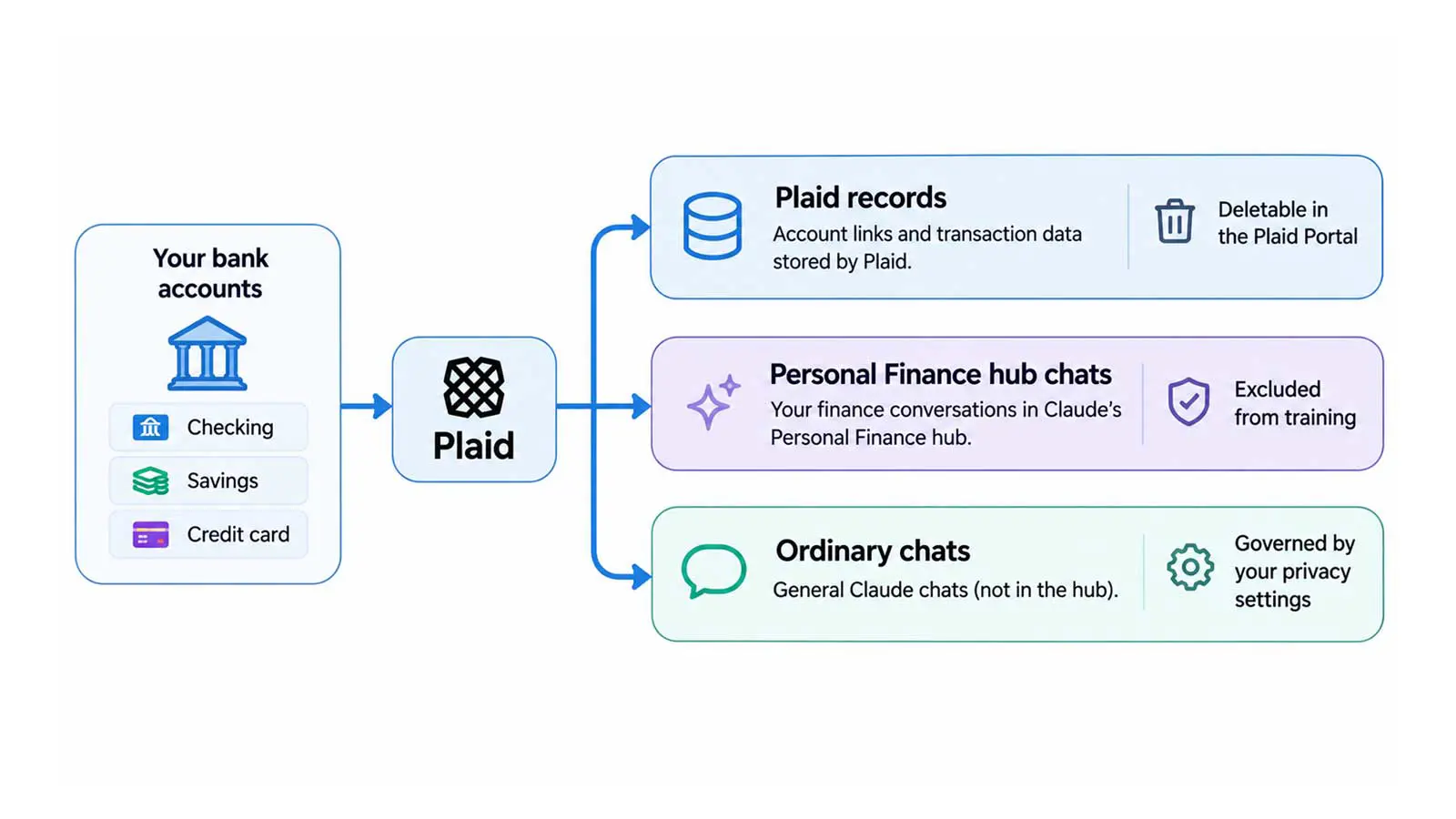
That boundary matters in practice. A subscriber who pastes a statement into an ordinary chat, or asks a follow-up there, leaves the hub's training exclusion behind and falls under whatever setting the account already has. Keeping money questions inside the hub is the simplest way to stay under the stronger promise.
Retention is the open question. Anthropic's post says unlinking an account stops Claude from seeing its data, but it points to the Privacy Center for detail and gives no deletion timeline in the announcement. OpenAI publishes one for ChatGPT, removing synced data within 30 days of disconnecting, the same window it uses for Health in ChatGPT. A deletion window is probably the first thing privacy-minded users will look for.
Claude Personal Finance Starts at $20 a Month, While ChatGPT Finances Began at Pro
OpenAI got there first. ChatGPT Finances went into preview on May 15 for US Pro subscribers only, with Plus subscribers expected to follow later. Saganote's pricing guide lists ChatGPT Pro at $100 and $200 a month, so the entry price for an assistant that reads bank data started at $100. Claude's beta opens to Pro at $20 a month, plus Max at $100 and Ultra at $200.
| Anthropic's Claude beta | ChatGPT Finances | |
|---|---|---|
| Launch | Nov. 5, 2026 (beta) | May 15, 2026 (preview) |
| Plans | Pro, Max, Ultra (US) | Pro (US), Plus later |
| Entry price | $20 a month (Pro) | $100 a month (Pro) |
| Linking | Plaid | Plaid, 12,000+ institutions |
| Accounts | Bank and card accounts | Banks, cards, brokerages, investments, liabilities |
| Access | Read-only | Cannot change accounts |
| Training | Hub chats excluded; other chats follow privacy settings | OpenAI's data controls apply |
| Disconnect | Unlink an account; Claude stops seeing its data | Settings > Apps > Finances; synced data removed within 30 days |
Brokerage coverage is the visible gap. ChatGPT Finances reads investment accounts, while Claude's beta, as Anthropic and TechCrunch describe it, covers bank and credit card accounts, and Anthropic says the tool is not designed to give investment advice. For readers weighing the assistants overall, Saganote's ChatGPT vs Gemini vs Claude guide covers the general differences.
Training terms differ in structure. Engadget reports that ChatGPT's finance tool applies OpenAI's existing data controls, so training stays on by default for users who never changed them. Anthropic's hub exclusion does not depend on a setting, according to its post.
Duplicate Charges and Fee Creep Are the Strongest Use Cases
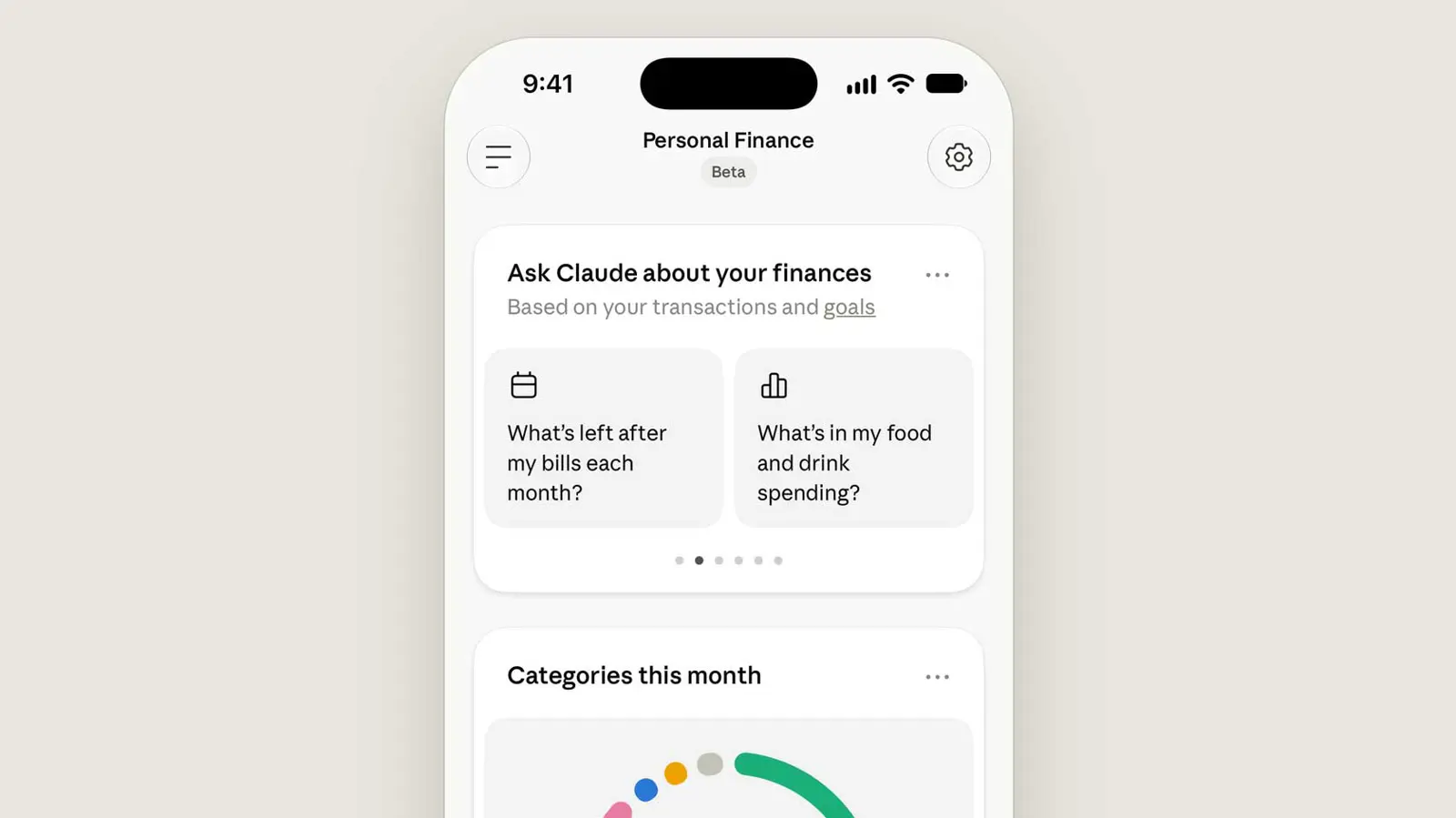
Anthropic pitches the tool at pattern-spotting: duplicate charges, unexpected fees and bills that crept up over time. Those tasks suit it. Answers sit in a list of transactions Claude can read, not in a forecast. Claude also totals spending by category, compares the current month with earlier ones, and builds weekly spending charts, due-date calendars and dashboards a user can keep adjusting.
Language models can slip on arithmetic, which is why Anthropic's own advice is to ask which transactions sit behind a number and to check important figures with the bank. A grocery total that looks too high, for example, may include a miscategorized rent payment. Asking for the underlying list takes seconds.
A First Session Takes Five Steps and One Linked Account
Anthropic's post says to open Personal Finance, connect one account and ask a single question, and it points to the Help Center for full setup steps. A cautious first run looks like this.
- Open Personal Finance in Claude and choose one account to link.
- Start with a credit card, since cards show the widest mix of recurring charges.
- Approve read-only access in Plaid's window; the bank password goes to the bank, not to Claude.
- Ask one broad question, such as where the money went this month.
- Ask which transactions sit behind the largest category, then check one against the bank's own app.
Afterward, the Plaid Portal shows which data types each connected app received and lets users disconnect an app or delete data Plaid holds. Reviewing it once after the first session confirms the link does what Anthropic says. Disconnecting is one click away.
Eight Prompts That Show Whether the Numbers Hold Up
These map to features TechCrunch and Anthropic describe. Prompts three and seven double as accuracy checks, because a bank statement can confirm the answer within minutes and expose any category Claude got wrong.
- "Where did my money go this month? Group it by category."
- "Is that more than usual? Compare it with the last three months."
- "List the transactions behind my food and drink total."
- "Find possible duplicate charges in the last 90 days."
- "Which recurring bills have increased over the past year?"
- "Do I spend more than I earn each month? Show the monthly figures."
- "How much interest did this card charge me over the past 12 months?"
- "Explain what APR means using my own card as the example."
Anthropic Is Building Toward Licensed Professionals, Not Investment Advice
Personal Finance did not arrive from nowhere. BleepingComputer reported on Sept. 16 that a Money section had appeared in the Claude iOS app, with the line "Link your bank accounts and ask Claude about spending, plans, and more." At the time, BleepingComputer noted that supported banks and regional limits were unknown.
Claude Personal Finance follows two professional products. Anthropic launched Claude for Financial Services earlier and Claude for Financial Advisors on Oct. 27. Engadget links the consumer launch to Anthropic's expected IPO, while Anthropic's post says the company is exploring how Claude can work alongside licensed professionals and regulated firms and is asking banks and wealth managers to get in touch.
Rollout continues through the week. Anthropic's post describes a US-only beta for Pro, Max and Ultra subscribers and gives no timeline for Free users or other countries.
Frequently Asked Questions
What does Anthropic's Personal Finance tool do?
Who can use the Personal Finance beta?
Can Claude move money or place trades?
Does Anthropic train its models on bank data?
How does a user disconnect an account?