
Why Decision Models Like Jev Can Be Much Faster Than LLMs
The difference is not simply model size. It is what the model is built to return.

Decision models are built for a different job from large language models. Instead of generating an open-ended answer, they evaluate an input against a defined set of possible outcomes and return a structured decision. Jev, a decision model from TypeSafe, is a current example of this approach. It is designed to return choices, scores, or yes/no probabilities that software can use directly.
That difference helps explain why a decision model can be much faster than an LLM on narrow tasks. An LLM is designed to generate language, usually one token after another. A decision model can evaluate the input and return the required decision without generating a paragraph first. The trade-off is equally important: the decision model gives up the flexibility of open-ended generation.
For background, a large language model is a system built to predict and generate language. Decision models narrow the problem before inference begins: the application defines what kind of answer it needs, and the model evaluates the input within that boundary.
What Is a Decision Model?
A decision model answers a question whose possible outcomes are known in advance. A support system might need to choose between Billing, Technical Support, and General Support. A moderation system might need to decide whether content is allowed, needs review, or should be blocked. A workflow might need a score for urgency or a probability that a condition is true.
The important part is the shape of the output. The software already knows what it can do with the result. It does not need an essay explaining the answer. It needs a value that can trigger the next step.
- Choice: select one option from a defined set.
- Score: place an input on an ordered scale such as urgency or risk.
- Probability: estimate how likely a yes/no statement is to be true.
TypeSafe's current Jev documentation uses these three primitives under the names Choice, Score, and Noul. The company describes Jev as a System One model for software, although "System One" is TypeSafe's product terminology rather than a general industry standard. Jev's developer documentation describes the input as application state plus typed questions, with results that code can branch on, sort, and route.
How an LLM Handles the Same Task
Consider a customer who writes: "I was charged twice for my subscription and I want my money back." A conventional LLM can read the message, interpret the intent, and generate something such as "Billing." That works, but the model's natural interface is still text generation.
The model has to produce output that the application then has to interpret. If the application expects JSON, the LLM can be instructed to return JSON, but the generated response still has to be parsed and validated. If the answer does not match the expected schema or label set, the application may need a retry or fallback.
This is one reason structured-output prompting is not exactly the same thing as a decision model. An LLM can be constrained to produce a particular format, but its fundamental operation remains generative. A decision model starts with a constrained output space instead.
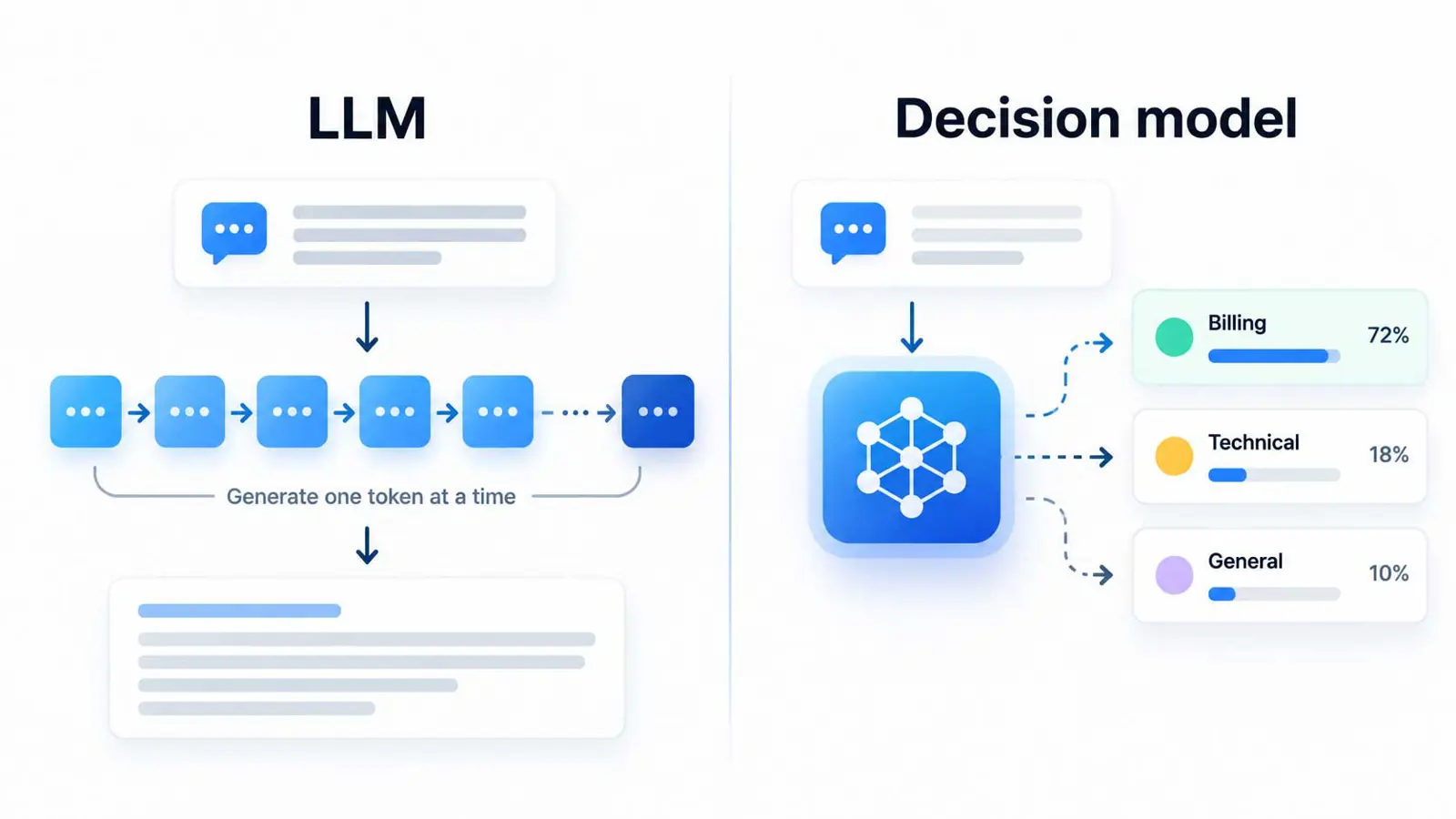
Why Decision Models Can Be Faster Than LLMs
The main reason is that the two systems are solving different inference problems. A generative LLM has to produce an output sequence. Each generated token becomes part of the context for the next token, so a longer response generally requires more generation steps.
A non-autoregressive decision model does not need to generate that sequence. Jev's model documentation describes it as evaluating an input in a single pass and returning a typed result. That removes the token-generation loop from the decision itself.
The distinction matters most when the application needs a small answer. If the next software action is simply "send this ticket to Billing," generating a paragraph about why it belongs in Billing is extra work. The application needs the decision, not the prose.
That does not make every decision model automatically faster in every real-world deployment. Network latency, server load, batching, hardware, request size, and the competing LLM all affect end-to-end response time. TypeSafe's published Jev latency figures are server-side measurements, so they should not be treated as a universal end-to-end multiplier.
Jev's Output Is Designed for Software
Jev's design becomes easier to understand when the output is viewed as part of an application rather than a chat response. A Choice result can determine which queue receives a ticket. A Score can determine whether an item crosses an escalation threshold. A Noul probability can determine whether the application asks for human confirmation.
The model can also answer multiple typed questions about the same input in one request. For a support ticket, an application could ask for department, urgency, and whether a refund request is present. The software can then combine those signals instead of asking a general-purpose model to explain all three decisions in natural language.
The approach fits naturally beside AI agents. An agent can use a generative model for open-ended reasoning and use a decision model for narrow routing or checks around that reasoning. TypeSafe itself describes Jev as sitting beside an LLM rather than replacing it.
A Decision Model Does Not Mean a Correct Decision
Constrained output solves one class of engineering problem, not the problem of accuracy. If an application gives a decision model four allowed categories, the model cannot invent a fifth category. But it can still select the wrong one.
Constraining the output space prevents malformed or out-of-range answers, but it does not guarantee that the selected option is correct. Probability and confidence should be treated as signals for application logic and human review, not as proof.
That distinction is important when comparing Jev with LLMs. A model that always returns a valid category may be easier to integrate, but a valid category is not the same as a correct category. Accuracy has to be measured on the actual decision task.
Recent 2026 research on Jev-style decision systems illustrates that trade-off. One study evaluated a Jev-based judge against generative judges and reported very low inference cost while also finding larger gaps on tasks that required checking a derivation or resisting a carefully written wrong answer. Another study on legal document judgments found Jev had lower measured cost and median response time in its tested configurations, while language models achieved higher baseline accuracy. These are task-specific research results, not evidence that one architecture wins across all AI workloads. JEV-as-a-Judge and Same Scores, Different Decisions provide the experimental details.
Where Decision Models Make Sense
Decision models are most useful when the application already knows what decisions it needs to make. Common examples include:
- Ticket routing: choose a support queue or escalation path.
- Risk scoring: assign an input to an ordered risk or urgency scale.
- Moderation: classify content into predefined policy outcomes.
- Human handoff: decide whether a request should be handled automatically or reviewed.
- Model routing: decide whether a request needs a faster model or a more capable reasoning model.
- Tool guardrails: check whether an action should proceed before an agent executes it.
These workloads share a useful property: the software has a finite set of next actions. That makes a typed result more useful than free-form prose.
Where an LLM Is Still the Better Fit
An LLM remains the natural choice when the answer itself needs to be generated. Writing an email, summarizing a long document, explaining a technical problem, generating code, holding a conversation, or answering an open-ended question all require flexibility that a bounded decision interface does not provide.
The difference is therefore less about choosing one model for everything and more about matching the model to the job. A useful architecture can use both: a decision model handles repetitive, bounded judgments while an LLM handles the cases that require explanation, generation, or broader reasoning.
That pattern also connects to the broader challenge of LLM inference. The cost and latency of AI systems depend on more than the model's raw capability. The amount of computation, generated output, serving hardware, and network path all shape what an application experiences.
Decision Models vs. LLMs: What Actually Changes?
| Factor | Decision model | Generative LLM |
|---|---|---|
| Primary output | Choice, score, or probability | Generated text or structured generation |
| Output space | Defined by the application | Broad token space |
| Generation | No token-by-token response required | Autoregressive generation is typical |
| Best fit | Routing, triage, scoring, guardrails | Writing, explanation, reasoning, conversation |
| Uncertainty | Can expose probabilities directly | Usually needs separate handling or prompting |
| Flexibility | Narrower | Much broader |
| Failure to watch for | Wrong decision inside valid options | Wrong or malformed generated output |
The table also shows why a simple "faster than LLMs" claim needs context. A decision model is fast partly because it is doing less. Comparing it with an LLM only makes sense when both are being asked to perform the same bounded decision.
The Practical Rule: Match the Output to the Job
A useful way to think about decision models is to start with the software's next action rather than the model's name. If the next step is a known branch, a score, a threshold, or a human-review decision, a decision model may fit naturally. If the next step requires new language, explanation, or open-ended reasoning, an LLM remains the more appropriate interface.
Jev makes that distinction concrete. Its speed comes from a constrained, non-autoregressive decision interface, not from a magical shortcut that makes every AI workload faster. The same constraint that makes it efficient also limits what it can do.
As decision models mature, the more useful question is not whether they replace LLMs. It is whether software can stop asking a generative model to produce language when all it really needs is a reliable machine-readable decision.
Frequently Asked Questions
Is Jev an LLM?
Why can a decision model be faster than an LLM?
Can a decision model still be wrong?
Does a decision model replace an LLM?
What is Jev's "System One" model?