Grok Voice 3.0 customer support is a useful way to judge xAI's new voice model because support calls require more than natural-sounding speech. An agent must understand a caller through noisy phone audio, ask relevant follow-up questions, retrieve account information, and complete a task without losing the thread. xAI says Grok Voice 3.0 is built for that kind of real-time work, and that it already powers customer conversations at Starlink and voice interactions in Tesla vehicles.
The model launched on October 14, 2026, through xAI's Voice Agent API. The company says it ranks first on Artificial Analysis's Speech-to-Speech Index and costs $0.08 per minute, the same rate as Grok Voice 2.0. Those are meaningful claims, but the practical test is whether an automated agent can solve a customer's problem reliably, not simply produce a fast or convincing voice.
What Grok Voice 3.0 is designed to do
Grok Voice 3.0 is a speech-to-speech model. Rather than requiring an application to treat every conversation as a separate speech-recognition, text-model, and speech-generation job, it is designed to process spoken input and respond with speech in a real-time session. Developers can connect the agent to tools and business systems so it can do more than answer general questions.
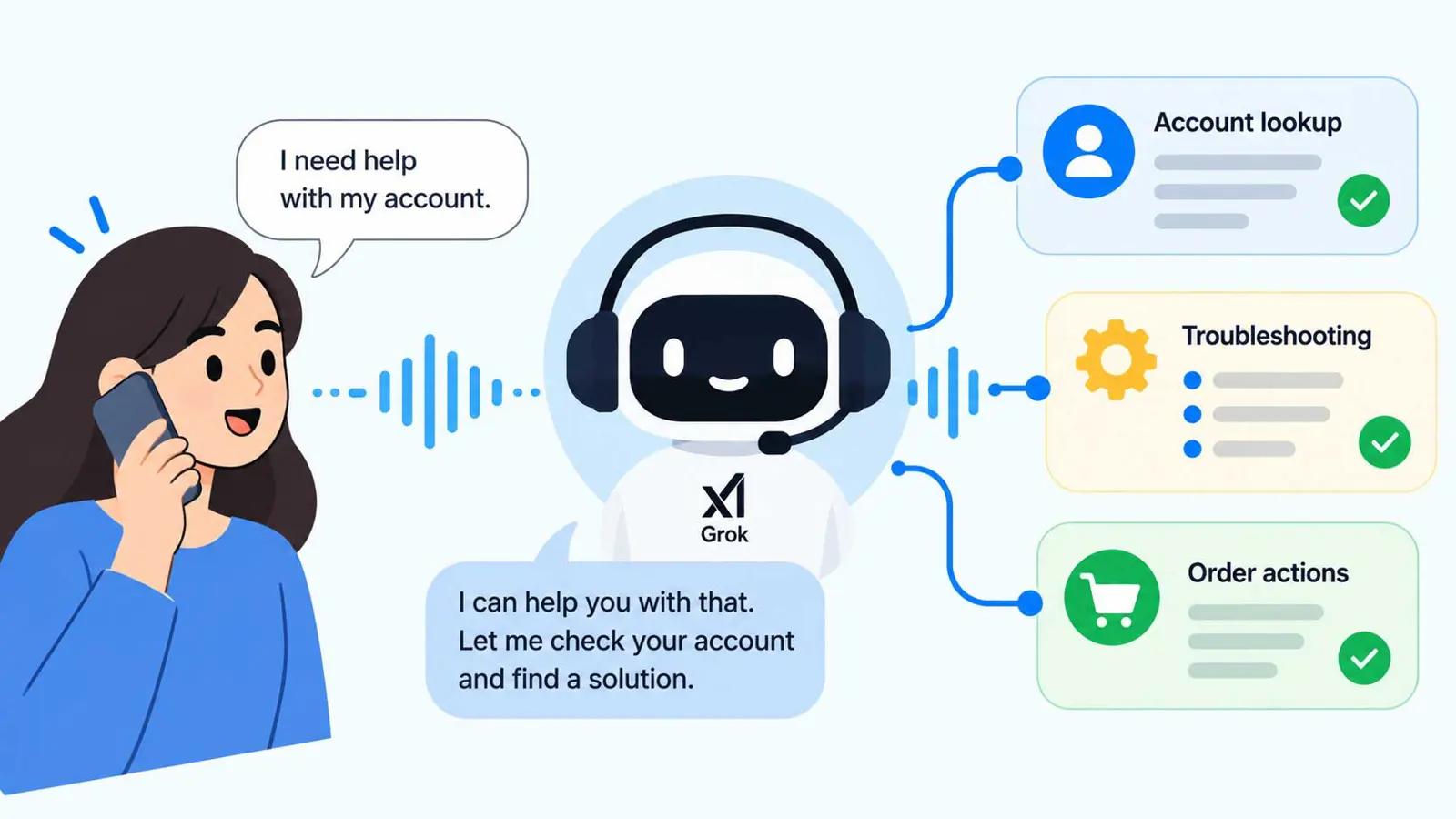
That distinction matters in customer support. A basic voice bot might explain a return policy or read out troubleshooting steps. A connected agent could, if the business has granted the right permissions and built the integration, look up an order, check an account, issue an eligible credit, or start a replacement shipment. The model supplies conversation and reasoning capabilities; the surrounding software determines which real actions it is allowed to take.
A strong voice model does not automatically have access to customer records, payment systems, shipping tools, or company policies. Those capabilities depend on the application, integrations, permissions, and safeguards built around it.
What xAI says Grok Voice 3.0 can do at Starlink
The most concrete example in xAI's announcement is Starlink's phone support operation. In its Grok Voice 3.0 announcement, xAI says Grok Voice handles around 20,000 customer calls a day across multiple languages, resolves roughly 70% without a human agent, and converts about one in four sales calls before the caller hangs up. The company describes an agent that can verify customers, troubleshoot hardware, issue credits, and arrange replacement equipment. xAI has also published a separate Starlink case study describing how the system handles support and inbound sales calls.
These are company-reported operating figures, not an independent audit of every call. They nevertheless show the kind of workflow xAI wants customers to imagine: the voice agent does not merely explain a process, but carries a request through several steps until the customer has a result.
- Account verification: establish which customer is calling before exposing or changing account information.
- Troubleshooting: ask questions, interpret the answers, and guide the caller through relevant checks.
- Service recovery: apply an approved credit or arrange a replacement when the case meets company rules.
- Sales: answer product questions and help complete an order during the call.
The underlying challenge is orchestration. A successful call may require the agent to understand what the customer means, choose the next step, call the right tool, interpret the tool's response, and explain the result clearly. If any link in that chain fails, a natural voice can make the failure sound smoother without actually solving the problem.
For more context on the product category, see Saganote's explainer on how voice AI models work. It explains the broader technology behind systems that listen, reason, and speak during a live conversation.
Do the benchmarks prove it is better?
xAI cites Artificial Analysis testing dated October 13, 2026. In that evaluation, Grok Voice 3.0 scored 86.9 on the Speech-to-Speech Index, compared with 81.3 for Grok Voice 2.0, 83.2 for GPT-Live-1 (Astra, Medium), and 82.6 for Gemini 3.8 Live (Extended Thinking, High). The index combines several measures, including speech reasoning, task success, and human preference.
| Published measure | Grok Voice 3.0 | What it helps assess |
|---|---|---|
| Artificial Analysis Speech-to-Speech Index | 86.9 | Combined performance across multiple voice-agent evaluations |
| Speech Reasoning Big Bench Audio | 98.5% | Performance on spoken reasoning tasks in that benchmark |
| Task Completion success rate | 94.8% | Whether the agent completes the benchmark task |
| Full Duplex Bench | 97.0% | How naturally the system handles pauses, turn-taking, and interruptions |
| τ-Voice | 71.6% | Handling support-call conditions such as accents, noise, and interruptions |
The results are encouraging, but they answer different questions. A high task-completion score does not guarantee that an agent will correctly handle every refund, a frustrated customer, or an unusual hardware problem. A conversational-dynamics score measures aspects of turn-taking, not whether the company's answer was correct or fair. And a benchmark's test set cannot represent every language, accent, telephone connection, or business workflow.
The most relevant figure for support operators may be task success, alongside the τ-Voice result for calls with accents, noise, and interruptions. Even then, companies should test the model on their own anonymized cases and measure successful resolution, repeat calls, escalation quality, customer satisfaction, and mistakes that require remediation.
Why response speed matters, but cannot be the only goal
xAI says Grok Voice 3.0 has latency below one second and reports 40% lower latency than GPT-Live-1 on the cited τ-Voice comparison. In a phone conversation, latency is the delay between a person speaking and the agent responding. Long pauses can make a system feel broken, cause callers to repeat themselves, or make it harder to interrupt a mistaken answer.
But the fastest response is not always the best response. A billing dispute or a request to change an account may require the agent to verify information or check a policy before answering. For those cases, a short pause followed by a correct answer is better than an instant guess. Support teams should optimize for useful resolution and safe action, not speed in isolation.
What does Grok Voice 3.0 cost?
xAI lists Grok Voice 3.0 at $0.08 per minute of audio, or $4.80 per hour, through the Voice Agent API. The company says the rate is unchanged from Grok Voice 2.0. At that listed model rate, the raw audio charge for 10,000 minutes would be $800 before other applicable costs.
| Monthly audio usage | Model charge at $0.08/minute |
|---|---|
| 1,000 minutes | $80 |
| 10,000 minutes | $800 |
| 50,000 minutes | $4,000 |
| 100,000 minutes | $8,000 |
These are simple estimates based on the published per-minute rate, not a full call-center budget. A real deployment may also need phone service, software integration, monitoring, secure data access, human escalation, and ongoing testing. Before comparing providers, check whether each price includes telephony and the surrounding agent platform, or only the model's audio processing.
For background on xAI's previous voice release, read Grok Voice Think Fast 2 and its focus on faster real-time agents. The new release keeps the same published per-minute price while updating the model behind the API.
How the rest of xAI's voice stack fits together
Grok Voice 3.0 is one part of a larger set of audio tools. A company may need a live conversational agent, transcription of recorded calls, generated speech for an app, or a way to configure an agent without building every component from scratch. These products overlap, but they are not interchangeable.
- Live voice conversations: Grok Voice 3.0 is aimed at speech-to-speech sessions where the agent listens and responds in real time.
- Transcription: Grok Voice Transcribe 2.0 is the relevant Saganote coverage for xAI's speech-to-text model, which turns audio into text rather than handling the entire conversation itself.
- Building an agent: xAI's broader agent products include Grok Bot, its cloud-based AI teammate, and later coverage of Grok Bot's expanded access. Those are broader agent workflows, not simply voice-model releases.
- Voice technology fundamentals: the voice AI models explainer provides background for readers comparing speech recognition, speech generation, and live speech-to-speech systems.
For readers following the broader product ecosystem, Saganote has also covered Grok 4.7's launch and context window, Grok 4.6's pricing and long-running agents, and Grok 4.6 on Google Cloud Vertex AI. These releases concern general-purpose models and deployment options, while Grok Voice 3.0 focuses specifically on live audio interactions.
Another related development is Grok Build's wider availability for eligible plans. It is a developer workflow product rather than a customer-support voice model, but it illustrates how xAI is expanding its software tools around the Grok family.
For a broader comparison of personal-agent products, see Meta Muse vs. Grok Bot vs. OpenAI Dots. That comparison is useful for distinguishing assistants that perform ongoing tasks from a voice agent designed to handle a live phone conversation.
Where AI customer support can still go wrong
A high-performing model can still make support worse if a company gives it too much authority or measures the wrong outcome. Common risks include incorrect account actions, misunderstood requests, weak handling of edge cases, and conversations that keep customers trapped in automation when they need a person.
- Incorrect actions: tool calls should have permission checks, confirmation steps, and clear limits on refunds, account changes, and shipments.
- Poor escalation: callers need a clear route to a human when the issue is sensitive, ambiguous, or unresolved.
- Privacy and identity: the system should verify callers appropriately and avoid exposing personal information to someone who is not authorized to receive it.
- Uneven performance: real calls contain accents, background noise, interruptions, and network problems that may not be fully represented in benchmark tests.
- Misleading success metrics: a call that ends quickly is not necessarily a resolved call. Teams should track repeat contacts, complaints, reversals, and customer feedback as well.
The best deployment is likely to start with well-defined, repetitive workflows, while leaving high-impact or uncertain decisions to trained staff. Human escalation should be part of the design, not a fallback added after customers start reporting problems.
Who should consider Grok Voice 3.0?
Grok Voice 3.0 is worth evaluating for teams that handle a high volume of predictable phone requests and can connect the agent to reliable internal tools. Examples include order status, basic troubleshooting, appointment changes, product questions, and selected sales workflows. Its listed per-minute price makes it possible to estimate model costs before a pilot, though total cost depends on the surrounding system.
It is a less obvious fit for organizations that cannot safely expose the necessary systems to an automated agent, have complex cases that routinely require human judgment, or lack the staff to audit call outcomes. Those teams may get more value from transcription and agent-assist tools that help human representatives rather than replace the conversation.
The practical next step is a controlled pilot. Select a narrow set of call types, compare the agent against existing outcomes, review failures manually, and expand only when the system meets clear standards for accuracy, escalation, and customer experience.
Frequently Asked Questions
Frequently Asked Questions
Is Grok Voice 3.0 available to developers?
grok-voice-latest has been switched to Grok Voice 3.0 automatically, with no API changes required for users of that alias.How much does Grok Voice 3.0 cost?
Does Grok Voice 3.0 resolve 70% of all customer support calls?
Is Grok Voice 3.0 better than OpenAI or Gemini voice models?
Can Grok Voice 3.0 replace a customer support team?
The bottom line
Grok Voice 3.0 is notable because xAI is positioning it as a voice agent that can complete support workflows, not just speak naturally. Its benchmark results, reported Starlink use, and predictable per-minute price make it a serious option for companies exploring automated phone support. The evidence is promising, but the deciding factor for any business will be its own measured resolution rate, error rate, escalation quality, and customer experience.