The reported Nuvacore valuation of approximately $2.5 billion is striking for one reason: the six-month-old semiconductor startup does not yet have a commercial product. Reuters reported on October 9, 2026, that Nuvacore was raising hundreds of millions of dollars at that valuation. The round was still being raised when the report appeared, so the amount and valuation should be treated as reported terms, not a completed deal.
The story is bigger than a funding headline. It is a useful look at how venture investors price a possible future in AI infrastructure, where technical experience, a large potential market, and a credible engineering plan can attract capital long before customers can buy a product. Those same factors can also create a gap between investor expectations and what a startup ultimately delivers.
Why AI infrastructure needs more than GPUs
The AI hardware conversation often centers on graphics processing units, or GPUs. They perform much of the parallel computation used to train and run modern AI models. But data centers are not simply collections of GPUs. Central processing units, or CPUs, coordinate workloads, manage systems, move data, and handle software and infrastructure around accelerators.
As AI services grow, the work around those accelerators grows too. AI agents can call tools, process information, and coordinate tasks across multiple steps. Those activities create demands beyond a model's core calculations. CPUs remain an important part of the systems required to run AI services, even when GPUs receive more attention.
That does not mean any new CPU design will beat established products or automatically become profitable. The opportunity exists if a startup can deliver a measurable improvement in performance, energy efficiency, or total operating cost. Customers need a reason to adopt a new chip, not just a claim that the market is growing.
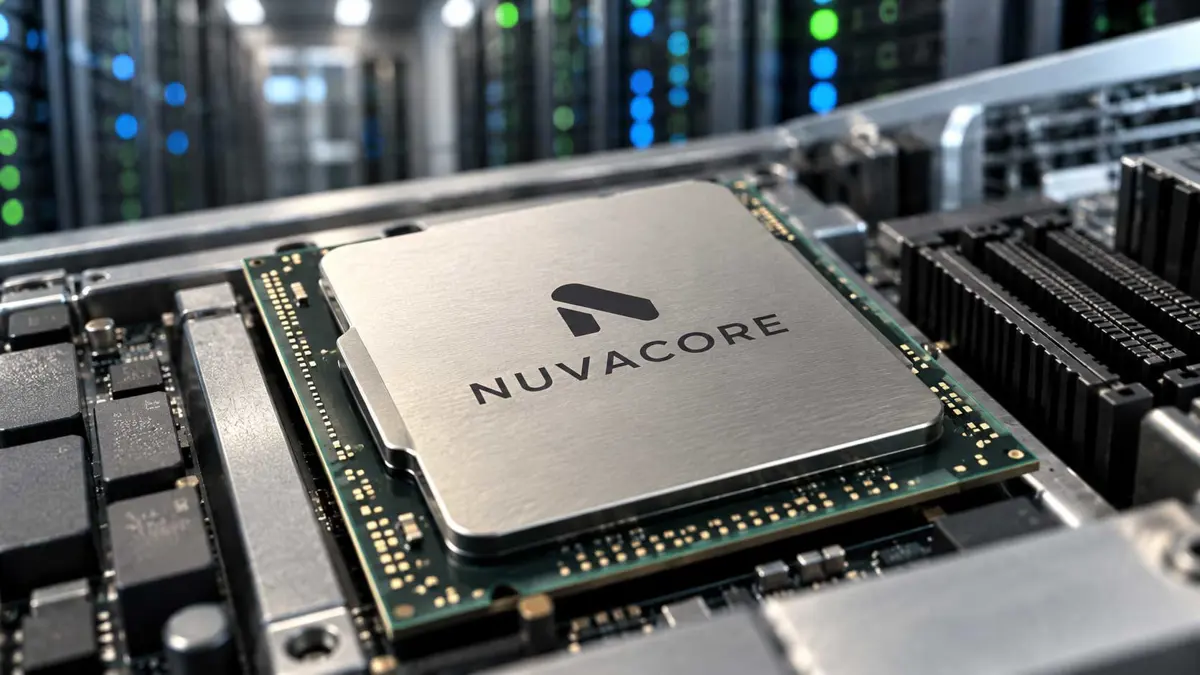
Nuvacore describes its work as developing a general-purpose CPU core for data-center workloads, with performance, power efficiency, and silicon area considered together. Those are company-stated design goals, not independently verified benchmark results. Its official website provides the company's own description of its approach.
What investors may be betting on
A semiconductor startup is difficult to build. Processor development involves architecture, verification, physical design, manufacturing relationships, software, and systems engineering. A design has to work reliably, be manufacturable at scale, and compete on cost with products from established suppliers.
Nuvacore's founders are Gerard Williams III, John Bruno, and Ram Srinivasan. Their experience in semiconductor and computing work may help investors judge whether the team can attempt a technically demanding project. In deep technology, a team's ability to solve hard engineering problems can matter before a finished product exists.
But experience is not proof of product-market fit. The design still has to work, customers must see a practical reason to switch, and the company must deliver hardware at a competitive cost. Investors are effectively pricing the chance that the team can clear those hurdles and establish a valuable position in a growing market.
That is why early-stage chip valuations can look different from software startup valuations. Semiconductor companies often need substantial capital and long development cycles before they can generate meaningful revenue. Investors may be estimating future strategic value rather than judging current sales, but that makes the outcome less certain, not more.
Nuvacore is part of a wider AI hardware race
Nuvacore is not the only startup targeting a specific part of AI computing. Etched is pursuing specialized inference hardware, while other companies are developing chips and systems designed to improve how AI workloads run. These businesses share a broad market tailwind, but their technical approaches and target workloads differ.
Saganote previously covered Etched's $300 million funding round and its plan to build frontier inference clusters. Etched's specialized inference focus is not the same as Nuvacore's stated general-purpose CPU approach. The comparison is useful because it shows how investors are funding different bets across the AI computing stack rather than backing one single hardware strategy.
Large technology companies are also developing their own silicon to gain more control over computing costs and infrastructure. Saganote has reported on Anthropic's reported discussions around Microsoft's Maia 200 AI chips. Such efforts illustrate why cloud providers and AI companies are looking at alternatives to relying entirely on external hardware suppliers.
The scale of infrastructure spending creates opportunity for chip startups, but it also puts them up against well-funded competitors with existing products, software ecosystems, and customer relationships. A new company has to offer a clear advantage, not merely enter a fast-growing category.
What a $2.5 billion valuation actually tells us
A valuation at this stage is not a score for a finished product. It reflects expectations about the company's potential, the people building it, the size of the market, and the possibility that it can establish a position before competitors close the gap.
If Nuvacore develops a competitive CPU and wins adoption among data-center operators, early investors could own a stake in a valuable infrastructure business. It would not need to replace every existing processor. It would need to solve a meaningful problem for enough customers and do so at economics that make sense.
The risks are concrete. Chip development can take years. Technical targets may prove difficult to reach, manufacturing and supply arrangements can complicate delivery, and customers are reluctant to change infrastructure that already works. Even a technically strong processor can struggle if its software ecosystem is immature or the economics do not justify switching.
There is also financing risk. The reported funding round had not closed at the time of the Reuters report, and proposed terms can change as investors negotiate or market conditions shift. A large round would give Nuvacore resources to develop its technology, but it would also raise expectations for what the company must deliver next.
This is a useful contrast with AI startups that spend heavily on computing capacity before shipping a widely available product. Saganote previously examined Reflection AI's reported compute agreement with SpaceX and the cost of building AI infrastructure. Nuvacore's challenge is different, but the underlying question is similar: how much capital should investors commit before product and commercial returns are proven?
What to watch next
The next meaningful milestones are not another headline valuation. They are evidence that Nuvacore can turn its design goals into a product customers can evaluate.
- Funding confirmation: Whether Nuvacore closes the reported round, how much capital it raises, and at what valuation.
- Technical evidence: Whether the company publishes credible specifications, benchmarks, or other evidence of CPU performance and efficiency.
- Customer traction: Whether data-center operators or technology partners announce evaluations, design wins, or deployment plans.
- Product timeline: When the company expects to deliver working hardware and what must happen before commercial availability.
- Business economics: Whether the design can offer a compelling total cost of ownership after manufacturing, power, software, and deployment costs.
These milestones would tell us more than the valuation alone. A funding announcement can show that investors are willing to finance an ambitious plan. Technical evidence and customer adoption will show whether that plan is becoming a business.
The bigger lesson for startup watchers
The Nuvacore valuation is a reminder that venture capital often prices a possible future, not a finished present. In AI infrastructure, investors are looking beyond the model itself to the processors, networking, memory, and systems needed to run AI at scale.
That creates room for companies with credible technical teams and a clear reason to exist. It also allows capital to move ahead of proof. A startup can have experienced founders and a large potential market and still fail to deliver a competitive product.
For now, Nuvacore is worth watching because it is attempting a difficult but important part of the AI stack. The reported valuation tells us that investors see potential. Whether that potential becomes a durable business will depend on engineering results, customer demand, and the company's ability to execute.
Sources and further reading
- Nuvacore: Official company website and CPU design overview
- Saganote: Etched's $300 million funding round
- Saganote: Anthropic's reported discussions around Microsoft's Maia 200 chips
- Saganote: Reflection AI's reported compute agreement with SpaceX
Frequently Asked Questions
Has Nuvacore raised money at a $2.5 billion valuation?
What is Nuvacore building?
Why would investors fund a chip startup before it has a product?
What would show that Nuvacore's investment thesis is working?
Editorial note: The funding amount and valuation are reported fundraising terms, not a completed deal. The company's descriptions of its architecture are its own claims and should not be presented as independently verified benchmark results.