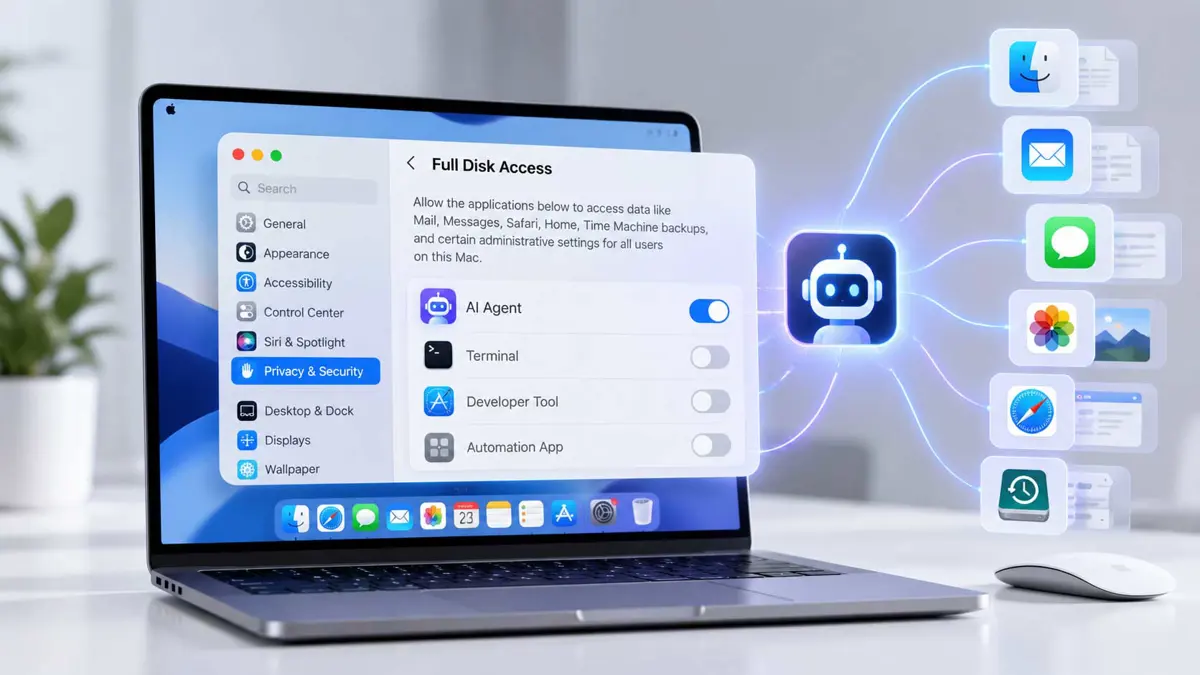
Apple Full Disk Access is changing as AI agents become more capable of working directly with information on a Mac. In an October 2 developer announcement, Apple said it will introduce additional controls so users who want to grant the permission must take "very explicit user action."
The announcement does not describe the final interface, identify a specific macOS release, or give a rollout date. What Apple has made clear is the reason for the change: Full Disk Access can expose sensitive information across a Mac, and Apple expects the risk to increase as AI agents become more autonomous.
What Apple Full Disk Access Actually Allows
Full Disk Access is a macOS privacy permission originally intended to let certain applications, particularly backup software, work around some of the system's normal privacy protections. Apple says the permission largely sidesteps those controls.
According to Apple, an app with this level of access can potentially reach files, mail, messages, and browsing history. For communication apps, Apple also warns that this can affect the privacy of people communicating with the Mac user.
| Area | What Apple says is at risk |
|---|---|
| Files | Applications may be able to access files across the system |
| Mail data can become accessible to an app | |
| Messages | Communication history can be exposed |
| Browsing history | Browser history can become accessible |
| Other private data | Full Disk Access largely bypasses normal privacy controls |
Why AI Agents Change the Equation
Traditional applications usually perform a narrower set of tasks. AI agents are increasingly designed to interpret information, make decisions, and take actions across multiple applications. Giving an agent broad access therefore creates a different privacy question from giving a conventional utility access to a specific folder or function.
Apple did not say that AI agents are the only reason Full Disk Access needs additional controls. Instead, its developer notice says some developers are using the permission in ways that could put users at risk and then specifically says the risks will grow as AI agents become increasingly capable and autonomous.
Apple has announced additional controls, but it has not specified exactly how the new permission flow will work, which macOS release will contain it, or when the changes will become available.
The Muse Controversy Put the Permission in Focus
Apple's announcement arrived after a dispute involving Meta's Muse AI agent on Mac. Journalist Jason Aten said Muse referenced content from a private Apple Messages conversation even though he believed he had not granted the agent permission to access his messages. Meta disputed that account and said its Messages integration is opt-in and requires both macOS Full Disk Access and the Messages connector to be enabled.
That disagreement is important because it highlights the difference between what a user thinks an AI assistant can see and what the underlying operating-system permissions may technically allow. Apple did not name Muse in its announcement, and its statement should not be read as a finding about that specific incident.
Apple's Broader Mac AI Strategy Makes This More Important
Apple has simultaneously been giving developers more ways to build agentic software. At WWDC 2026, Apple introduced expanded agentic coding capabilities in Xcode 27, allowing coding agents to plan, answer questions, validate their work, and operate for longer periods.
That direction makes the permission issue more significant. Apple's Safari MCP server gives AI agents direct browser access for debugging, while its broader Apple Intelligence work is bringing more AI capabilities into Apple's platforms.
Saganote has also covered Apple's WWDC 2026 Siri rebuild with Google Gemini, showing how deeply AI is becoming part of Apple's software strategy. At the same time, tools such as Perplexity Hybrid Compute bring private AI work to the Mac, making the boundary between local data and AI processing increasingly important.
This Is a Permission Problem, Not an AI Shutdown
Apple's announcement does not say it is blocking AI agents from accessing Mac data. Instead, the company says users who genuinely want to grant this unusually broad permission should have to make a clearer and more deliberate decision.
That distinction matters. Developers may still build powerful Mac agents, but Apple is signaling that access to large portions of a user's personal data should come with stronger consent controls.
What Mac Users Should Know Right Now
- The existing Full Disk Access permission remains available while Apple prepares the new controls.
- Apple has not yet explained exactly what the replacement or additional confirmation flow will look like.
- Users should treat Full Disk Access as a broad system-level permission rather than a normal app setting.
- An AI agent with broad access can potentially work with information that spans multiple apps and data types.
- Apple's announcement is about the permission model; it does not establish that any particular AI agent has accessed a user's data improperly.
The Change Fits a Larger Shift Toward Agentic Computing
The Mac is becoming a more attractive platform for AI agents because it gives software access to files, applications, browsers, messages, and other desktop workflows. That creates useful possibilities, but it also makes permissions more consequential.
Other Saganote coverage shows how quickly this ecosystem is developing. 1Password for Claude lets AI agents sign into websites without touching users' passwords, while Microsoft's MDASH AI scans Windows commits for security vulnerabilities.
ChatGPT's iMessage plugin on Mac can read, draft, and send messages, while iOS 27 adds a new Siri app, Camera Vision, and battery-focused changes. These features are different from Full Disk Access, but together they show how AI is moving closer to personal data and system-level actions.
For broader Apple software context, What's New in iCloud in iOS 27 covers how Apple's cloud services are evolving alongside its device software.
What Happens Next
Apple's next step is the part users and developers still have to wait for. The company has promised additional controls but has not said when they will arrive or exactly how they will change the authorization process.
For now, the clearest message from Apple is that Full Disk Access was designed for powerful desktop utilities such as backup software, but its implications are changing as AI agents gain the ability to act across a computer. Apple's planned controls are intended to make that tradeoff more explicit before users grant access.
For Mac owners preparing for Apple's next software generation, Saganote's macOS 27 Golden Gate guide provides broader context, while macOS Tahoe 26.6's security update covers the platform's recent security work.