TL;DR:
- Galaxy Z Fold8 starts at $1,899.99, while iPhone Duo starts at $1,999 in the U.S.
- Galaxy Z Fold8 is much lighter at 201g versus 254g for iPhone Duo.
- Both phones have 7.6-inch inner displays, but their outer displays and aspect ratios differ.
- iPhone Duo has 48MP Main and Ultra Wide cameras with an optical-quality 2x Telephoto option, Fold8 uses dual 50MP rear cameras with 2x optical-quality zoom from its Wide camera.
- Apple rates Duo for up to 31 hours of inner-display video playback or 44 hours using the outer display, Samsung rates Fold8 for up to 26 hours of video playback.
- iPhone Duo offers 256GB to 2TB, while Galaxy Z Fold8 tops out at 1TB.
- iPhone Duo has an IP68 rating and will support Apple Pencil with USB-C later in 2026, Galaxy Z Fold8 has IP48 and does not support S Pen.
- Galaxy Z Fold8 is the safer pick for weight and an established foldable platform, while iPhone Duo is the more compelling choice for Apple users who specifically want a foldable iPhone.
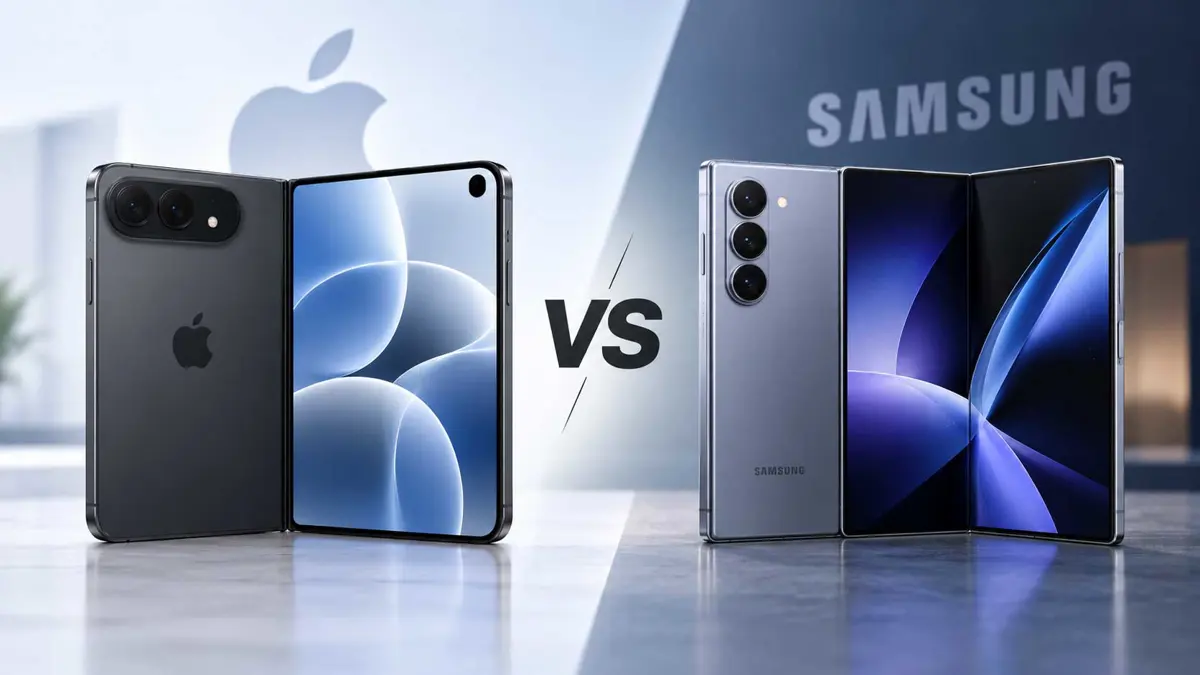
The iPhone Duo vs Galaxy Z Fold8 comparison is no longer a question about whether Apple will make a foldable phone. Apple has now entered the category with its first foldable iPhone, while Samsung is already selling the eighth-generation Galaxy Z Fold8.
On paper, the two phones have more in common than their ecosystems suggest. Both open to a 7.6-inch main display, both use a wide foldable design, and both are positioned as premium phones that can become larger workspaces. But the details point to different priorities.
The iPhone Duo starts at $1,999 in the U.S., while Galaxy Z Fold8 starts at $1,899.99. Apple offers up to 2TB of storage and puts more emphasis on the foldable camera experience, while Samsung's Fold8 is much lighter and builds on years of Galaxy foldable development.
iPhone Duo vs Galaxy Z Fold8 at a glance
| Feature | iPhone Duo | Galaxy Z Fold8 |
|---|---|---|
| Starting price | $1,999 | $1,899.99 |
| Inner display | 7.6-inch OLED | 7.6-inch Dynamic AMOLED 2X |
| Outer display | 5.4-inch OLED | 5.5-inch display |
| Weight | 254g | 201g |
| Processor | A20 Pro | Snapdragon 8 Elite Gen 5 for Galaxy |
| Rear cameras | 48MP Main + 48MP Ultra Wide | 50MP Wide + 50MP Ultra Wide |
| Optical-quality zoom | 2x from Main | 2x from Wide |
| Battery | Dual battery, up to 31h inner / 44h outer video | 4,800mAh, up to 26h video |
| Storage | 256GB to 2TB | 256GB to 1TB |
| Water resistance | IP68 | IP48 |
| Stylus support | Apple Pencil (USB-C), later in 2026 | No S Pen support |
The table makes the central difference clear. Galaxy Z Fold8 is considerably lighter and cheaper to enter, while iPhone Duo offers more maximum storage, stronger water resistance on paper, and Apple's foldable-specific software and camera features.
Design and weight: Samsung has the easier everyday carry
Both phones are built around the same basic idea: a conventional-looking cover screen that opens into a much larger display. Samsung's Fold8 has a 5.5-inch cover screen and a 7.6-inch inner display. iPhone Duo uses a 5.4-inch outer screen and a 7.6-inch inner display.
The biggest physical difference is weight. Apple lists iPhone Duo at 254 grams, while Samsung lists Galaxy Z Fold8 at 201 grams. That 53-gram gap is large enough to matter in a device that will be carried and held every day.
Samsung also redesigned the Fold8 around a wider 10:16 cover display and a 4:3 inner display. Apple takes a different approach: both Duo displays use the same aspect ratio so content can scale more naturally between the outer and inner screens.
Apple's hardware has its own advantages. iPhone Duo uses Grade 5 titanium, a precision hinge, Ceramic Shield materials, and an IP68 rating. Samsung uses Armor Aluminum, Gorilla Glass materials, titanium reinforcement beneath the display, an Armor FlexHinge, and an IP48 rating.
If portability is the priority, Galaxy Z Fold8 has the obvious advantage. If water and dust resistance are a bigger concern, Apple's IP68 rating gives the Duo a stronger published protection rating.
Which design is better?
Galaxy Z Fold8 is the easier choice for people who dislike heavy phones. iPhone Duo is more compelling for buyers who value Apple's materials, IP68 protection, and a display experience designed to transition between two screens.
Displays: same inner size, different philosophy
The two phones converge on a 7.6-inch inner display, but the experience is not identical. Samsung's inner screen uses a 4:3 aspect ratio, which Samsung positions for reading, browsing, movies, and multitasking. Its 5.5-inch cover screen uses a 10:16 ratio aimed at familiar phone-style content.
iPhone Duo uses a 7.6-inch Super Retina XDR folding OLED display with a nano-texture finish, ProMotion up to 120Hz, Always-On display, and up to 3,000 nits of outdoor brightness. Apple says the nano-texture layer reduces glare and helps minimize crease visibility.
The Duo's 5.4-inch outer display also uses ProMotion and Always-On features. Because Apple keeps the same aspect ratio across the two displays, the company is aiming for a more continuous transition when an app moves from the cover screen to the inner display.
Neither approach is automatically better. Samsung's wider form factor has been designed around content consumption and comfortable use, while Apple is emphasizing continuity between the two screens.
Cameras: Apple focuses on the foldable experience
This is one of the most interesting differences in the iPhone Duo vs Galaxy Z Fold8 comparison because neither phone wins simply by having the larger megapixel number.
iPhone Duo uses a 48MP Fusion Main camera and a 48MP Fusion Ultra Wide camera. The Main camera also provides an optical-quality 2x Telephoto option. Apple adds a Center Stage front camera, an under-display FaceTime camera, 4K Dolby Vision recording, and foldable-specific features such as Smart Take, Duo Preview, Duo FaceTime, and rear-camera selfies with an outer-screen preview.
Galaxy Z Fold8 uses dual 50MP rear cameras: a Wide camera and an Ultra Wide camera. Samsung also lists 2x optical-quality zoom from the Wide camera. The phone has a 10MP cover camera and a 10MP main camera, along with Galaxy AI tools for editing and video features.
The more important distinction is how each company uses the foldable design. Apple's Duo Preview lets people being photographed see the framing on the outer display, while Smart Take can use on-device AI to capture a moment when subjects are ready. Samsung leans more heavily into Galaxy AI editing and content tools.
For conventional camera hardware, the two phones are closer than a megapixel comparison suggests. For foldable-specific camera interactions, Apple has a more unusual set of features built directly around the two-screen design.
Performance: A20 Pro vs Snapdragon 8 Elite Gen 5
The iPhone Duo vs Galaxy Z Fold8 performance battle is difficult to settle from specifications alone. Apple uses A20 Pro, the same chip found in the iPhone 18 Pro models, while Samsung uses Snapdragon 8 Elite Gen 5 for Galaxy.
Apple says A20 Pro is built on a 2-nanometer process, with a 6-core CPU, 7-core GPU, Dual 16-core Neural Engine, 50 percent more unified memory bandwidth than A19 Pro, and up to 40 percent faster GPU performance. iPhone Duo also uses a custom vapor chamber to sustain performance across demanding workloads and two displays.
Samsung describes its Snapdragon platform as customized for Galaxy, combining a next-generation CPU, GPU, and NPU for performance and AI workloads. The Fold8 is available with 12GB of memory on 256GB and 512GB models, while the 1TB model gets 16GB.
There is no good reason to declare one chip the universal winner before independent benchmark testing. Apple's A20 Pro has strong published specifications, but Samsung's platform is tuned around Android, One UI, Galaxy AI, and the Fold8's multitasking design.
For the Apple side of the equation, our A20 Pro 2nm chip coverage explains what changed in Apple's latest processor.
Battery life: Apple quotes more hours, but the tests are different
Battery capacity is not directly comparable because Apple does not publish the Duo's battery capacity in the same way Samsung publishes the Fold8's 4,800mAh rating.
Apple rates iPhone Duo for up to 31 hours of video playback when using the inner display and up to 44 hours when using the outer display. Apple also says typical usage can reach up to 24 hours when both displays are used equally.
Samsung rates Galaxy Z Fold8's 4,800mAh battery for up to 26 hours of video playback. The company's published figure is useful for comparison, but the test conditions and usage profiles are not identical to Apple's.
That means the headline numbers should not be treated as a laboratory shootout. Still, Apple's published endurance claims are notable, especially for a foldable that is also driving a large inner display.
Software and multitasking may decide the winner
The biggest difference between these phones may ultimately be the software rather than the hardware.
iPhone Duo ships with iOS 27. Apple redesigned parts of iOS around the foldable form factor, including Split View for two apps side by side, support for two windows of the same app, saved app pairs, and the ability to interact with Siri AI while viewing other content on the large display.
Apple also builds its Apple Intelligence features into the Duo experience. Siri AI can use personal context and onscreen awareness, while the larger display gives AI responses and multitasking more room.
Galaxy Z Fold8 uses Android with Samsung's One UI and Galaxy AI features. Samsung's 4:3 inner display is designed for side-by-side productivity, while Galaxy AI adds tools such as Now Nudge and Photo Assist. Samsung has also had multiple generations to refine its foldable software experience.
This is why the choice is not simply iOS versus Android. It is also a choice between Apple's first foldable software design and Samsung's eighth-generation foldable platform.
Apple has one ecosystem advantage, Samsung has another
The best foldable phone can depend heavily on the devices already sitting around it.
For an Apple user, iPhone Duo fits into an ecosystem that already includes Apple Watch, AirPods, iCloud, and Apple Intelligence. Our Apple Watch Series 12 and Watch Ultra 4 coverage and Apple Health coverage cover two important parts of that wider ecosystem.
Samsung's Fold8 is designed to work with the Galaxy ecosystem and Google's Android services. Samsung also supports easier data transfer from iPhone when switching to Galaxy, making the move less disruptive for people coming from Apple's platform.
There is another practical difference: Apple says iPhone Duo will support Apple Pencil with USB-C later in 2026, while Samsung's official Fold8 specifications say the phone does not support S Pen.
That makes the Duo particularly interesting for people who want a large foldable screen for handwritten notes or markup, although the Pencil feature is not available at launch.
Price and storage: Samsung is cheaper, Apple goes further
Galaxy Z Fold8 starts at $1,899.99 for 256GB in the U.S. Samsung also sells 512GB for $2,099.99 and 1TB for $2,499.99.
iPhone Duo starts at $1,999 for 256GB, with options for 512GB, 1TB, and 2TB. That makes Apple's entry price $99.01 higher than Samsung's, but Apple offers twice the maximum storage capacity.
The $99.01 difference is small compared with the overall cost of either phone. The more important question is whether the buyer values Samsung's lighter hardware and established foldable platform or Apple's iOS ecosystem and foldable-specific features.
Which foldable should you buy?
Buy iPhone Duo if...
- You already use iPhone, Apple Watch, AirPods, or other Apple services.
- You specifically want a foldable iPhone rather than simply the lightest foldable.
- You value IP68 water and dust resistance.
- You want up to 2TB of storage.
- You want Apple Pencil support when it arrives later in 2026.
- You like Apple's foldable-specific camera and multitasking features.
Buy Galaxy Z Fold8 if...
- You want a much lighter foldable at 201g.
- You prefer Android and Samsung's One UI ecosystem.
- You want to spend less at the entry level.
- You want a foldable platform that has already reached its eighth generation.
- You want Samsung's Galaxy AI features and multitasking tools.
- You do not need S Pen support.
Wait before choosing either if...
- Camera quality is the deciding factor and you want independent testing.
- You want long-term durability testing of Apple's first foldable.
- You are unsure whether a foldable is actually more useful than a conventional flagship.
- You want real-world battery and performance comparisons rather than manufacturer claims.
iPhone Duo vs Galaxy Z Fold8: final verdict
The Galaxy Z Fold8 is the safer recommendation if the goal is a lighter, slightly cheaper foldable with a mature Samsung foldable platform. At 201 grams, it is dramatically easier to carry than the 254-gram iPhone Duo, and Samsung has already reached the eighth generation of its Fold line.
The iPhone Duo is the more interesting choice for Apple users who specifically want the foldable experience. Its 7.6-inch inner display, 2TB storage option, IP68 rating, Apple Intelligence features, and foldable-specific camera tools give it a distinct identity rather than making it a simple copy of a Galaxy Fold.
The biggest caution is timing. iPhone Duo is Apple's first foldable and does not go on sale until October 23, while Galaxy Z Fold8 is already available. That means independent testing of the Duo will be important before calling it the better overall foldable.
If the priority is weight and a proven foldable platform, Galaxy Z Fold8 has the stronger case. If the priority is Apple's ecosystem and a first-generation foldable built around iOS, iPhone Duo is the more compelling choice.
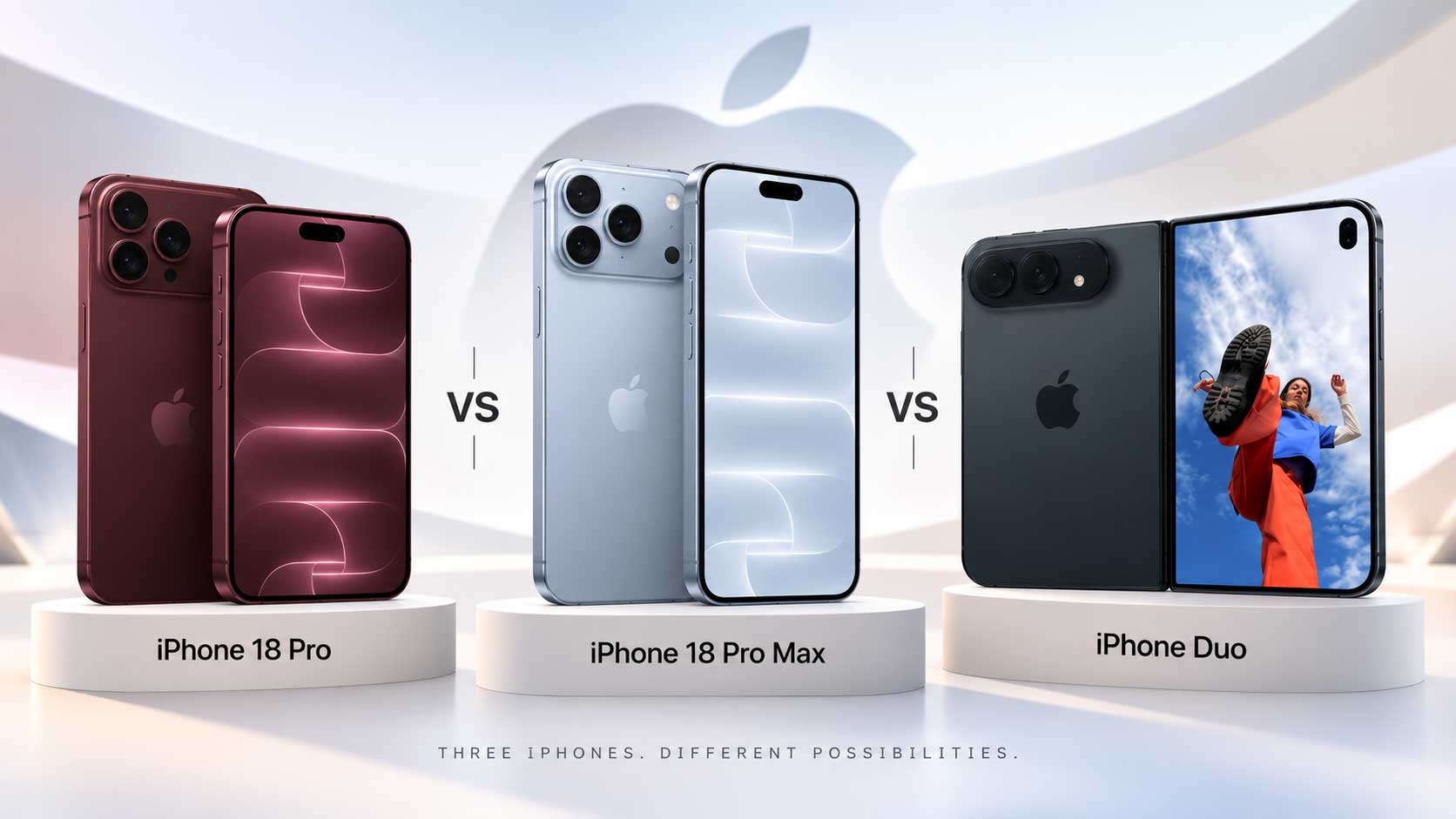
For the Apple side of the comparison, see our iPhone Duo coverage. For a broader look at Apple's new flagship phones, our iPhone 18 Pro vs 18 Pro Max vs iPhone Duo comparison puts the Duo alongside Apple's conventional Pro models.
The comparison also fits into our wider Apple September 2026 event pillar, which brings together Apple's iPhone, Watch, AirPods, iOS, Health, and Apple Intelligence announcements.
Source: Apple iPhone Duo, Apple iPhone Duo Technical Specifications, Samsung Galaxy Z Fold8, and Samsung Galaxy Z Fold8 launch announcement.