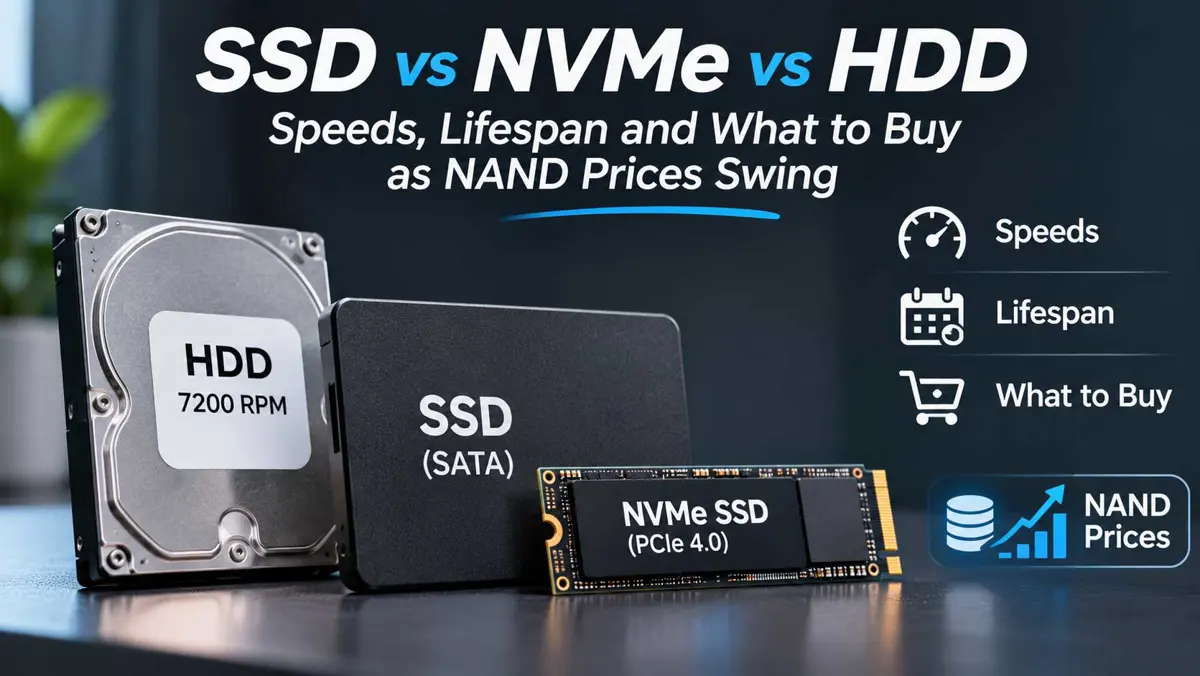
SSD vs NVMe vs HDD is a muddled comparison because the three names sit on different layers: SSD describes flash storage, NVMe describes how a flash drive talks to the computer, and HDD describes spinning platters. A SATA SSD and an NVMe SSD are both SSDs, so the real choice is among three drive types. Names aside, the speed gap is large.
Interfaces Set the Limit: SATA Caps SSDs at 560 MB/s, NVMe Reaches 7,450 MB/s, HDDs Reach 220 MB/s
| Drive type | Example | Interface | Sequential speed | Rated endurance at 1TB |
|---|---|---|---|---|
| 7200 RPM hard drive | Seagate BarraCuda | SATA 6 Gb/s | 220 MB/s maximum sustained read | Rated by workload, not TBW |
| SATA SSD | Samsung 870 EVO | SATA 6 Gb/s | 560 MB/s read, 530 MB/s write | 600 TBW |
| NVMe SSD, PCIe 4.0 | Samsung 990 Pro | PCIe 4.0 x4 | 7,450 MB/s read, 6,900 MB/s write | 600 TBW |
Spinning disks shaped SATA, and it shows. Samsung's 870 EVO reaches the SATA interface limit of 560 MB/s read and 530 MB/s write, so faster flash inside would change nothing. NVMe skips that ceiling by using PCIe lanes, which lets the 990 Pro reach 7,450 MB/s read and 6,900 MB/s write, close to the 8,000 MB/s theoretical PCIe 4.0 peak Samsung cites.
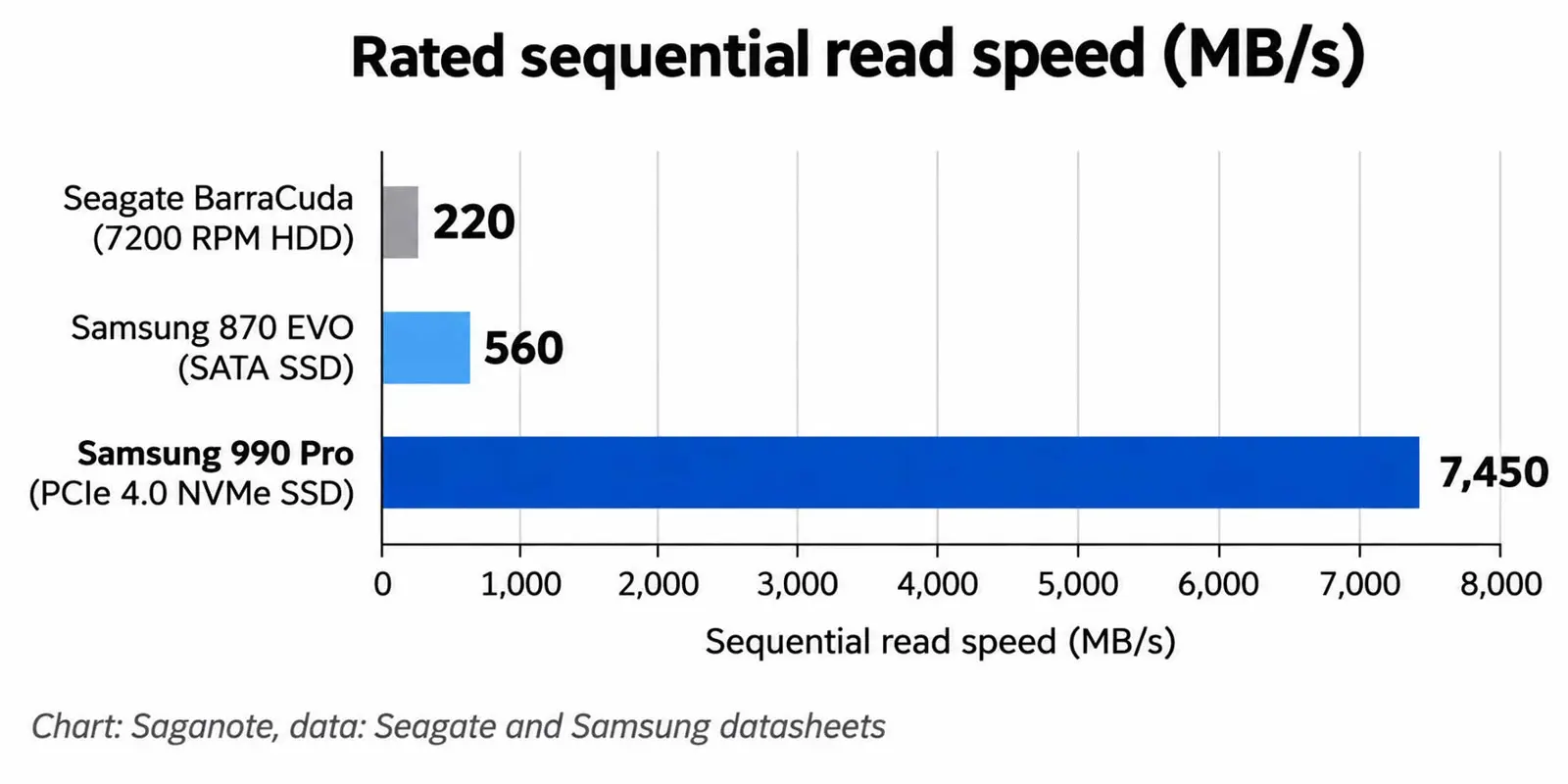
Hard drives trade speed for capacity. Seagate's BarraCuda datasheet lists a 220 MB/s maximum sustained read rate at 7200 RPM, with desktop capacities up to 24TB, and some lines use shingled magnetic recording, which packs tracks closer together at a cost to sustained writes.
Slot generation caps NVMe too. Puget Systems lists the 990 Pro at 3,000 to 3,300 MB/s in a PCIe 3.0 M.2 slot, which means an older motherboard wastes part of the drive's speed.
Portable drives hit a different wall. A USB connection, not the flash, usually sets the speed of an external SSD, a tradeoff the best external SSD roundup weighs across portable models.
Real Waits: Loading a 43 GB Model Takes About Six Seconds on NVMe, 77 on SATA and 195 on an HDD
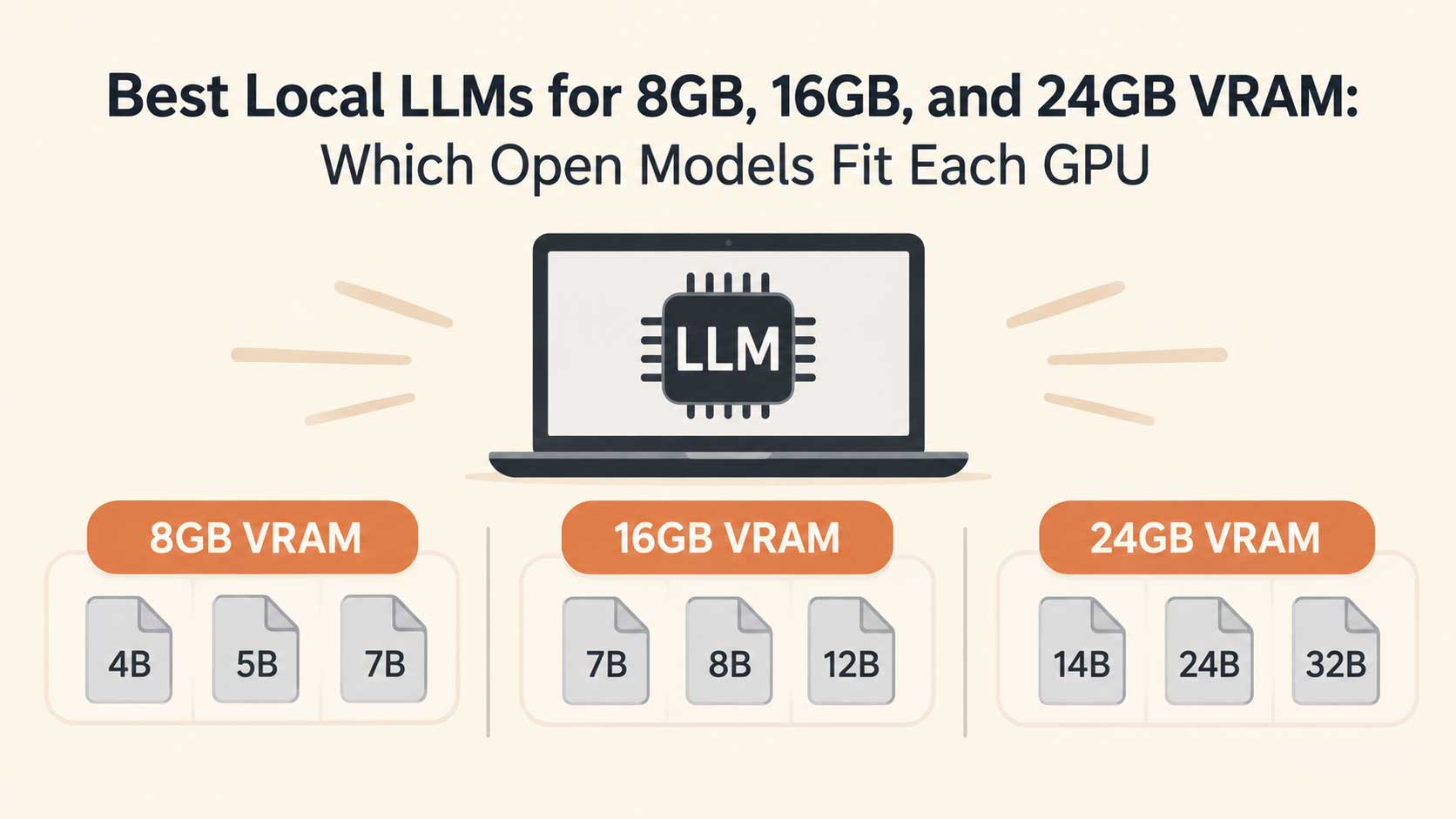
Local AI makes the gap concrete. Open-weight models in the best local LLMs by VRAM guide arrive as multi-gigabyte files, and a 43 GB model at rated read speeds loads in about six seconds from a 990 Pro, 77 seconds from an 870 EVO and 195 seconds from a BarraCuda. Real loads run slower than rated sequential speeds.
Nobody enjoys a three-minute wait. Ollama, LM Studio and llama.cpp all read weights from disk at load time, so the drive shows up in the first-load wait and fades once the model sits in memory, and the VRAM requirements chart shows how large those files get.
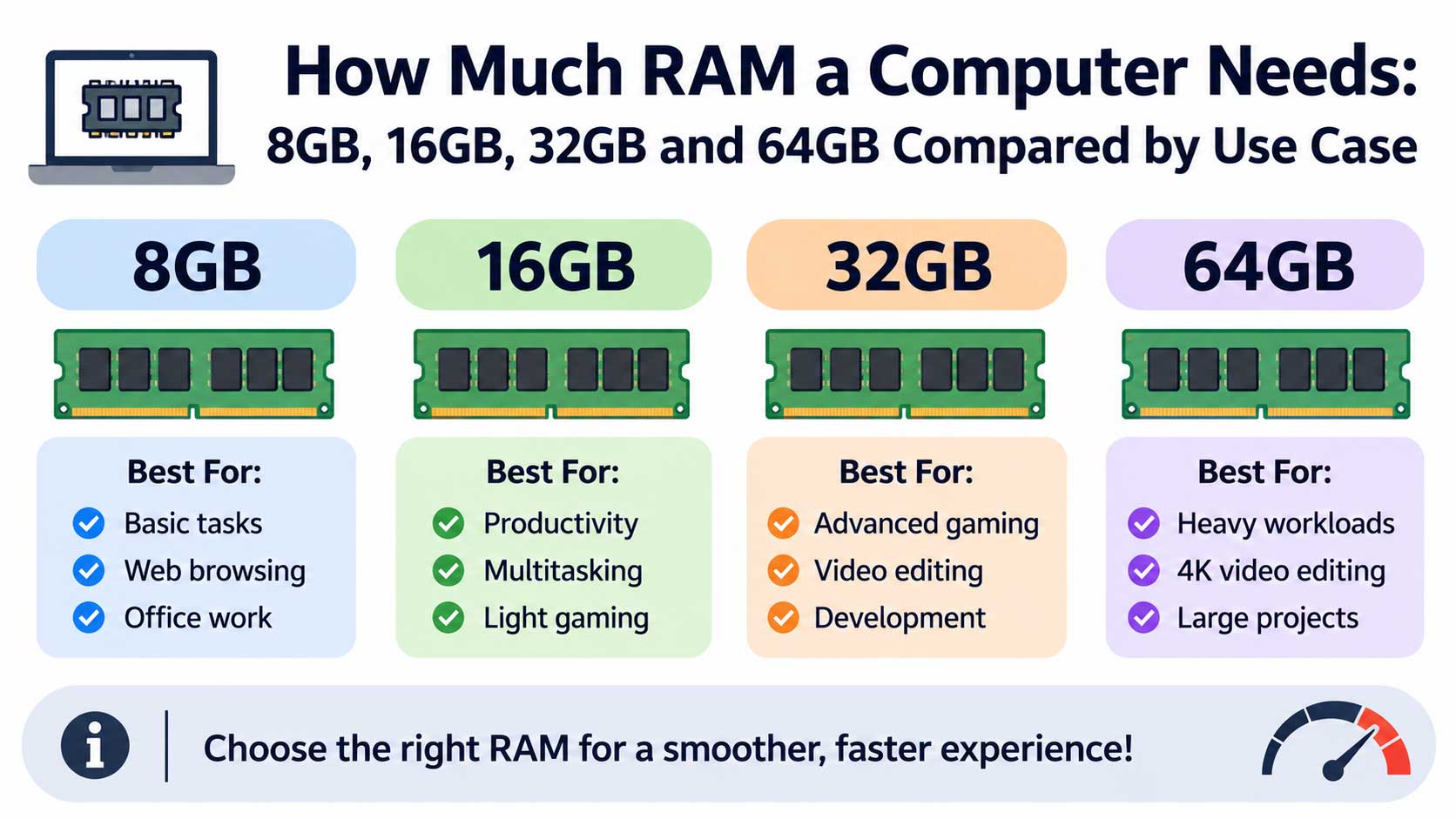
Memory and storage trade places under pressure. A PC short on memory leans on the drive for paging, so the answer to how much RAM is enough changes how hard the SSD works, and a hard drive turns that pressure into stalls.
Software can mimic a failing drive. Before replacing hardware, the fixes for a slow Windows 11 after an update are worth trying, since an update can slow a healthy PC for reasons unrelated to storage.
Lifespan: 600 TBW Equals About 329 GB of Writes per Day for Five Years
Samsung rates the 870 EVO and 990 Pro at 600 TBW for the 1TB model, with a five-year warranty on both, and the ratings double at 2TB and quadruple at 4TB. Spread across five years, 600 TB works out to about 329 GB of writes every day. Few desktops write that much.
Endurance scales with size. Samsung lists the 870 EVO at 300 TBW for 500 GB against 600 TBW for 1TB, so a smaller drive wears out its rating twice as fast under the same daily writes.
Hard drives wear differently. Backblaze reported a 1.36% annualized failure rate across 344,196 hard drives of 30 models in 2025, down from 1.55% in 2024, with a lifetime rate of 1.30%. Backblaze runs its fleet in data centers, so a home PC sees a different workload.
Its SSD figures cover boot drives in its storage servers, not consumer PCs, and its fairer comparison matched them with hard drives of a similar age, according to Kommando Tech's summary.
Prices: NAND Contracts Rose 15% to 20% in 4Q26, but Spot Prices Fell 20% in Two Weeks
AI demand drove it. TrendForce projected NAND contract prices up 15% to 20% quarter over quarter in 4Q26, with enterprise SSD contracts up 23% to 28% as hyperscalers ordered QLC drives for KV cache. Why RAM prices spiked and Micron's HBM revenue jump trace back to that same buildout.
Now the trend is bending. TrendForce News reported on Nov. 17 that NAND spot prices slid 20% in two weeks as Chinese traders trimmed inventory, and its Nov. 18 bulletin says contract price gains are fading. Channel destocking is widening the gap between spot and contract prices.
Black Friday lands Nov. 27, and the price-history guide for tech deals advises measuring any sale price against the 90-day low and the post-sale price. A drive that beats both is a fair buy. Waiting carries its own risk, since TrendForce's oversupply view is a model, not a guarantee.
Which Drive to Buy in the SSD vs NVMe vs HDD Choice
Use cases settle it. Slot availability and capacity needs decide most cases, so this table maps common situations to a drive type using the spec and pricing evidence above.
| Situation | Drive to buy | Basis |
|---|---|---|
| New or recent PC with an M.2 slot | PCIe 4.0 NVMe, 1TB or 2TB | Samsung 990 Pro specs |
| Older PC or laptop with no M.2 slot | SATA SSD | Samsung 870 EVO hits the SATA limit |
| Local AI models and large game libraries | NVMe for load speed | 6 seconds vs 195 seconds math |
| Archives and backups | HDD, up to 24TB | Seagate BarraCuda datasheet |
| Portable or Mac expansion | External SSD | USB limits apply |
Pairing wins. Many builds pair an NVMe boot drive with an HDD for bulk storage, so SSD vs NVMe vs HDD rarely needs a single winner. A hard drive holding archives costs less per terabyte than flash while the NVMe drive handles the work that benefits from speed.
Frequently Asked Questions
Is NVMe the same as an SSD?
How much faster is NVMe than a hard drive?
How long does an SSD last?
Should an HDD still be bought?
Will SSD prices fall?
Prices may soften soon. TrendForce expects NAND to tip into oversupply next year as Chinese enterprise orders shrink, consumer devices ship with less storage and new capacity keeps ramping.