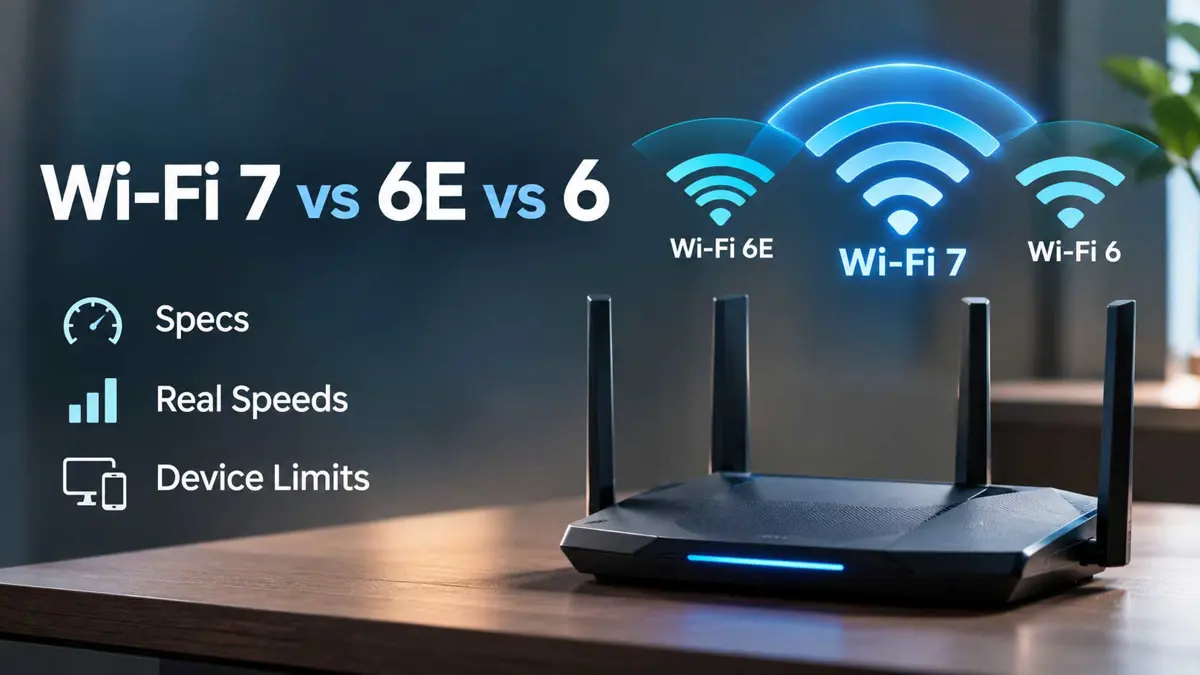
Wi-Fi 7 vs Wi-Fi 6E is a contest between three spec changes and one practical limit: whether the phones and laptops in a home can use them. Wi-Fi 6E runs Wi-Fi 6 in the 6 GHz band, so the older pair differs in spectrum, not speed. Wi-Fi 7 adds width and efficiency on top.
What Changed: Wi-Fi 6E Added Spectrum, Wi-Fi 7 Added Channel Width and Multi-Link Operation
| Feature | Wi-Fi 6 | Wi-Fi 6E | Wi-Fi 7 |
|---|---|---|---|
| IEEE standard | 802.11ax | 802.11ax | 802.11be |
| Bands | 2.4 and 5 GHz | 2.4, 5 and 6 GHz | 2.4, 5 and 6 GHz |
| Widest channel | 160 MHz | 160 MHz | 320 MHz, 6 GHz only |
| Modulation | 1024-QAM | 1024-QAM | 4096-QAM |
| Multi-Link Operation | No | No | Yes |
| Max 2x2 client speed, per Intel | 2.4 Gbps | 2.4 Gbps | 5.76 Gbps theoretical, 5.19 Gbps estimated over the air |
| Theoretical maximum | 9.6 Gbps | 9.6 Gbps | About 46 Gbps |
Room was Wi-Fi 6E's contribution. Adding the 6 GHz band opened up to 1,200 MHz of spectrum and seven extra 160 MHz channels, and only Wi-Fi 6E and newer clients can join it, which keeps older devices off the lane. Even earbuds now carry it, since Qualcomm's Snapdragon Sound Elite Gen 2 platform includes integrated micro-power Wi-Fi 6E.
Wi-Fi 7 changes the road itself. On Jan. 8, 2024, the Wi-Fi Alliance introduced Wi-Fi CERTIFIED 7, with 320 MHz channels that double the widest channel and exist only in 6 GHz, 4096-QAM, which delivers 20% higher transmission rates than 1024-QAM, and Multi-Link Operation, which lets a device send and receive across several links at once. Intel rates a 2x2 Wi-Fi 7 client at 5.76 Gbps in theory and 5.19 Gbps over the air, against 2.4 Gbps for Wi-Fi 6 and 6E.
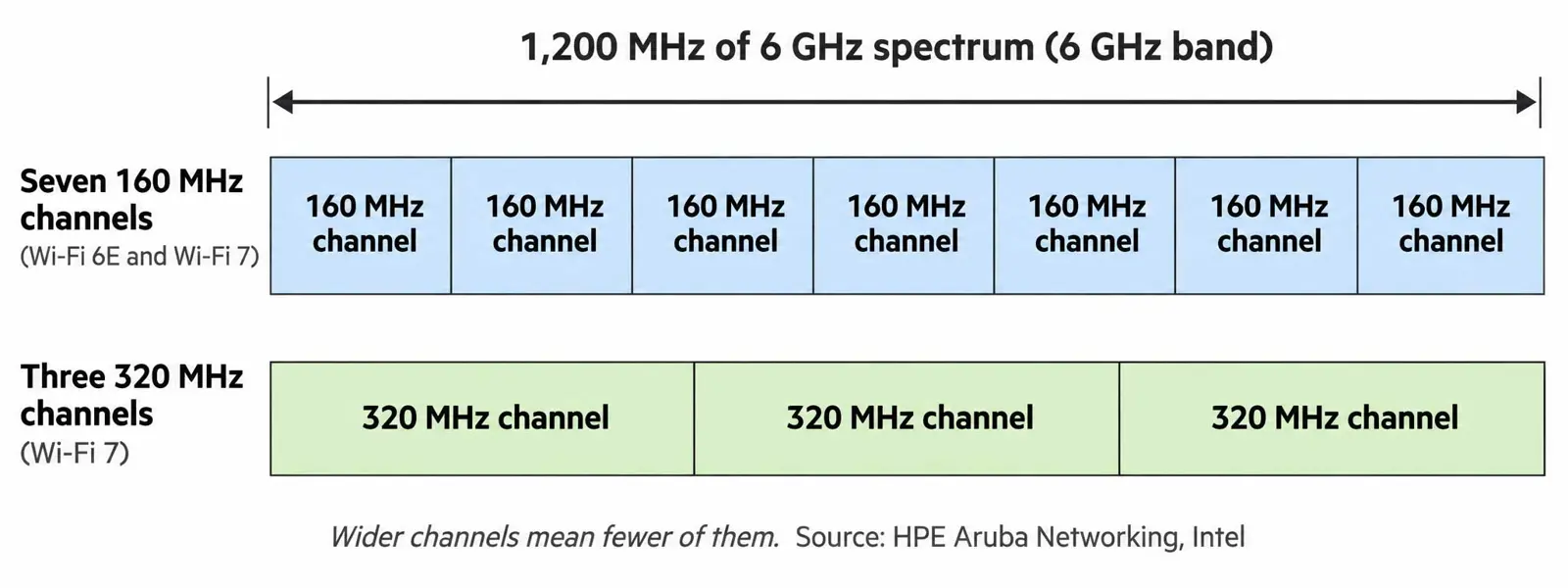
Width has a cost. HPE Aruba Networking counts only three 320 MHz channels in 1,200 MHz regulatory domains, against seven 160 MHz channels, which leaves less room for neighboring networks to avoid each other. Regulators matter too, since the Wi-Fi Alliance limits 320 MHz to countries that open 6 GHz to Wi-Fi.
Lab Results: CNET Labs Measured 3,169 Mbps on Wi-Fi 7 Routers and 1,309 Mbps on Wi-Fi 6E
CNET Labs tested more than 30 routers across Wi-Fi 5, 6, 6E and 7, measuring throughput at 7, 25 and 50 feet and signal strength at 61 locations in a 15,000-square-foot facility. Total throughput across all bands reached 3,169 Mbps on Wi-Fi 7 routers against 1,309 Mbps on Wi-Fi 6E. Netgear's Nighthawk RS700S led the field at 4,346 Mbps.
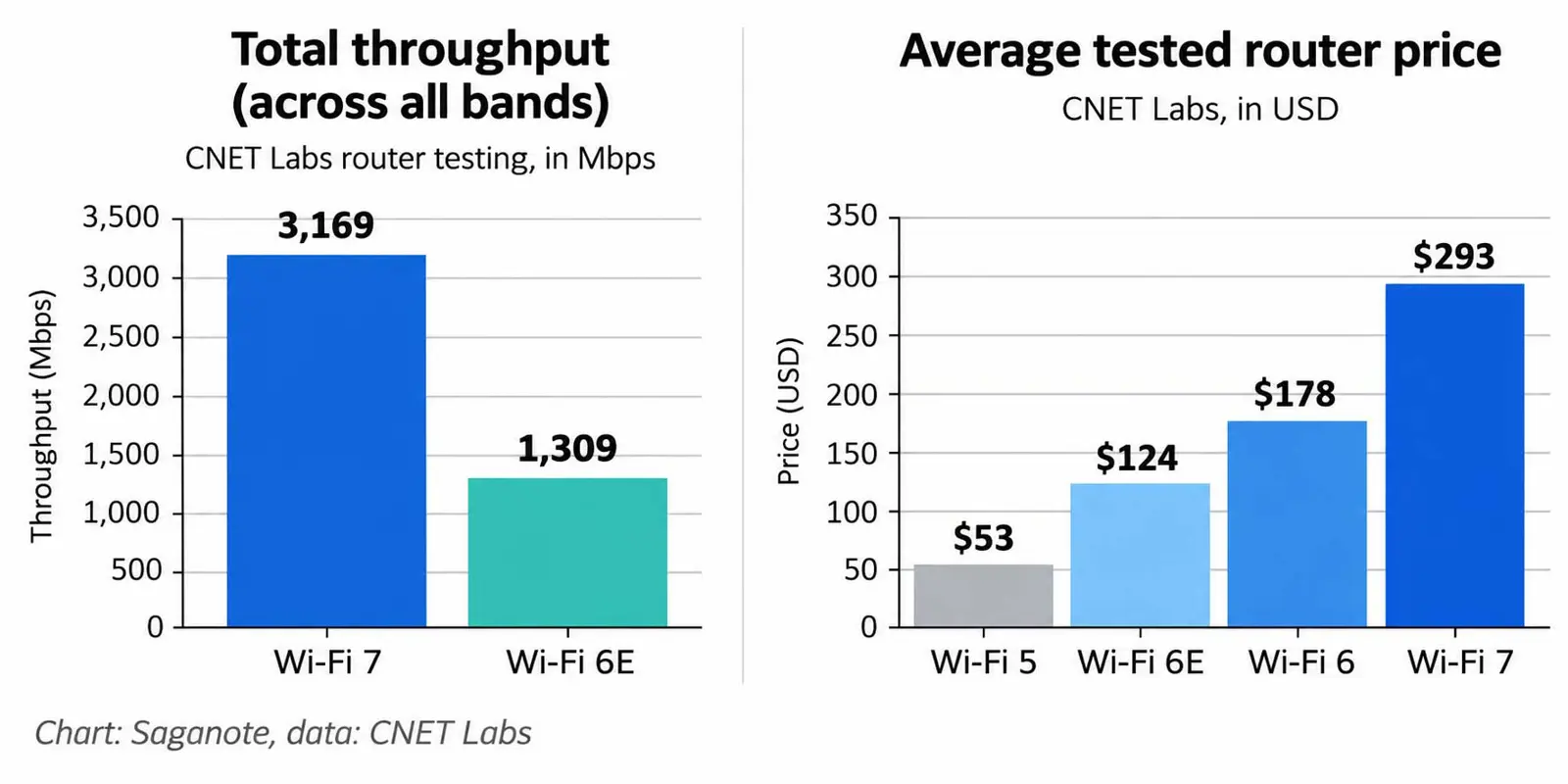
Total throughput spans every band. A single phone on a single band sees less. At 50 feet, the 15 Wi-Fi 7 routers CNET tested averaged 515 Mbps against 383 Mbps for Wi-Fi 6, a 34% gap rather than a 2x one, and jitter and packet loss barely moved, since nearly every router stayed under CNET's 1 ms jitter target and none reached its 1% packet loss goal on 5 GHz.
Price tracks the standard. CNET's tested Wi-Fi 7 routers averaged $293, against $178 for Wi-Fi 6, $124 for Wi-Fi 6E and $53 for Wi-Fi 5, and the fastest Wi-Fi 6E router, TP-Link's Archer AXE75, sold for $113 when CNET wrote its review. CNET's reviewer, who once told readers to skip Wi-Fi 7 routers, now recommends skipping Wi-Fi 6 for new purchases and buying tri-band Wi-Fi 7 models under $200.
CNET found that dual-band Wi-Fi 7 routers, which lack the 6 GHz band, performed close to Wi-Fi 6 and were often no better in value, and Ookla notes that not every Wi-Fi 7 router supports 6 GHz.
Ookla Data on Wi-Fi 7 vs Wi-Fi 6E: Medians Run 600 to 800 Mbps, but the ISP Changes the Result
Ookla's Speedtest analysis from 2025, reported by PCMag, put the median Wi-Fi 7 download between 600 and 800 Mbps, about 2x the median for Wi-Fi 6 users and 4x the median for Wi-Fi 5 users. Provider mattered as much as the standard. Frontier Fiber posted the highest Wi-Fi 7 median at 1,010 Mbps and Verizon the lowest at 532 Mbps, and depending on the ISP, Wi-Fi 6E users could post faster tests than Wi-Fi 7 users.
Adoption was still thin. Only 1.8% of US Speedtest users ran a Wi-Fi 7 router in that analysis, against 44.2% on Wi-Fi 6 and 33% on Wi-Fi 5, and Ookla shares a parent company, Ziff Davis, with PCMag, which disclosed the tie. PCMag's own tests found Wi-Fi 7 routers can reach 2 Gbps depending on distance.
The Device Gap: iPhone 16 and 17 Models Stop Wi-Fi 7 at 160 MHz, the Same Width as Wi-Fi 6E
Devices set the ceiling. Apple's N1 chip in the iPhone 17 lineup supports up to 160 MHz channels for Wi-Fi 7, according to FCC documents MacRumors reviewed, and Apple lists the same 160 MHz limit for the iPhone 16 family. Wi-Fi 6 and 6E top out at 160 MHz too, which is why CNET warns that some newer iPhones will not see the 320 MHz gains.
Android flagships look better on paper. BGR's 2026 compatibility roundup lists the Galaxy S25 and S26 lineups, excluding FE models, and the last three generations of flagship Google Pixel and OnePlus phones, while Xataka Movil's device list includes foldables such as the Galaxy Z Fold 8 Ultra. Support does not equal 320 MHz.
Software bugs can mimic a slow router. Under iOS 27.0 and 27.0.1, apps fail to connect over Wi-Fi or 5G on iPhone 15, iPhone 16 and older models, and Apple has named no fix, per the iOS 27 problems guide, whose suggested steps are restarting the phone and toggling Airplane mode. Anyone about to blame the router should rule that out first, and the iOS 27 upgrade guide advises joining Wi-Fi and plugging in power before an update starts.
Wi-Fi Is Rarely the Only Limit: Plans, VPNs and Battery
Plans cap results before radios do. Ookla's analysis called its data most useful for buyers with gigabit connections, because a speed test to the internet cannot exceed the plan behind the router.
VPN overhead can outweigh a router upgrade. Lab tests on an uncontested 10 Gbps network showed Proton VPN reaching 1,548 Mbps on WireGuard and 449 Mbps on OpenVPN, according to the VPN speed test guide, and the WireGuard and OpenVPN comparison found OpenVPN with Data Channel Offload narrowing the gap to 700 Mbps against 600 Mbps for WireGuard in one GL.iNet router test.
Router-level VPNs change the device math. ExpressVPN's Aircove router covers every device on a home network without counting toward the device limit, a factor the VPN buying guide weighs, and the ranked VPN list gives a shortlist for anyone going the router route.
Radios are one battery variable among many. Pixel owners chasing idle drain can start with the Android 17 idle-drain guide, which lists turning off Wi-Fi scanning among the changes users reported, though it labels none of them verified.
Who Should Upgrade: Gigabit Plans, Wi-Fi 7 Clients and Tri-Band Hardware
Verdicts on Wi-Fi 7 vs Wi-Fi 6E vary by home. Black Friday arrives Nov. 27, and the price-history guide for tech deals advises comparing any sale price with the 90-day low and the price after the sale ends. CNET and Ookla supply the evidence below.
| Situation | Verdict | Basis |
|---|---|---|
| Buying a router with no current one | Skip Wi-Fi 6, favor tri-band Wi-Fi 7 under $200 | CNET Labs |
| Wi-Fi 6E router, mostly Wi-Fi 6E devices | Gains depend on adding Wi-Fi 7 clients | Ookla, ISP-dependent results |
| Dual-band Wi-Fi 7 router | Close to Wi-Fi 6 performance | CNET Labs |
| Gigabit plan and Wi-Fi 7 devices with 320 MHz | Strongest case for upgrading | Ookla, CNET |
| iPhone 16 or 17 as the main device | Expect 160 MHz, the same width as Wi-Fi 6E | MacRumors FCC report |
Wi-Fi 8 is already queued. ABI Research expects IEEE ratification of 802.11bn in May 2028 with Wi-Fi Alliance certification starting in January 2028, and the standard targets reliability rather than raw speed.
Frequently Asked Questions
Is Wi-Fi 7 faster than Wi-Fi 6E?
Do Wi-Fi 6E devices work with a Wi-Fi 7 router?
Does Wi-Fi 7 need the 6 GHz band?
Which phones support Wi-Fi 7?
How soon does Wi-Fi 8 arrive?