What Is Jev AI? How TypeSafe’s System One Decision Model Works
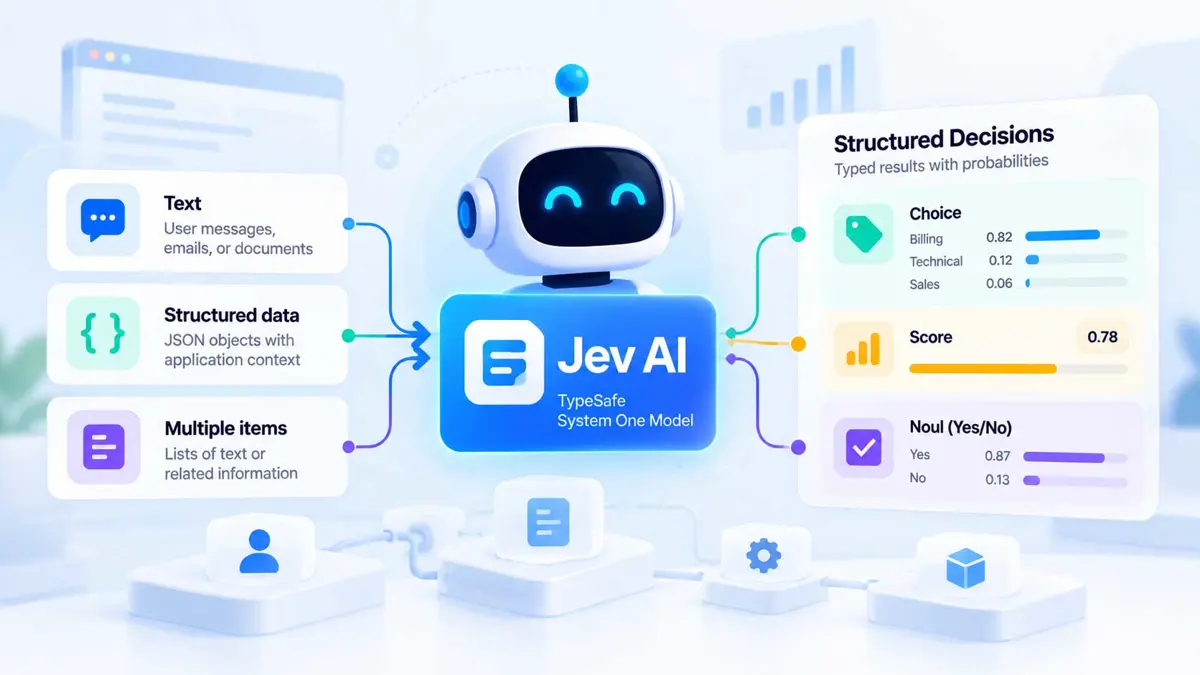
Jev turns application state and typed questions into structured decisions that software can use.

What Is Jev AI? Jev is TypeSafe’s first public System One model, designed for software that needs structured decisions rather than open-ended generated text. TypeSafe introduced Jev as its first public System One model in September 2026 and describes the model class as being built for fast, structured decisions that software can use directly.
The central idea is simple: instead of asking an AI system to write an answer and then making software interpret that answer, the application defines the kind of decision it needs. Jev evaluates the supplied state against those typed questions and returns values that the application already knows how to handle.
What Is Jev AI?
Jev AI is a decision model from TypeSafe built for software. TypeSafe describes Jev as its first public System One Model, a model class intended to produce structured decisions for machine use rather than primarily generating language for people.
A useful mental model is:
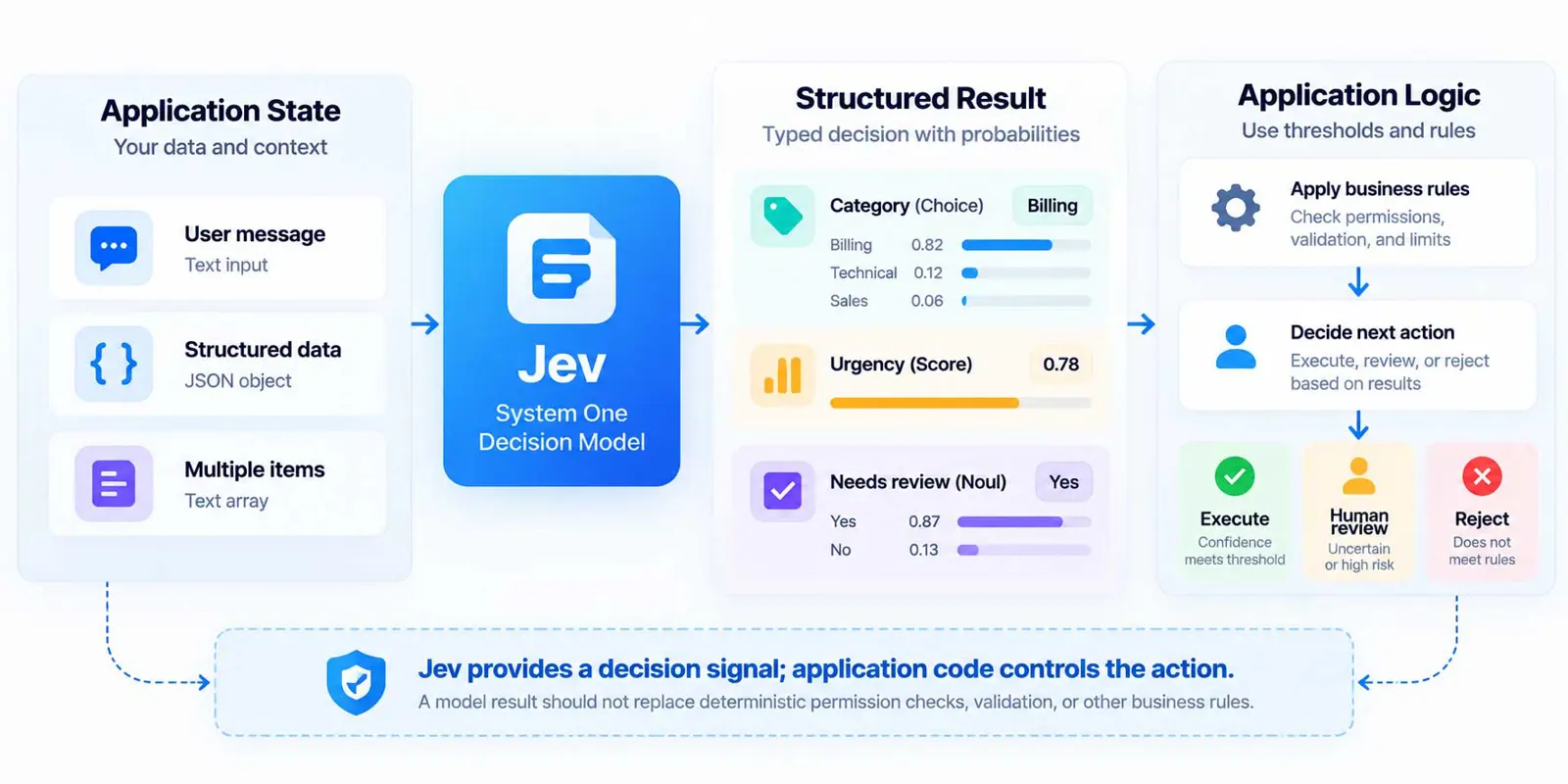
Application state
       ↓
     Jev
       ↓
Typed decisions + probabilities
       ↓
Application logic
The state might be a support ticket, a customer message, form data, a JSON object, or another piece of application context. The questions define what the software wants to know about that state.
For example, a support system could provide a customer message and ask Jev three separate questions: which team should receive it, how urgent it is, and whether a human should review the case.
That makes Jev different from a chatbot. A chatbot is usually expected to produce language that a person can read. Jev is designed to return information that software can branch on, store, sort, route, or combine with other rules.
What Does “System One” Mean?
System One is TypeSafe’s terminology for this model class. The company says the name is inspired by the distinction popularized by Daniel Kahneman between fast, intuitive System 1 thinking and slower, more deliberate System 2 reasoning. TypeSafe uses the term for a different purpose: models built around fast, structured decisions for software.
It is important not to treat System One as a general industry standard or an established technical category like “large language model.” It is TypeSafe’s product terminology for the architecture and training approach behind Jev.
TypeSafe says its System One approach uses a different model architecture, parallel sampling, and a training method called Reinforcement Learning for Calibrated Decisions, or RLCD. Those are implementation details from TypeSafe rather than requirements for decision models generally. TypeSafe’s System One overview
How Jev Works
Jev’s interface can be understood as three parts: state, typed questions, and structured answers.
1. Send the State
The application supplies the information Jev needs to make the decision. That can be unstructured text or structured application data.
For a support workflow, the state might contain the customer’s message, account context, previous support activity, and other fields that are relevant to the decision.
2. Define the Questions
The application then defines the exact judgments it needs. Current Jev interfaces support typed questions such as choices, scores, and yes/no-style evaluations. The official API documentation exposes Choice, Score, and Noul question and answer types.
3. Receive Structured Results
Jev returns typed results instead of a paragraph that the application must interpret. The results can include probability information, allowing the surrounding software to use thresholds or other rules when deciding what should happen next.
The important boundary is that Jev provides a decision signal; application code controls the action. A model result should not replace deterministic permission checks, validation, or other business rules.
What Kind of Decisions Can Jev Make?
Jev is designed for decisions where the application already knows the possible shape of the answer.
| Decision type | Example | What software can do with it |
|---|---|---|
| Choice | Which support team should handle this ticket? | Route the ticket |
| Score | How urgent is this request? | Apply an escalation threshold |
| Yes/no evaluation | Does this request need human review? | Continue or send to review |
This bounded output space is one of the defining ideas behind decision models. The application is not asking the model to invent an answer format. It is specifying the kind of result it needs before the model evaluates the state.
Jev vs. a Large Language Model
Jev and a large language model can both evaluate the same piece of text, but their interfaces are designed for different jobs.
| Jev | Generative LLM | |
|---|---|---|
| Primary output | Typed decision | Generated language |
| Answer space | Defined by the application | Broad |
| Typical tasks | Routing, scoring, classification, checks | Writing, explanation, coding, open-ended reasoning |
| Software integration | Decision can be consumed directly | Generated output usually needs parsing or validation |
| Main trade-off | Narrower interface | Greater flexibility |
That does not mean Jev replaces LLMs. A useful application can use both. An LLM can interpret a user’s request or generate a response, while Jev handles a bounded decision that the software needs to make consistently.
Saganote has already covered the deeper difference between these approaches in Decision Models vs. LLMs: Why Jev Can Be Faster. That article focuses on why a decision-oriented interface can avoid work associated with open-ended text generation and where the trade-offs appear.
Where Jev Fits in an AI Agent
AI agents combine models, tools, application logic, and external systems to complete tasks. A decision model can sit at a specific decision point inside that workflow rather than replacing the agent’s main generative model.
For example:
User request
     ↓
AI agent / LLM
     ↓
Jev evaluates a bounded decision
     ↓
Application rules
     ↓
Tool, model, or human review
An agent might use Jev to classify a request, choose a queue, score risk, decide whether a proposed action needs review, or select between predefined paths. The agent can still use a generative model when it needs to reason broadly, write an explanation, or communicate with the user.
For readers new to agents, Saganote’s guide to what an AI agent is explains the broader agent architecture. Our introduction to agentic AI covers the larger shift from AI that responds to AI systems that can carry out multi-step tasks.
Why Typed Decisions Matter
Software needs predictable interfaces. If a workflow expects one of three queues, a numeric score, or a yes/no judgment, returning exactly that kind of value reduces the amount of interpretation required after inference.
This is different from simply asking an LLM to return JSON. A generative model can be instructed to produce a particular schema, but it is still generating a response. A decision model starts with a defined answer space and is designed around returning that structured result.
The difference becomes more useful as a workflow grows. A program can combine several typed decisions, apply thresholds, route uncertain cases to review, and keep deterministic business rules in ordinary code.
What Jev Does Not Do
Jev is not a general-purpose chatbot, a replacement for every LLM, or a substitute for application logic.
- It is not designed primarily to write long-form responses.
- It does not remove the need for application-level permissions and validation.
- A valid structured answer can still be an incorrect decision.
- Its usefulness depends on whether the application can define a meaningful decision space.
- Open-ended generation remains a better fit for tasks where the output itself needs to be language.
This distinction is important for evaluating Jev fairly. Constraining the output makes software integration different, but it does not guarantee that every decision will be correct.
What Is Jev AI Useful For?
The strongest fit is a workflow where the application already knows what it needs to decide.
- Routing: choose a support queue, workflow, or model.
- Classification: place an input into a defined category.
- Scoring: estimate urgency, risk, relevance, or another ordered property.
- Verification: evaluate whether a condition is satisfied.
- Human review: identify cases that should be escalated instead of handled automatically.
- Agent control: evaluate a bounded condition around a tool call or next step.
These use cases share the same pattern: the software has a known set of possible next actions, even if the information used to choose among them is messy or unstructured.
Jev and the Emerging AI Decision Layer
The broader idea behind Jev is bigger than one model. AI applications increasingly need to make small machine-readable judgments around larger generative workflows. Those decisions can determine which model runs next, which tool is allowed to proceed, which queue receives a request, or when a human should take over.
That creates a useful separation of responsibilities. A generative model can handle language and open-ended reasoning. A decision model can handle bounded judgments. Application code can enforce permissions and deterministic rules.
This pattern fits naturally with the rise of AI agents. Saganote’s guide to creating an AI agent covers the broader process of assembling models, tools, state, and application logic into an agent workflow.
Jev is still an early technology. TypeSafe introduced it in September 2026 and is currently making it available through its developer ecosystem. Integration options are also expanding, including an HTTP API and integrations through AI SDK and Vercel AI Gateway.
Frequently Asked Questions
Is Jev an LLM?
What does Jev return?
Is System One a standard AI term?
Can Jev replace an LLM?
Can Jev make wrong decisions?
Conclusion
Jev AI is best understood as a software-oriented decision model, not another chatbot. Its interface starts with application state and typed questions, then returns structured decisions that code can use directly.
That makes Jev useful for routing, classification, scoring, verification, and other bounded decisions inside AI applications. The larger idea is a division of labor: generative models handle open-ended language and reasoning, decision models handle defined judgments, and application code controls what happens next.